AI Workflow Integration: Engineering Guide to Automation

What if the digital tools currently fragmenting your team's focus could be engineered into a single, cohesive nervous system that anticipates your operational needs? Most executives realize that while they've adopted various software solutions, these platforms often remain isolated, forcing staff to bridge the gaps with manual labor and repetitive data entry. You likely feel the mounting friction of high administrative costs and the persistent worry that your data privacy isn't as robust as it should be. It's a common struggle to maintain harmony when your technological components don't communicate effectively.
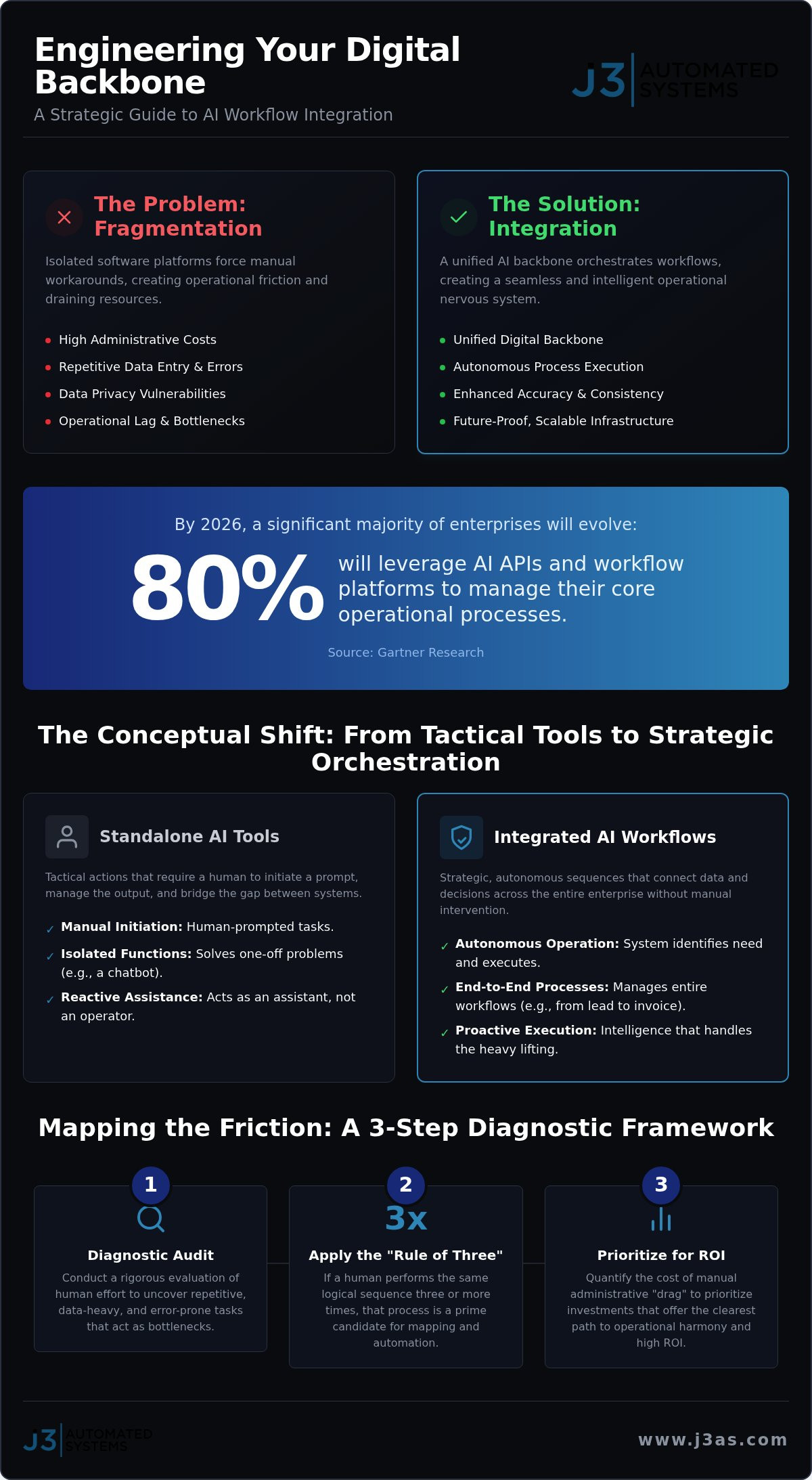
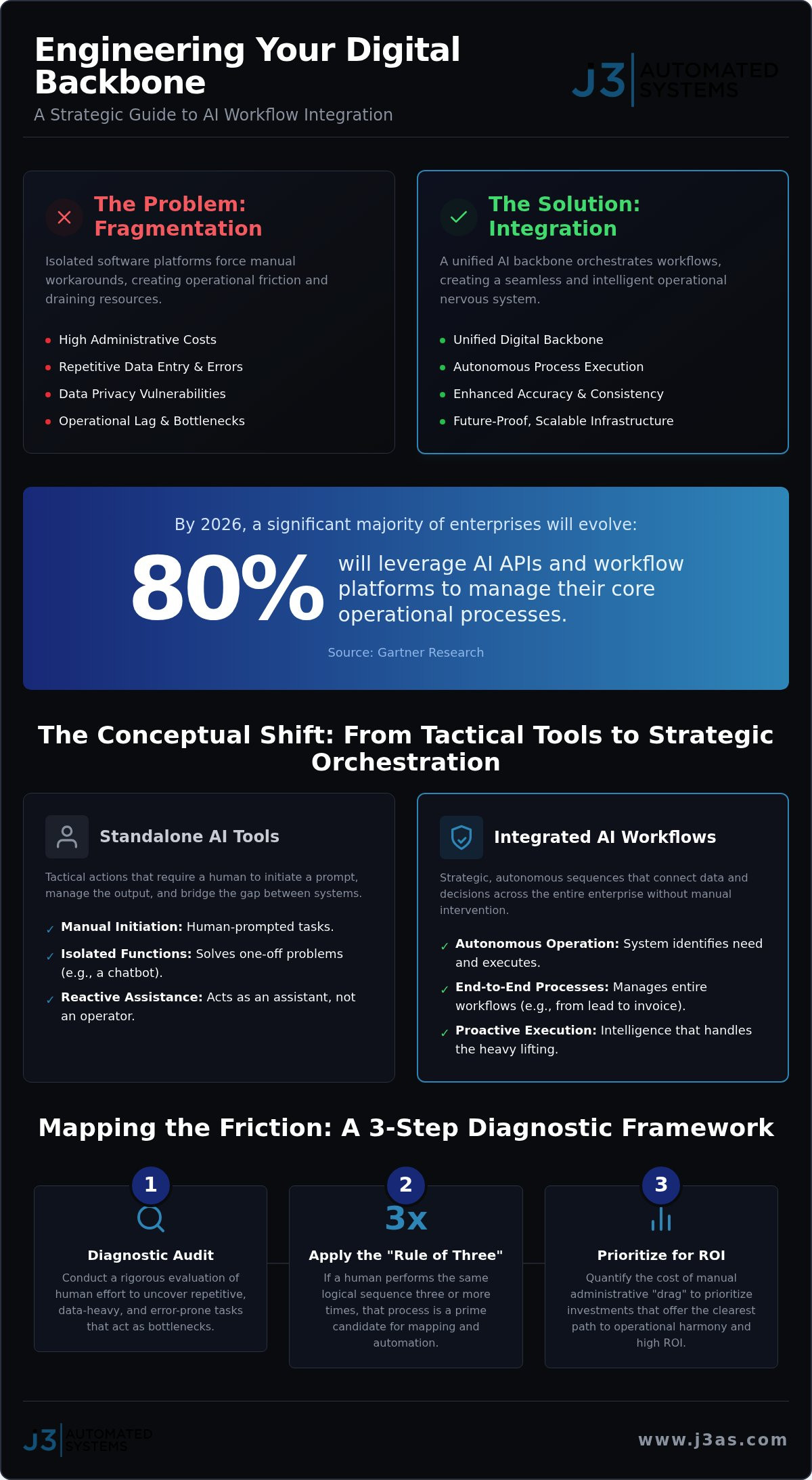
Achieving a truly scalable operation requires more than just adding another subscription; it demands a sophisticated AI workflow integration for business. Recent research from Gartner suggests that by 2026, 80% of enterprises will leverage AI APIs and workflow platforms to manage their core processes. This guide provides an engineering perspective on moving beyond basic chatbots toward a seamless digital backbone. You'll discover how to architect an integrated infrastructure that removes operational burdens, ensures security, and creates a future-proof foundation where intelligence handles the heavy lifting. We will examine how to transition from fragmented manual efforts to a state of intelligent, effortless operation.
Key Takeaways
- Shift from isolated tools to a unified digital backbone where orchestrated intelligence manages complex operational sequences rather than standalone tasks.
- Conduct a precise diagnostic audit to uncover high-friction bottlenecks where automated logic can immediately reduce repetitive administrative burdens.
- Evaluate the long-term ROI of bespoke AI workflow integration for business against the inherent limitations and fragmentation of standard SaaS subscriptions.
- Establish a secure implementation roadmap that bridges the gap between sophisticated data pipelines and critical human-in-the-loop requirements.
- Gain a holistic perspective on automation that integrates your physical environment with digital processes for a truly resilient and future-proof business infrastructure.
Beyond the Chatbot: Defining Strategic AI Workflow Integration for Business
Many organizations view artificial intelligence through the narrow lens of a productivity tool, perhaps a window for generating text or summarizing emails. This perspective overlooks the transformative potential of a coordinated architecture. True AI workflow integration for business involves moving beyond isolated interactions to create a unified digital backbone. It's the difference between having a collection of high-performance parts and a finely tuned engine. When these systems operate in isolation, they often contribute to a "friction of fragmentation" where staff must manually transfer data between platforms, leading to errors and operational lag. AI workflow integration is the engineering of automated sequences that connect disparate data points and human decisions.
The Difference Between AI Tools and Integrated Orchestration
Using a chatbot is a tactical act; it requires a human to initiate a prompt and manage the output. In contrast, strategic integration relies on Business process automation to ensure that data flows autonomously across your enterprise. Custom middleware and robust APIs serve as the connective tissue, allowing AI to interact directly with your CRM, project management tools, and proprietary databases. This evolution shifts the focus from asking questions to executing complex processes. Instead of a staff member prompting an AI to draft a report, the system identifies the need, gathers the data, and delivers the finished product to the necessary stakeholders without manual intervention. It's a fundamental move from manual assistance to autonomous operation.
Why Texas Enterprises are Moving Toward Intelligent Systems
Leaders in San Antonio and Austin are increasingly recognizing that manual administrative labor is a bottleneck to growth. As the Texas market expands, the ability to maintain high-touch service while scaling operations depends on intelligent systems. Implementing ai business process automation allows these enterprises to redirect human talent toward high-value oversight and creative problem solving. For businesses managing multiple locations or complex logistics, a scalable digital infrastructure is no longer optional. It is the foundation for a resilient operation that maintains precision even as volume increases. This shift ensures that your business logic remains consistent, regardless of the scale of the task at hand. By removing the burden of repetitive tasks, firms can focus on the visionary work that defines their market leadership.
Mapping the Friction: Identifying High-ROI Automation Opportunities
Implementing a strategic AI workflow integration for business begins with a rigorous audit of your existing operational machinery. This diagnostic phase isn't merely about listing software tools; it's an architectural evaluation of human effort. High-friction tasks are typically those that are repetitive, data-heavy, and inherently prone to human error. By quantifying the cost of manual administrative drag, leaders can prioritize investments that offer the clearest path to operational harmony and measurable ROI.
Successful execution relies heavily on the synergy between business process mapping and automation. Without a clear map, AI becomes a superficial patch rather than a structural solution. Mapping allows you to see the hidden bottlenecks, such as a sales lead that stalls because data must be manually moved from an email to a CRM. Identifying these gaps is the first step toward a seamless digital backbone. If your team spends hours each week on manual data reconciliation, you're not just losing time; you're accumulating a "friction tax" that slows your entire enterprise.
Diagnostic Framework: Where Manual Processes Drain Capital
We often utilize the "Rule of Three" to identify prime candidates for automation. If a human performs the same logical sequence three times, that process is a candidate for mapping. Analyzing data entry, complex scheduling, and multi-source reporting often reveals significant capital leakage. Visualizing the flow of information from the initial client inquiry through to the final commissioning of a project helps pinpoint exactly where momentum is lost. For those ready to eliminate these inefficiencies, exploring custom automation audits can provide the necessary clarity to move forward.
The Role of Data Readiness in Integration Success
The transition to an intelligent system requires more than just intent; it requires data readiness. AI is only as capable as the data architecture it sits upon. Fragmented information residing in isolated ERPs or legacy databases creates "data silos" that stifle AI's ability to reason and act. Centralizing this information is a prerequisite for any sophisticated AI workflow integration for business. As noted in research regarding redesigning work for AI, productivity gains are only realized when the underlying processes and data structures are purposefully reconstructed. Clean, accessible data ensures that your automated sequences are grounded in reality, providing the precision required for high-stakes decision making.
Custom AI vs. Off-the-Shelf SaaS: Engineering for Longevity
Many organizations inadvertently fall into the "SaaS Trap," where a patchwork of monthly subscriptions creates more friction than it solves. While these tools promise immediate relief, they often demand that your business logic bends to fit the software's rigid parameters. Engineering a custom AI workflow integration for business flips this paradigm. It ensures the technology serves your established processes. Transitioning from a tenant of generic software to an owner of bespoke digital infrastructure ensures that your technology remains a permanent asset. This approach allows custom AI tools for SMB to deliver enterprise-level power without the typical overhead of massive, bloated software suites.
The Limitations of Fragmented Software Solutions
Fragmented solutions introduce "integration fatigue" that drains team productivity. When tools don't communicate natively, staff must manually bridge the gap, leading to the administrative drag and data silos discussed in earlier diagnostic phases. Generic AI often lacks the nuance required for industry-specific tasks; it cannot grasp the unique commissioning requirements of a complex commercial automation project or the aesthetic subtleties of high-end architectural lighting. Additionally, passing sensitive data through multiple third-party vendors introduces unnecessary security risks. A unified system minimizes these vulnerabilities by keeping your proprietary data within a controlled, secure environment that you own and oversee.
Bespoke Engineering: Architecture That Grows With You
Bespoke engineering creates a foundation that evolves alongside your enterprise. These systems aren't static; they can be tuned and commissioned as your business needs shift, ensuring long-term functionality over quick, temporary fixes. Partnering with a single accountable team for both physical building management and digital process automation ensures a holistic perspective that generic vendors cannot replicate. This unified oversight allows for a "master of complexity" approach where the hidden connections between your networking hardware and your AI workflow integration for business are fully optimized. Custom web apps often act as the intuitive user interface for these complex backend processes, simplifying the interaction for your team while maintaining high-tier functionality. This architectural approach transforms technology into a sophisticated engine that scales with your ambition, providing a state of intelligent, effortless operation.
The Implementation Roadmap: Integrating AI Without Operational Friction
Engineering a sophisticated AI workflow integration for business requires a methodical roadmap that mirrors a high-end construction project. It begins with architectural discovery and ends with meticulous commissioning, ensuring that the transition from manual fragmentation to intelligent harmony is both secure and sustainable. By following a structured, logical progression, organizations can avoid the frantic energy of poorly planned technology rollouts and instead move toward a state of calm reliability.
This sequence follows five critical phases of development:
- Step 1: Discovery and Mapping. We identify 'Human-in-the-Loop' requirements to determine exactly where human judgment is non-negotiable and where automated logic can take the lead.
- Step 2: Engineering the Data Pipeline. Our team constructs secure API connections and data architectures that facilitate seamless communication between your existing software stack and new intelligent nodes.
- Step 3: Model Integration. We develop custom AI models or integrate Large Language Models (LLMs) into specific operational points, ensuring the technology is tuned to your specific business logic.
- Step 4: Pilot Testing and Commissioning. The system is deployed in a live environment under close supervision to verify performance and remove any remaining operational friction.
- Step 5: Ongoing Tuning. We provide iterative adjustments to ensure the AI evolves alongside your operational reality and market demands.
Human-in-the-Loop: Maintaining Oversight in Automated Systems
True automation should augment human expertise rather than replace it entirely. We design 'Approval Nodes' that act as quality control checkpoints, ensuring that automated outputs meet your exacting standards before they reach a client. This architectural approach allows you to automate repetitive administrative tasks while keeping your most valuable staff focused on high-value strategy and relationship management. It's about removing the burden of the mundane to empower the visionary.
Security and Compliance in the Age of Intelligent Automation
As AI becomes an invisible infrastructure, security must be built into the foundation. With the California AI Transparency Act and the EU AI Act now active as of August 2026, compliance is a matter of enterprise survival. A secure AI workflow integration for business relies on resilient networking to protect proprietary data and ensure privacy within custom environments. We prioritize data governance to ensure your systems are trained on accurate, relevant data while avoiding the algorithmic discrimination risks highlighted by the Colorado AI Act. If you are ready to architect a secure, automated future, you can start your engineering consultation today.
Engineering Your Digital Backbone: The J3 Approach to AI Integration
J3 Automated Systems operates on the philosophy that your enterprise is a single, living organism. While many providers focus strictly on software or hardware in isolation, our approach unifies physical environments with digital processes to create a seamless digital backbone. We don't just sell technology; we engineer harmony. By connecting your commercial building automation with a sophisticated AI workflow integration for business, we ensure that every component of your operation, from the HVAC sensors to your internal data pipelines, speaks the same language. This holistic perspective eliminates the friction of fragmentation and replaces it with a state of intelligent, effortless operation.
In a marketplace saturated with automated support tickets and generic help desks, we maintain a "white-glove" service model. We believe that high-tier technology deserves high-tier stewardship. This means you work with a single accountable team that understands the hidden connections between your networking infrastructure and your automated workflows. We act as a visionary integrator, simplifying the most complex technical challenges so you can focus on leading your industry. Moving from a collection of disparate tools to a unified, intelligent enterprise isn't just an upgrade; it's a structural transformation that secures your market position for the long term.
From Discovery to Commissioning: Our Bespoke Process
Our methodology prioritizes engineering logic before writing a single line of code. We take the time to define the "why" and the "how" of your specific business needs, ensuring that the final solution feels inevitable and reassuring rather than forced. This commitment to precision is why we provide a single accountable team for the entire project lifecycle, from initial mapping to final commissioning. We specialize in bridging the gap between custom web app development San Antonio and the deep backend power of integrated AI. These custom interfaces serve as the intuitive control center for your automated sequences, providing high-level oversight without the complexity of traditional software management.
Scaling Intelligence: Future-Proofing Your Business in Central Texas
Enterprises in San Antonio and Austin are uniquely positioned to lead the next wave of AI-driven growth. The Central Texas corridor demands a scalable, resilient infrastructure that can keep pace with rapid expansion. Our long-term partnership model ensures that your systems aren't just installed, but continuously tuned as technology advances. We act as dedicated stewards of your experience, ensuring that your AI workflow integration for business remains a competitive advantage as the regulatory and technological landscape evolves. If you're ready to move beyond manual effort and embrace a future of intelligent orchestration, Schedule a consultation with J3 Automated Systems to engineer your AI roadmap.
Architecting a Future of Operational Harmony
Transitioning from a collection of isolated software tools to a unified digital backbone is a strategic evolution that transforms the core functionality of an enterprise. By moving beyond the limitations of generic SaaS and prioritizing bespoke engineering, you ensure that your technology adapts to your unique business logic rather than the reverse. This structural shift removes the mounting friction of administrative drag and establishes a foundation of calm reliability where intelligence handles the heavy lifting. It's the difference between managing a series of disconnected tasks and overseeing a coordinated, high-performance engine.
Achieving a sophisticated AI workflow integration for business requires more than just code; it demands the expertise of a visionary integrator who understands the interplay between physical environments and digital processes. As Texas-based engineering and installation specialists, J3 Automated Systems provides a single accountable team to guide you through every phase of mapping, engineering, and commissioning. We deliver bespoke solutions designed for operational harmony, ensuring your infrastructure is both resilient and future-proof. Your path to a seamless, intelligent enterprise starts with a commitment to precision and long-term functionality.
Engineer Your Intelligent Workflow with J3 Automated Systems
Frequently Asked Questions
What is AI workflow integration for business?
AI workflow integration for business is the architectural process of connecting disparate software systems and data points into a unified, automated sequence. It replaces manual data transfers with intelligent orchestration, creating a digital backbone that anticipates operational needs and executes tasks without human intervention. This engineering approach ensures that your technological components operate as a single, cohesive nervous system rather than isolated tools.
How does custom AI integration differ from using ChatGPT?
Custom integration focuses on autonomous process execution rather than simple text generation. While tools like ChatGPT are tactical interfaces for human-led prompts, an integrated system uses secure APIs to connect intelligence directly to your internal tools. This allows the AI to act on your proprietary data and business logic automatically, moving from a state of manual assistance to one of effortless, intelligent operation.
Can AI be integrated into my existing legacy software?
Yes, we can integrate AI into most legacy systems through the development of custom middleware and API connections. This approach allows your existing ERP or database to communicate with modern intelligent models, extending the lifespan of your current infrastructure while adding sophisticated automation capabilities. It bridges the gap between your established physical environments and new digital processes without requiring a total software overhaul.
How long does it take to implement an AI business process automation?
Implementation follows a methodical roadmap that typically spans several months from initial discovery to final commissioning. This steady pace allows for rigorous mapping of human-in-the-loop requirements and ensures that the data pipeline is secure and compliant before the system goes live in your environment. Taking the time to properly architect the solution ensures long-term functionality and a higher return on investment.
Is AI workflow integration secure for sensitive business data?
Security is built into the foundation of every custom integration we engineer. By utilizing enterprise-grade networking and private environments, we protect your sensitive data from third-party exposure and ensure your systems meet current regulatory standards, such as the California AI Transparency Act. This focus on data governance ensures that your automated sequences remain private, secure, and compliant with evolving legal requirements.
What is the typical ROI for automating repetitive administrative tasks?
ROI is measured by the significant reduction in operational friction and labor costs associated with manual data entry and reconciliation. Organizations often see a clear return as staff are redirected from repetitive administrative tasks toward high-value strategic roles, effectively removing the "friction tax" that slows enterprise growth. McKinsey research suggests that up to 50% of current work activities can be automated, providing a clear path to enhanced profitability.
Does my business need to be a certain size to benefit from AI integration?
Any organization experiencing administrative drag can benefit from AI workflow integration for business. While the complexity of the digital backbone scales with the enterprise, even growing firms in San Antonio and Austin find that bespoke automation provides the precision needed to compete with larger rivals. The removal of operational burden is a universal advantage that allows businesses of all sizes to scale without a proportional increase in overhead.
How do I start mapping my business processes for AI?
Start by auditing your current workflows for tasks that are repetitive, data-heavy, and prone to human error. Utilizing the "Rule of Three" helps identify sequences that should be mapped; if a human performs a specific logical sequence three times, it's a prime candidate for structural automation. This diagnostic phase allows you to visualize the flow of information and pinpoint exactly where momentum is lost to manual intervention.