Automate Repetitive Administrative Tasks: A Bespoke Engineering Approach for Texas Enterprises

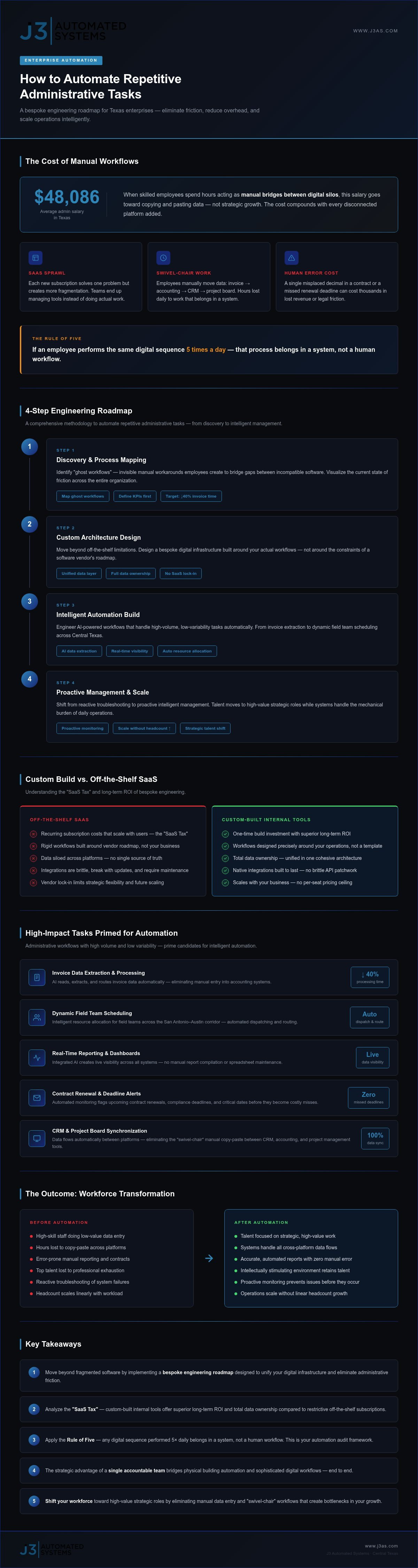
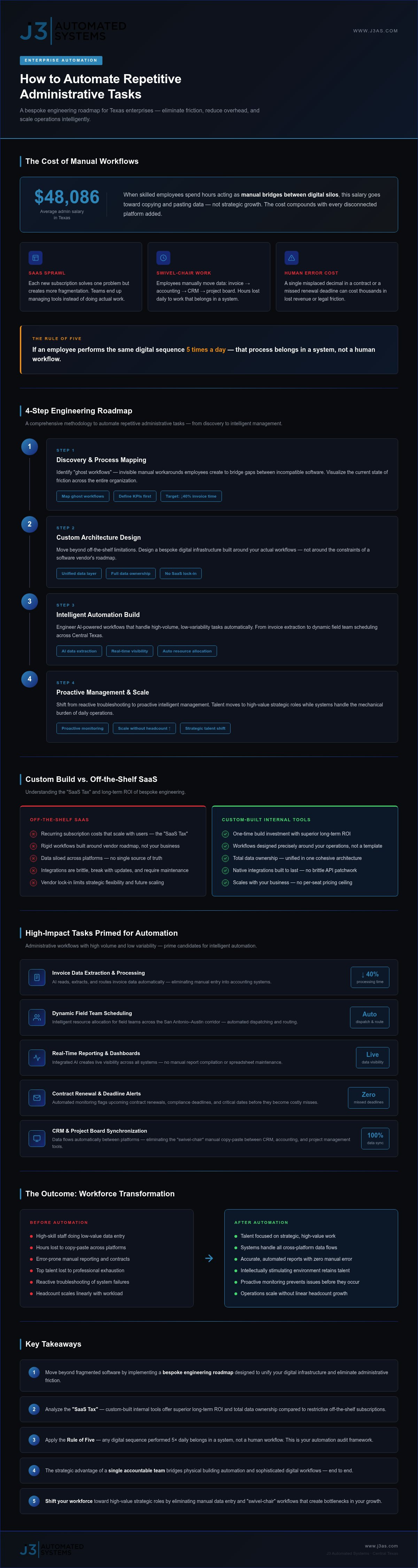
With the average administrative salary in Texas now reaching up to $48,086, the cost of manual labor for routine data entry has become a significant barrier to enterprise scaling. It's a reality most leaders recognize. When data remains fragmented across disconnected platforms, human error in critical reporting becomes inevitable and operational overhead climbs. You likely feel the weight of these mounting costs and the friction of systems that simply don't talk to each other. You deserve a digital environment that operates with the precision of a well-engineered machine.
This guide demonstrates how to automate repetitive administrative tasks through custom-engineered roadmaps that replace off-the-shelf limitations with intelligent, fluid workflows. Discover how a bespoke engineering approach eliminates administrative friction and scales your operations beyond the rigid boundaries of standard software subscriptions. We will analyze the shift toward hyper-automation, the role of custom internal tools, and the specific ways integrated AI creates real-time visibility while shifting your talent toward high-value, strategic work.
Key Takeaways
- Move beyond fragmented software by implementing a bespoke engineering roadmap designed to automate repetitive administrative tasks and unify your digital infrastructure.
- Analyze the "SaaS Tax" and understand why custom-built internal tools offer superior long-term ROI and total data ownership compared to restrictive off-the-shelf subscriptions.
- Identify high-impact opportunities for intelligent automation, ranging from automated invoice extraction to dynamic resource allocation for field teams across Central Texas.
- Discover the strategic advantage of a single accountable team that bridges the gap between physical building automation and sophisticated digital workflows.
- Shift your workforce toward high-value strategic roles by eliminating the manual data entry and "swivel-chair" workflows that create bottlenecks in your growth.
The Administrative Friction Point: Why Manual Workflows Stifle Growth
Growth for a Texas enterprise often brings a hidden tax. This tax manifests as "swivel-chair" automation, a state where your most valuable employees act as manual bridges between digital silos. Moving data from an invoice into an accounting tool, then into a CRM, and finally into a project management board consumes hours that should be spent on strategic development. This manual orchestration is a significant bottleneck for businesses along the San Antonio to Austin corridor trying to scale without a linear increase in headcount. When your systems don't talk to each other, your staff becomes the integration layer, a role that is both expensive and prone to failure.
SaaS sprawl often exacerbates this issue. Adding a new subscription for every departmental problem frequently creates more work than it eliminates. When platforms remain disconnected, your team spends more time managing the tools than doing the actual work. This fragmentation leads to a specialized form of professional exhaustion. High-tier talent rarely stays in roles that demand hours of tedious data entry; they seek environments where their intellect is applied to complex problems, not repetitive copying and pasting. Retaining top performers requires removing the mechanical burdens that stifle their creativity.
The ROI of Eliminating Administrative Burden
Human error in reporting isn't just a minor annoyance. It is a direct financial drain. A single misplaced decimal in a contract or a missed deadline in a renewal can cost thousands in lost revenue or legal friction. By choosing a path of reducing commercial operating costs via automation, businesses reclaim the mental bandwidth of their leadership. Automation unlocks the capacity for high-value initiatives that drive revenue, rather than just maintaining the status quo. To automate repetitive administrative tasks is to invest in the long-term resilience and profitability of your operational framework.
Identifying Automation-Ready Processes
Success begins by identifying tasks characterized by high volume and low variability. We often apply the "Rule of Five": if an employee performs a specific digital sequence five times a day, that process belongs in a system, not a human workflow. Implementing Business process automation (BPA) allows for a seamless transition of these duties to intelligent software layers. Administrative friction is the gap between potential and realized efficiency. Closing this gap requires a move away from fragmented apps toward a unified, engineered architecture that treats your business as a single, cohesive organism.
Engineering the Solution: A 4-Step Roadmap to Automate Repetitive Administrative Tasks
Standard automation often fails because it attempts to solve a symptom rather than the systemic cause of friction. To truly automate repetitive administrative tasks, one must move beyond simple triggers and adopt a comprehensive engineering methodology for enterprise task automation. This roadmap ensures that every digital interaction serves a purpose, creating a unified architecture that supports your long-term vision. It moves the business from a state of reactive troubleshooting to proactive, intelligent management.
Step 1: Discovery and Process Mapping
Successful integration starts with a whiteboard, not a login screen. We begin by identifying "ghost" workflows; those invisible, manual workarounds employees create to bridge gaps between incompatible software. By utilizing business process mapping and automation, we visualize the current state of friction across your entire organization. This phase establishes clear KPIs tailored to your specific market.
For your San Antonio office, success might mean reducing invoice processing time by 40% or eliminating manual data entry errors entirely. We define what success looks like before a single line of code is written, ensuring the final product meets the actual needs of your team rather than forcing them to adapt to a rigid software template. This clarity is the foundation of a resilient system.
Step 2 & 3: Engineering and Bespoke Development
Once the map is clear, we design the architecture that connects fragmented tools into a single ecosystem. This involves a critical choice between integrating existing APIs or building custom software layers from the ground up. While off-the-shelf tools handle structured data well, custom-trained AI excels at processing the unstructured administrative data that plagues most offices, such as emails, PDFs, and complex invoices.
We engineer systems that extract intelligence from these chaotic sources and inject it directly into your core business tools. This bespoke development ensures your infrastructure scales effortlessly as you expand into New Braunfels or Austin. If you are ready to see how a tailored automation strategy can transform your operations, the first step is identifying which systems are currently holding you back. We build with the future in mind, creating tools that grow as your headcount stays lean.
The final phase is the transition from development to a live, operational environment through commissioning and ongoing support. Commissioning is a meticulous process of testing and refinement where we verify that every integration point is resilient. We ensure the new system performs under real-world pressure without disrupting your existing services or client experiences. Unlike vendors who vanish after a software sale, a single accountable team provides the stewardship required to maintain peak efficiency. This holistic approach transforms administrative work from a burden into a silent, high-performance engine that supports your growth without adding to your overhead.
Custom Web Apps vs. Off-the-Shelf SaaS: Choosing the Right Architecture
The decision to automate repetitive administrative tasks often begins with a choice between a monthly subscription and a permanent asset. Off-the-shelf Software-as-a-Service (SaaS) platforms offer immediate entry, but they frequently carry a hidden "SaaS Tax." While a Professional plan on a platform like Zapier might start at $19.99 per month for 750 tasks, high-volume enterprises quickly find themselves pushed into Team or Enterprise tiers as their transaction volume grows. These recurring costs represent a perpetual drain on capital. In contrast, bespoke engineering involves a one-time investment in a tool that you own entirely, eliminating per-task fees and providing a predictable financial horizon.
Data ownership remains a critical pillar of this architectural choice. Generic platforms require you to pipe sensitive business intelligence through third-party servers, creating potential vulnerabilities and complex governance issues. Custom internal tools offer superior security by keeping your data within your own controlled environment. This control allows for a unified dashboard that aggregates information from multiple Texas locations, whether your operations span San Antonio, Austin, or Boerne. A single, engineered interface provides a level of visibility that fragmented SaaS tools simply cannot match.
Bespoke applications adapt to your specific workflow rather than forcing your team to adapt to the software. Standard apps are built for the "average" user, which often means they lack the nuance required for specialized industries. When you build a custom solution, you are automating time-consuming work duties according to your unique logic. This flexibility ensures that the system supports your growth instead of becoming a rigid constraint that requires manual workarounds.
When to Stick with SaaS
Off-the-shelf tools suffice for low-complexity, non-critical tasks where the "Good Enough" threshold is easily met. Early-stage startups or small offices with minimal data volume may find that generic triggers are a cost-effective way to automate repetitive administrative tasks before they reach a scale that justifies custom development. Over-engineering a simple notification system or a basic contact form often yields diminishing returns. Use SaaS for the peripheral duties that don't define your core operational excellence.
When Bespoke Engineering is Non-Negotiable
Custom engineering becomes essential when your administrative reporting must integrate with physical building data, such as HVAC or automated lighting systems. For high-end commercial or residential sectors, handling sensitive client data requires a level of precision and privacy that mass-market tools cannot guarantee. By creating a proprietary operational "moat," you transform your internal processes into a competitive advantage. This architectural integrity ensures that your digital infrastructure is as resilient and sophisticated as the physical environments you manage.
High-Impact Administrative Tasks Primed for Intelligent Automation
To truly automate repetitive administrative tasks, an organization must look beyond simple email filters. High-impact automation targets the core functions that keep a business moving; document intake, resource scheduling, and compliance reporting. By applying an engineering mindset to these areas, Texas enterprises can transition from reactive management to a state of predictive operation. This isn't just about speed. It's about precision and the removal of the human error that inevitably occurs when volume exceeds manual capacity.
Dynamic scheduling takes this intelligence into the field. For businesses managing teams across the San Marcos and Boerne corridor, manual dispatching is a constant source of friction. An automated system analyzes traffic patterns, technician skill sets, and job priority to optimize routes in real time. Similarly, automated client onboarding creates a high-touch, premium experience without manual intervention. From the moment a contract is signed, the system triggers welcome sequences, sets up portal access, and schedules initial consultations, ensuring no detail is overlooked.
AI-Driven Document Management
Intelligent Document Processing (IDP) represents a quantum leap over traditional optical character recognition. Instead of just seeing text, custom AI business process automation understands context. It reads an invoice, identifies the vendor, extracts the line items, and cross-references them with a purchase order before ever involving a human in the approval chain. This technology turns unstructured text into actionable database entries by mapping linguistic patterns to specific data fields. This process effectively eliminates the approval bottleneck that often stalls projects in the San Antonio and Austin corridor.
Automated Reporting and Compliance
Automated reporting and compliance remove the burden of the end-of-month "data scramble." Instead of financial teams manually compiling spreadsheets, a unified system performs continuous, system-to-system verification. This ensures total data integrity. For Texas building enterprises, this means generating regional compliance reports for state building standards automatically, a critical task as the state government continues to deploy AI-integrated regulatory platforms like the TREO system.
Eliminating these manual checks allows your leadership to shift from historical analysis to real-time strategy. If you are ready to engineer high-performance internal tools that replace manual labor with intelligent workflows, the path forward begins with identifying your highest-friction processes. Real-time operational dashboards then provide live visualization of this data, allowing you to make decisions based on what is happening now, not what happened thirty days ago.
The J3 Roadmap: Bespoke AI and Software Integration for Texas Enterprises
The transition from manual effort to intelligent operation requires more than just software; it demands a single point of accountability. J3 Automated Systems provides this stewardship through a unique "Single Accountable Team" model. We manage the entire lifecycle of your project, from the initial discovery and mapping to the final commissioning of your custom environment. This holistic approach ensures that the sophisticated systems we design remain resilient and functional long after the initial installation. By choosing a partner that understands both the digital and physical layers of your business, you eliminate the friction of managing multiple, disconnected vendors.
Our expertise is deeply rooted in the San Antonio to Austin corridor, serving the specific needs of the Texas Triangle and the Hill Country. We understand the local regulatory landscape and the unique scaling challenges faced by enterprises in this fast-growing region. The path to automate repetitive administrative tasks is not a generic journey. It is a precise engineering exercise that aligns your internal tools with your long-term commercial goals. We don't just provide equipment; we act as visionary integrators who see the hidden connections between your staff's workflows and your business's potential.
Integrated Building and Business Intelligence
Administrative work doesn't exist in a vacuum. It is the digital reflection of your physical operations. By connecting your Building Management Systems (BMS) directly to your administrative dashboards, we create a state of "Integrated Intelligence." For example, data from integrated HVAC and lighting systems can feed directly into operational reporting, allowing for automated energy auditing and resource allocation. This level of connectivity transforms your facility into an active participant in your business's efficiency. The future of the intelligent enterprise in Central Texas lies in this seamless harmony between the environment and the digital process.
Your Next Step Toward Effortless Operation
The journey toward a friction-free office begins with a dedicated discovery session. During this consultation, we map your specific administrative hurdles and identify the "ghost" workflows that currently stifle your growth. We move with a deliberate pace, taking the time to define the solution before we begin the engineering and installation phase. You can expect a methodical, professional experience that prioritizes precision and long-term functionality over quick, temporary fixes. Your business deserves an infrastructure that works as hard as you do.
If you are ready to reclaim your time and shift your focus to high-value strategic work, the roadmap is clear. We invite you to schedule your bespoke automation roadmap session with J3 Automated Systems today. Let's engineer a system that allows your enterprise to scale beyond the limits of manual administration, creating a state of intelligent, effortless operation that defines the modern Texas leader.
Transitioning to an Intelligent Operational Standard
The pursuit of efficiency is a journey from fragmentation to harmony. By choosing to automate repetitive administrative tasks through a bespoke engineering lens, you move beyond the limitations of generic software subscriptions and enter a state of true operational excellence. You've seen how custom-built internal tools provide superior data ownership while bridging the gap between your physical building systems and your digital reporting. This unified approach doesn't just save time; it builds a proprietary operational moat that scales with your ambition.
As a Texas-based engineering and support firm, J3 Automated Systems provides a single accountable team for the design and installation of your entire automation ecosystem. We specialize in AI-driven digital transformation that simplifies complex workflows for commercial leaders from San Antonio to Austin. Our white-glove service ensures your transition is methodical, precise, and permanent. It's time to let your systems handle the routine so your talent can focus on the visionary.
Engineer your competitive advantage with a J3 Custom Automation Roadmap
The future of your enterprise is waiting. We look forward to helping you build a more intelligent, effortless business.
Frequently Asked Questions
What are the most common administrative tasks to automate first?
High-volume tasks with low variability offer the most immediate return on investment. You should prioritize data synchronization between your CRM and accounting software, automated invoice extraction, and client onboarding sequences. These processes often represent the heaviest manual burden. By targeting these areas, you reclaim significant hours of employee time and eliminate the primary sources of data entry error within your office.
How much does custom administrative automation cost compared to SaaS?
Custom automation requires an initial engineering investment but eliminates the perpetual "SaaS Tax" of monthly subscriptions. While off-the-shelf platforms seem inexpensive at the entry level, per-task fees and user licenses escalate quickly as your business scales. A bespoke solution is a permanent asset that you own. This model provides a predictable financial horizon and superior long-term value for established Texas enterprises.
Can AI really handle complex administrative paperwork accurately?
Intelligent Document Processing uses contextual understanding to extract data with precision that far exceeds traditional methods. Unlike basic scanning tools, custom-trained AI reads the unstructured text within invoices and contracts to identify specific entities and intent. It maps these linguistic patterns directly to your database fields. This technology effectively turns chaotic paperwork into actionable intelligence without the friction of manual oversight.
How long does it take to implement a custom automation roadmap?
The timeline for a custom roadmap depends on the complexity of your existing infrastructure and the breadth of the integration. A typical project moves from discovery and process mapping to final commissioning over a period of several weeks. We move with a methodical, steady pace to ensure every integration point is resilient. This deliberate approach guarantees a polished result that integrates seamlessly into your live environment.
Will automating tasks lead to job losses in my administration team?
Automation is designed to remove the burden of mechanical work, not the people who perform it. When you automate repetitive administrative tasks, you allow your high-tier talent to shift their focus toward strategic, high-value initiatives. This transformation often improves employee retention. It replaces tedious data entry with more engaging work, fostering a culture of innovation rather than one of repetitive exhaustion.
Do I need a large IT department to maintain custom automation systems?
You don't need an internal team because J3 acts as your single accountable partner for the entire system lifecycle. We engineer our custom web apps and internal tools to be resilient and low-maintenance by design. Our team provides the necessary stewardship and technical support. This allows your business to remain lean and focused on growth while we ensure your automation continues to perform at its peak.
How does J3 ensure our automated systems remain secure?
We prioritize total data ownership by building tools that keep your business intelligence within your own controlled digital environment. Custom-engineered solutions avoid the inherent risks of piping sensitive client information through third-party SaaS servers. This architectural integrity provides superior security and control. You maintain full governance over your data, ensuring it remains private and protected against the vulnerabilities of mass-market platforms.
What happens if our business processes change after the system is built?
Bespoke systems are engineered with the flexibility to adapt as your organization evolves. Unlike rigid, off-the-shelf software that forces you to work within its constraints, our custom tools are modular. We design your automation roadmap to be a living asset. If your workflows change or you expand into new markets like Austin or San Antonio, we can update the software to mirror your new operational reality.