Business Process Mapping and Automation: A Comprehensive Engineering Guide

What if the friction slowing your organization's growth isn't a lack of talent, but a lack of architectural clarity? In the rapidly expanding San Antonio market, many executives find themselves buried under high administrative overhead and departmental data silos that refuse to communicate. You likely feel that your current workflows are fragmented, forcing your team to act as the manual bridge between disconnected software. Achieving true efficiency requires more than just another subscription; it demands a disciplined approach to business process mapping and automation that treats your operations as a unified, high-performance engine.
It's frustrating to watch valuable resources disappear into the gaps of a broken system, yet this is the reality for organizations without a strategic blueprint. This guide provides a clear roadmap for your digital transformation, demonstrating how to replace manual labor with systems that talk to each other seamlessly. We'll explore the transition from fragmented workflows to bespoke engineering, offering the insights needed to move your business from a state of constant maintenance to one of intelligent, effortless operation.
Key Takeaways
- Understand why a precise architectural map serves as the essential blueprint for any successful digital transformation project.
- Learn to conduct collaborative discovery sessions that reveal the hidden operational friction slowing your organization's growth.
- Discover how professional business process mapping and automation converts static workflows into dynamic requirement documents for custom AI and software tools.
- Identify strategies to overcome cultural inertia and the dangers of over-mapping to keep your systems lean and actionable.
- Recognize the value of a single accountable partner for the design and implementation of bespoke internal tools tailored to your specific market needs.
The Foundation: Why Business Process Mapping is the Blueprint for Automation
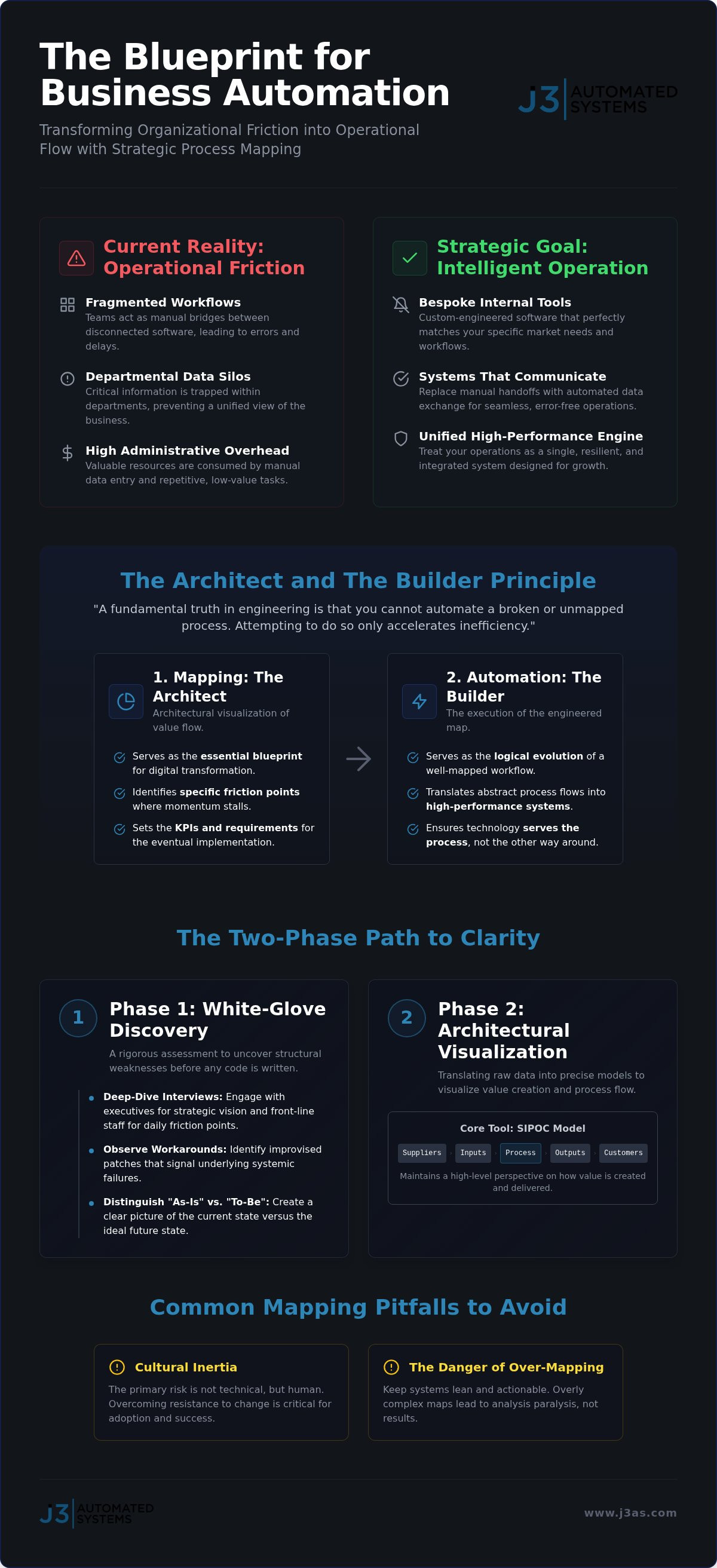
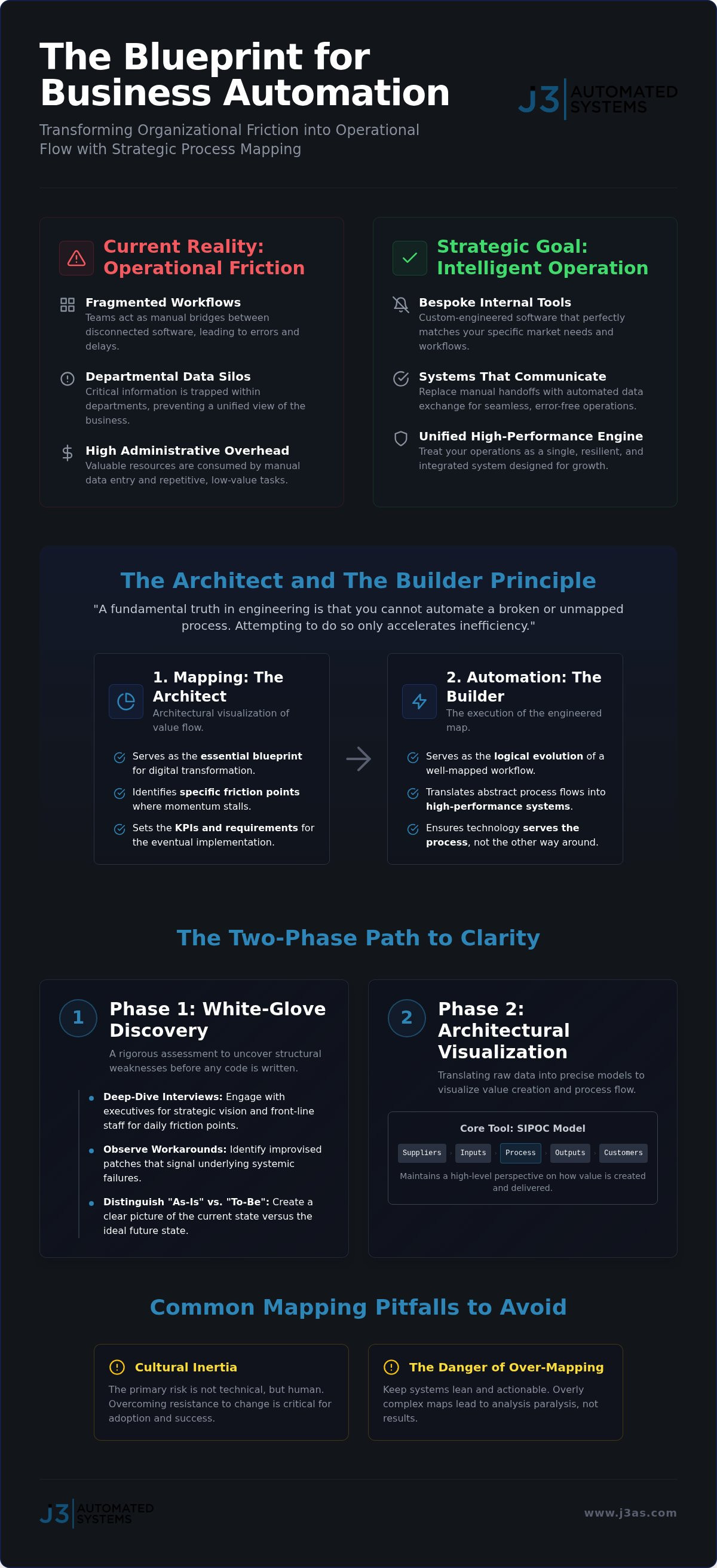
In high-stakes commercial environments, success is often the result of invisible structures. Implementing business process mapping and automation serves as the architectural visualization of how value moves through your organization, providing a clear view of the complex paths that data and decisions travel. It's the difference between a simple drawing and an engineered map. The former merely sketches a workflow, while the latter accounts for technical constraints, resource allocation, and logical dependencies. Without this precision, any attempt at improvement is merely guesswork. Business process mapping provides the necessary clarity to begin this journey.
Mapping identifies the specific friction points where operational momentum stalls. These are the manual handoffs where data is lost or time is wasted because systems don't communicate. By documenting these gaps, we prepare the ground for ai business process automation, which serves as the logical evolution of a well-mapped workflow. This transition from visualization to execution ensures that technology serves the process, rather than forcing the process to fit the technology.
Identifying Friction in Modern Texas Enterprises
The rapid economic expansion in Austin and San Antonio often creates accidental processes. As companies scale quickly to meet demand, they frequently adopt fragmented tools to solve immediate problems. This leads to the proliferation of shadow IT and excessive manual data entry, which increases administrative overhead. Visibility is your first step toward reclaiming control. When you map these workflows, you expose the hidden costs of fragmentation and create a baseline for a more resilient, integrated operation.
Mapping vs. Automation: The Architect vs. The Builder
A fundamental truth in engineering is that you cannot automate a broken or unmapped process. Attempting to do so only accelerates inefficiency. Think of mapping as the architect's blueprint and automation as the builder's construction. The map sets the KPIs for the eventual implementation, ensuring that every automated step has a measurable purpose. A sophisticated systems integrator bridges these two phases, translating abstract process flows into high-performance business process mapping and automation systems that deliver long-term functionality.
Step-by-Step: How to Map Your Workflows for Maximum Clarity
Effective business process mapping and automation begins with a diagnostic mindset. It isn't a mere documentation exercise; it's a rigorous assessment of your organization's current operational health. We treat this phase as a fundamental rethinking and radical redesign of how your business functions. By distinguishing between the "As-Is" state, where you are now, and the idealized "To-Be" state, we uncover the structural weaknesses that prevent peak performance. This clarity is essential because automating a flawed process only creates a faster way to fail. Instead, we use mapping to engineer out the flaws before a single line of code is written.
Phase 1: The White-Glove Discovery Process
We begin with deep-dive interviews across every level of the organization. Executives provide the high-level strategic vision, while front-line staff reveal the daily friction points that slow them down. Often, the most valuable insights come from observing the workarounds employees have invented to bypass rigid, outdated systems. These improvised patches are symptoms of underlying systemic failure. The Discovery Session is the most critical hour in any automation project. For those seeking to eliminate these burdens, partnering with a visionary integrator ensures no detail is overlooked during this diagnostic phase. We don't just ask what you do; we analyze why you do it and how it can be improved.
Phase 2: Visualizing the Flow with SIPOC and Swimlanes
Once we gather raw data, we translate it into precise architectural models. We use SIPOC—Suppliers, Inputs, Process, Outputs, Customers—to maintain a high-level perspective on how value is created. This ensures we don't lose sight of the objective while diving into the technical details. Swimlane diagrams then introduce accountability by clearly defining which department or system owns each specific step. This process moves beyond static sticky notes on a whiteboard, evolving into digital models that serve as the foundation for your business process mapping and automation strategy. We replace departmental ambiguity with engineering precision, turning fragmented activities into a cohesive, high-performance system that is ready for the next stage of digital transformation.
Engineering Intelligence: Transitioning from Static Maps to Dynamic Automation
The transition from a static process map to a dynamic automated system is where theoretical planning meets functional engineering. Once the discovery phase concludes, the resulting map serves as the primary requirement document for custom software development. This stage distinguishes simple task automation, which handles isolated triggers, from the more complex orchestration of Intelligent automation (IA). While task automation might move a file from one folder to another, true business process mapping and automation synchronizes multiple departments, databases, and physical systems into a single, fluid operation.
This holistic approach allows for the integration of physical infrastructure into digital workflows. For example, sophisticated commercial security system design can be engineered to trigger specific administrative actions, such as logging facility access data directly into an internal management tool. By bridging the gap between the physical environment and digital processes, we remove the friction of manual data entry and ensure that every facet of the enterprise operates under a unified logic.
Custom Web Apps vs. Off-the-Shelf SaaS
Many Texas enterprises eventually outgrow the limitations of generic, off-the-shelf SaaS products. These tools often require "duct-tape" integrations and per-user fees that escalate as your organization scales. Transitioning to bespoke internal tools allows you to own your software infrastructure completely. Custom web apps eliminate the need for awkward workarounds, providing a precise fit for your unique workflows. The long-term ROI of this ownership is substantial; you're no longer renting a solution but building a permanent asset that evolves alongside your business.
Integrating AI into the Workflow Architecture
Modern business process mapping and automation leverages AI to handle the unstructured data that previously required constant human intervention. By implementing AI-driven decision nodes, systems can now interpret complex documents, extract relevant data, and route tasks without a "human-in-the-loop" for every repetitive approval. This integration reduces employee friction and allows your team to focus on high-value strategic work. We treat AI as an invisible layer of intelligence that enhances the mapped workflow, ensuring that the system remains both powerful and effortless for the end user.
Overcoming Friction: Common Mapping Pitfalls and How to Avoid Them
Resistance to change often stems from the quiet comfort of established routines. The phrase "we've always done it this way" acts as a structural barrier to innovation, preserving friction under the guise of tradition. Successful business process mapping and automation requires a willingness to challenge these legacy behaviors and view them through a lens of engineering efficiency. One of the most significant risks in digital transformation is the attempt to automate a bad process. Digitizing a flawed workflow merely accelerates the dysfunction, ensuring that errors occur with greater frequency and less human oversight. We focus on identifying the highest-impact friction points first, ensuring that the foundation is sound before layering on technical solutions.
Iterative mapping allows for a more responsive and agile implementation. Rather than attempting to solve every organizational nuance at once, we target the areas where manual labor is most intensive. This methodical approach prevents the paralysis that often accompanies complex transitions. To begin eliminating these operational bottlenecks in your organization, connect with our engineering team for a diagnostic review of your current systems.
The Trap of Perfectionism in Process Design
Many organizations stall because they try to map every possible outlier and edge case before taking action. This leads to "Over-Mapping," where the complexity of the documentation prevents any actual progress. A 90% accurate map that allows for immediate action is far more valuable than a 100% map that takes six months to finalize. We prioritize the "Happy Path"—the standard flow that accounts for the vast majority of your transactions. This leads to a Minimum Viable Automation (MVA) strategy, which provides immediate relief from administrative burden while allowing for the system to be refined over time.
Managing the Human Element of Digital Transformation
Automation is frequently misunderstood as a threat to job security when its true purpose is the removal of burden. It's essential that your staff understands that these systems exist to eliminate the repetitive, soul-crushing tasks that lead to burnout. Successful transformation requires a white-glove approach to system commissioning, including comprehensive training and ongoing support. Our local Texas support ensures that every system is tuned to the specific operational culture of the San Antonio workforce, creating a sense of calm reliability. When employees see that the new tools make their daily lives easier, resistance transforms into enthusiastic adoption.
Bespoke Automation: Why Texas Businesses Choose J3 Automated Systems
Texas enterprises deserve a level of precision that off-the-shelf solutions cannot provide. J3 Automated Systems serves the San Antonio, Austin, and New Braunfels corridor with a focus on removing operational friction through custom-engineered strategies. By acting as a single accountable partner, we manage the entire lifecycle of a project, from the initial discovery to the final implementation of business process mapping and automation systems. This integrated approach ensures that your digital tools and physical infrastructure exist in a state of constant harmony, reflecting a commitment to long-term functionality over temporary fixes. We don't just sell software; we engineer the intelligence that powers your organization's growth.
A Single Accountable Team for Texas SMBs
Managing multiple vendors often leads to finger-pointing and fragmented results. We eliminate this burden by providing a single team of engineers who possess a deep understanding of both software development and physical infrastructure. You gain direct access to senior engineers who lead the discovery process, ensuring that the architectural blueprint for your automation is sound from the start. This white-glove service model provides Texas businesses with the intellectual rigor required to simplify complex workflows, turning fragmented tasks into a unified, high-performance operation. We take full responsibility for the roadmap, allowing you to focus on leadership rather than troubleshooting.
Beyond Digital: Holistic Automation for Commercial Properties
True transformation extends beyond the screen. We bridge the gap between building management systems (BMS) and business operations, creating holistic environments where lighting, security, and digital workflows communicate seamlessly. For example, your facility's automated lighting and HVAC can be synchronized with internal scheduling tools to optimize energy use based on real-time operational data. This vision of an "intelligent environment" ensures that every asset in your organization contributes to a state of effortless operation. By integrating business process mapping and automation into the very fabric of your commercial property, you reclaim time and resources previously lost to manual coordination.
The business process automation market is projected to grow to $56.68 billion by 2034, making a sophisticated, locally-supported strategy more urgent than ever. We ensure your organization remains compliant with regional regulations, such as the Texas Responsible Artificial Intelligence Governance Act (TRAIGA) which took effect on January 1, 2026, while scaling your capabilities. To begin your transformation and move toward a state of calm reliability, schedule a discovery session to map your business automation roadmap with J3AS and experience the clarity of a truly engineered system.
Reclaiming Operational Excellence through Precision Engineering
Transforming a fragmented organization into a high-performance system requires more than just new software; it demands a fundamental shift in how you visualize and execute your workflows. We've explored how business process mapping and automation serves as the essential blueprint for this evolution, moving from diagnostic discovery to the deployment of bespoke digital tools. By integrating custom AI and internal web apps into the very fabric of your operations, you eliminate the friction that stalls growth and creates administrative burden.
As a single, accountable partner, our Texas-based engineering team provides the intellectual rigor needed to bridge the gap between physical environments and digital intelligence. We specialize in custom AI and software integration, ensuring that your systems don't just function but thrive under a unified logic. From the initial map to long-term maintenance, we take full responsibility for your digital transformation. Engineer a frictionless future for your business—contact J3 Automated Systems today. Your path to a state of calm, effortless operation begins with a single, precise blueprint.
Frequently Asked Questions
What is the difference between process mapping and process modeling?
Process mapping focuses on the visual documentation of a workflow to create clarity, while process modeling involves simulating that workflow to analyze performance under various conditions. Think of mapping as the architectural floor plan and modeling as the structural analysis that tests how the building handles a load. Both are essential steps in a sophisticated business process mapping and automation strategy to ensure the final system is both efficient and resilient.
How long does a typical business process mapping engagement take?
A standard discovery and mapping phase typically spans two to four weeks depending on the complexity of the organization. This timeframe allows our engineers to conduct deep-dive interviews, observe real-world workarounds, and finalize the digital architectural models. We prioritize precision over speed to ensure the resulting blueprint is a reliable foundation for future automation, preventing the need for costly mid-project corrections.
Does my San Antonio business need custom software, or is a SaaS tool enough?
While off-the-shelf SaaS tools solve immediate problems, they often create data silos and high per-user costs as you scale. Custom web apps and internal tools eliminate the need for "duct-tape" integrations between platforms, providing a bespoke fit for your unique workflows. Owning your infrastructure ensures long-term ROI and removes the burden of fragmented, generic software that forces your team to adapt to its limitations.
Can AI really help with business process mapping?
AI acts as a visionary co-pilot by using process mining to provide evidence-based insights into how your organization actually functions. It identifies hidden bottlenecks that human observation might miss, shifting mapping from a manual documentation exercise to an intelligent foundation for hyperautomation. This ensures that the final automated system is engineered with data-driven precision, reducing the "human-in-the-loop" requirement for repetitive approvals.
What are the most common processes that Texas businesses automate first?
High-growth organizations in Austin and San Antonio often start by automating high-frequency administrative tasks such as employee onboarding or cross-departmental data entry. We also see significant demand for integrating digital workflows with physical facility management, such as commercial building automation. Removing these friction points provides immediate relief from administrative overhead and allows your staff to focus on high-value strategic work.
How do I measure the ROI of business process automation?
ROI is measured through the reduction of manual labor hours and the elimination of costly data entry errors. Organizations frequently report cost reductions ranging from 10% to 50% after implementing a professional business process mapping and automation project. Beyond the balance sheet, the true value lies in the removal of operational friction and the creation of a more resilient, scalable enterprise that operates with calm reliability.
What happens if our business processes change after the automation is built?
We engineer our systems with long-term functionality in mind, utilizing modular architectures that allow for iterative updates as your organization evolves. Because we act as a single accountable partner from mapping to maintenance, we ensure your automation remains synchronized with your changing business logic. This approach prevents the technical debt often associated with rigid products and ensures your system remains an asset rather than a liability.