Commercial HVAC Automation Systems: Engineering Efficiency for Modern Texas Facilities

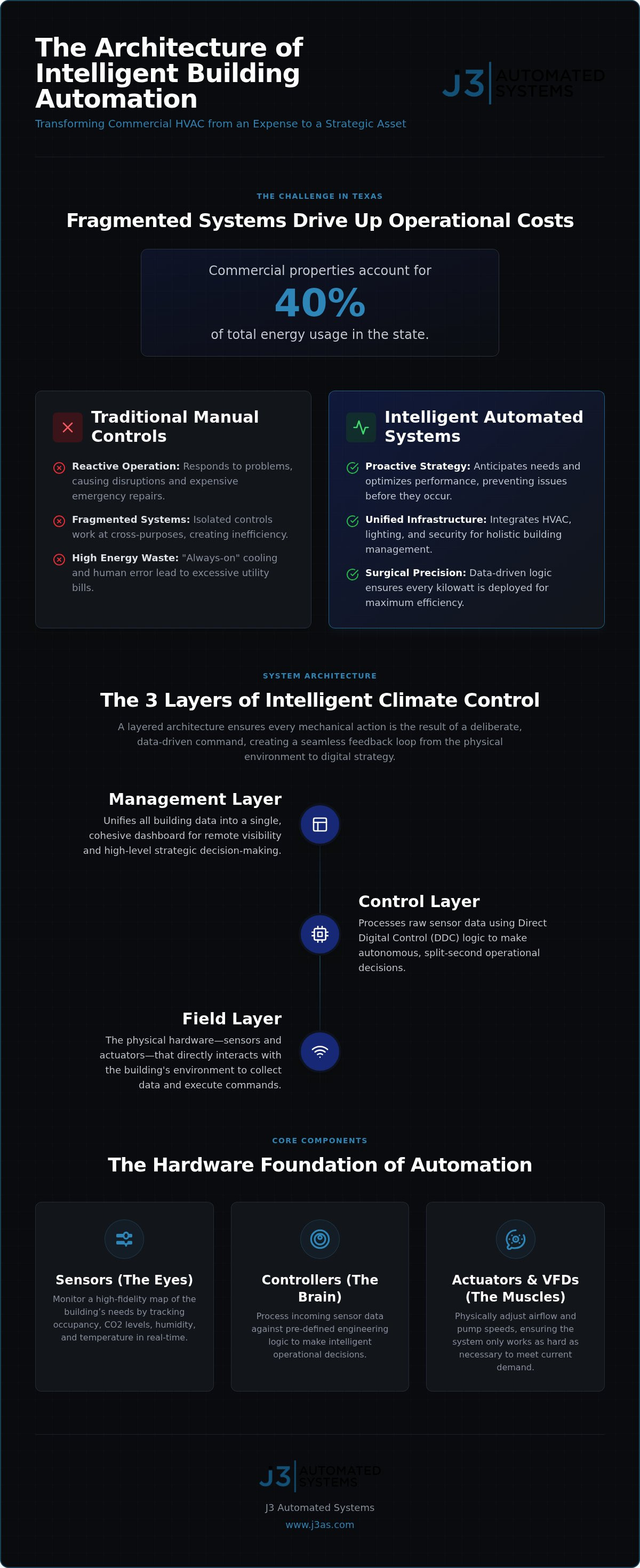
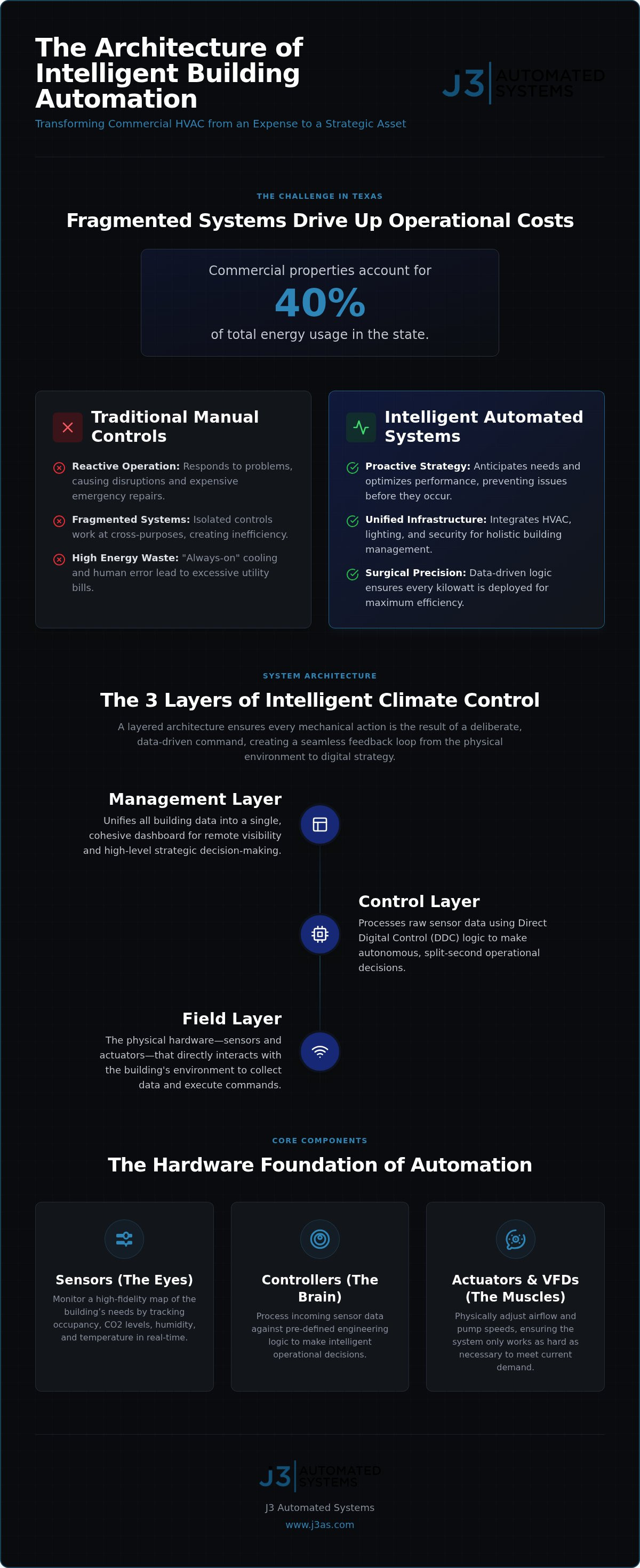
Commercial properties account for 40% of total energy usage in Texas, and during the peak of summer, an inefficient system does more than just struggle. It actively erodes your operational budget. You likely recognize the frustration of managing fragmented controls that refuse to communicate, or perhaps you're weary of the reactive cycle of expensive, emergency repairs that disrupt your daily workflow. It's a common burden, but it's one that sophisticated engineering can solve.
By implementing intelligent commercial HVAC automation systems, you can transform your building’s climate control from a recurring utility expense into a strategic, cost-saving asset. This shift provides the harmony and precision required to maintain peak performance without constant manual intervention. We will explore how unifying your digital and physical infrastructure through intelligent automation delivers remote visibility, lowers maintenance overhead, and secures the long-term value of your facility. From navigating the phase-out of legacy refrigerants to leveraging utility rebates, you'll discover how a holistic approach to building intelligence creates a state of effortless, efficient operation.
Key Takeaways
- Transitioning from manual controls to an autonomous, layered architecture ensures your facility operates with digital intelligence rather than simple mechanical logic.
- Implementing commercial HVAC automation systems allows you to reclaim operational costs through advanced strategies like peak load shedding and data-driven scheduling.
- Engineering for the specific Texas heat load requires specialized humidity control and climate logic to protect both indoor air quality and long-term building integrity.
- Unifying your building's performance into a single dashboard provides the remote visibility needed to move from reactive repairs to proactive, strategic maintenance.
- Integrating HVAC automation creates the necessary infrastructure for broader AI-driven business processes, transforming your facility into a high-value, smart asset.
What are Commercial HVAC Automation Systems?
Engineering a modern facility requires moving beyond the limitations of isolated hardware. Traditional climate control relied on "dumb" thermostats. These devices were reactive, binary, and often worked at cross-purposes with other building systems. In contrast, commercial HVAC automation systems function as a centralized network of hardware and software designed to govern a building's environment through autonomous, data-driven climate logic. The objective isn't merely to cool a room. It's about balancing occupant comfort with maximum energy efficiency, ensuring every kilowatt is deployed with surgical precision.
This infrastructure is often referred to as a Building Automation System (BAS). It replaces manual setpoints with a sophisticated feedback loop. By analyzing real-time variables rather than following a rigid schedule, these systems eliminate the friction of human error and the waste of "always-on" cooling. The result is a harmonious environment where the technology anticipates needs before they manifest as tenant complaints or skyrocketing utility bills.
The Core Components of an Automated System
To understand how these systems achieve such high levels of precision, one must look at the three primary layers of their architecture. Each plays a distinct role in the feedback loop that maintains building harmony.
- Sensors: These serve as the eyes of the system. They monitor occupancy, CO2 levels, humidity, and temperature to provide a high-fidelity map of the building’s immediate needs.
- Controllers: Acting as the brain, these units process sensor data against pre-defined engineering logic to make split-second operational decisions.
- Actuators and VFDs: These are the muscles. Variable Frequency Drives (VFDs) and actuators physically adjust airflow and pump speeds, ensuring the system only works as hard as necessary to meet the current demand.
BAS vs. BMS: Understanding the Hierarchy
Understanding the hierarchy of building technology is essential for high-end Texas facilities. While a BAS focuses specifically on HVAC performance, a Building Management System (BMS) acts as a more comprehensive umbrella, integrating all utilities, including lighting, security, and power monitoring. For large-scale properties in the Texas Hill Country, a unified approach is superior. It prevents systems from competing. If the lighting system detects a vacant floor, the commercial HVAC automation systems should respond instantly by reducing airflow to that zone.
J3 engineers these systems to be inherently future-proof. We design the digital architecture so it's ready for AI-integrated business upgrades, allowing your physical environment to evolve alongside your digital workflows. This visionary approach ensures that your investment remains relevant as technology advances, moving your facility from a state of fragmentation to one of intelligent, effortless operation.
The Architecture of Intelligent Climate Control
The intelligence of a facility isn't found in its hardware alone, but in the structured hierarchy of its communication. We engineer commercial HVAC automation systems through a layered architecture that mirrors a well-planned project lifecycle. At the base sits the Field Layer, where sensors and actuators interact directly with the physical environment. Above it, the Control Layer processes these signals through Direct Digital Control (DDC) logic. Finally, the Management Layer unifies these inputs into a cohesive digital experience. This progression ensures that every mechanical action is the result of a deliberate, data-driven command rather than a simple, binary response.
True building harmony requires interoperability. By prioritizing open protocols such as BACnet and Modbus, we eliminate the silos that often plague commercial properties. This approach allows lighting, HVAC, and security to speak a common language, facilitating a holistic response to building demand. Adhering to rigorous energy efficiency standards becomes far simpler when your systems aren't fighting for control. This seamless integration is supported by a dedicated backbone of low-voltage wiring, which provides the resilient, high-speed path necessary for real-time automation and long-term data integrity.
Sensory Input and Real-Time Data Processing
Occupancy sensors provide the granular visibility needed to prevent the cooling of empty conference rooms or vacant wings during off-peak hours. Demand-controlled ventilation (DCV) further refines this by adjusting outdoor air intake based on real-time CO2 concentrations, ensuring air quality remains high without overtaxing the compressor. Setpoint optimization serves as the core of automated logic, continuously calculating the most efficient path to reach the desired climate based on current load conditions.
Remote Visibility and Centralized Command
Modern facility management demands the ability to oversee multiple Texas sites from a single centralized office. Cloud-based dashboards provide this visibility, offering a comprehensive view of performance in Austin or San Antonio at a glance. Mobile alerts notify your team of equipment anomalies or performance drifts before they escalate into tenant complaints. This level of control isn't accidental; it's the result of meticulous system integration that prioritizes user experience and transforms complex data into actionable building intelligence.
Engineering Efficiency: ROI and Operational Benefits
Justifying the capital expenditure for advanced engineering requires a shift in perspective. You shouldn't view commercial HVAC automation systems as a simple hardware procurement, but as a strategic financial instrument. While the initial investment is higher than traditional installations, the return is realized through the immediate removal of operational friction. Research indicates that commercial properties can see a reduction in energy costs between 25% and 50% by implementing a comprehensive building management system. For a deeper financial dive into these projections, consult our Smart Building ROI Analysis.
The primary driver of these savings is the elimination of energy waste through peak load shedding and intelligent scheduling. Instead of running chillers at full capacity during expensive peak demand hours, the system pre-cools the building during off-peak windows. This methodical approach reduces the strain on the Texas power grid and your monthly statement. Beyond energy, automation extends the lifespan of your mechanical assets. By ensuring equipment only operates when necessary and within its optimal parameters, you delay the massive expense of premature system replacement.
Predictive Maintenance vs. Reactive Repair
The true value of building intelligence is often found in what doesn't happen. A sophisticated system identifies a failing motor or a refrigerant leak before it results in a total breakdown during a 105-degree August afternoon. This foresight allows you to schedule targeted maintenance during normal business hours, avoiding the exorbitant costs of emergency weekend calls. Furthermore, continuous data logging provides a transparent audit trail. This documentation is invaluable for warranty claims and insurance audits, proving that the equipment was maintained according to precise engineering standards.
Operational Cost Reduction and Tenant Retention
Automation minimizes the labor-intensive nature of facility management. It moves your team away from manual setpoint adjustments and toward high-level oversight. This transition is essential as we look toward the future of HVAC, where tenant expectations for "smart" environments are becoming the standard. Precise climate control is a primary factor in tenant satisfaction and long-term retention. When you provide a consistently harmonious environment, you increase the property’s market value. You can learn more about this in our guide on how to Reduce Commercial Operating Costs with Automation.
Overcoming Texas-Specific Climate and Infrastructure Challenges
Generic HVAC logic often fails when confronted with the unique thermal demands of the Southern United States. A system designed for the mild summers of the Pacific Northwest cannot withstand the relentless thermal pressure of a Central Texas July. In regions like San Antonio and Austin, commercial HVAC automation systems must be engineered to prioritize dehumidification alongside sensible cooling. Buildings account for 40% of total energy usage in Texas, and without localized climate logic, much of that energy is wasted fighting the state's aggressive humidity levels. We approach these challenges through a lens of regional expertise, ensuring that your building's digital brain understands the specific environmental stressors it must counteract.
Humidity control is more than a matter of comfort; it's a prerequisite for building longevity. Excess moisture leads to mold growth and structural degradation, yet traditional systems often overlook the "latent heat load" during cooling cycles. J3 engineers systems that monitor dew points in real-time, adjusting airflow and coil temperatures to extract moisture before it enters the ductwork. This precision prevents the common "cold and clammy" office environment and protects your investment from the long-term costs of moisture-related damage.
Managing Extreme Heat and Humidity Transitions
The Texas Hill Country is known for rapid temperature swings, where a 40-degree shift can occur within hours. Automated systems manage these transitions by modulating equipment rather than cycling it on and off, which reduces mechanical wear. While "economizer" cycles are often touted for efficiency, they can be a liability in humid environments if they draw in moist outdoor air. Our logic ensures that free cooling is only utilized when both temperature and humidity levels are within strict, engineered parameters. Latent heat load management in a commercial context is the process of removing moisture from the air to maintain a stable, healthy indoor environment regardless of external volatility.
Grid Reliability and Energy Load Shedding
Following the significant grid events of recent years, Texas facility managers must prioritize resilience. Intelligent automation allows your building to participate in "Demand Response" programs, automatically shedding non-essential loads when ERCOT issues energy alerts. This might include dimming non-critical lighting or slightly adjusting setpoints in low-occupancy zones to reduce the building's footprint during a crisis. Maintaining these sophisticated controls requires High-Performance Networking to ensure that your building remains online and responsive even when the local infrastructure is under strain. To ensure your facility is prepared for the next peak demand event, consult with our engineering team for a tailored automation assessment.
The Path to Integration: From Silos to Smart Buildings
Achieving building harmony requires more than just installing new hardware; it demands a unified roadmap that bridges the gap between physical infrastructure and digital intelligence. Most facility managers struggle with a patchwork of vendors and fragmented tools that don't communicate, leading to the operational friction we've discussed. J3 Automated Systems eliminates this complexity by serving as a single, accountable partner for the entire "Discovery to Commissioning" lifecycle. By consolidating the engineering and installation of commercial HVAC automation systems under one roof, we ensure the final result is a seamless, high-performance environment rather than a collection of mismatched parts.
This transition is the foundational step toward becoming a fully AI-Integrated Business. When your HVAC system is no longer a siloed utility but a data-producing asset, it can inform broader business decisions. We guide our clients through a methodical progression, moving from basic connectivity to sophisticated, autonomous operation. This approach transforms your facility from a passive shell into an active participant in your organization’s efficiency goals, moving you away from manual effort toward a state of intelligent, effortless operation.
Retrofitting Aging Texas Infrastructure
Modernizing a facility doesn't always require a total mechanical overhaul. Many established properties in the Texas Hill Country still rely on legacy pneumatic or early digital systems that are prone to drift and failure. We specialize in overlaying modern, high-precision controls onto existing infrastructure, allowing you to reclaim efficiency without the cost of full equipment replacement. A phased approach to automation allows you to manage capital expenditure while seeing immediate improvements in comfort and control. Our white-glove installation process is designed to be invisible; it minimizes tenant disruption while we engineer the invisible backbone of your smart building.
The Future: AI-Driven Building Intelligence
The next evolution of building management lies in predictive capability. Future-proof commercial HVAC automation systems will leverage AI to analyze historical occupancy patterns and real-time weather forecasts, pre-cooling specific zones with surgical accuracy before the first employee arrives. This data doesn't just live in a thermostat; it integrates into custom business dashboards to provide a holistic view of your operational health. Moving toward this level of precision is an investment in the long-term resilience of your property. To begin your transition from fragmented tools to a unified, intelligent roadmap, contact J3 Automated Systems for a professional system audit.
Securing the Future of Your Facility through Intelligent Engineering
Engineering a high-performance facility in the Texas Hill Country requires more than standard equipment; it demands a visionary approach to building intelligence. By transitioning from fragmented controls to unified commercial HVAC automation systems, you eliminate the operational friction that erodes your budget and tenant satisfaction. You've seen how precise climate logic, engineered specifically for the unique heat and humidity of San Antonio and Austin, transforms a building from a passive utility into a strategic asset.
J3 Automated Systems provides the intellectual rigor and technical mastery needed to navigate this complexity. As a single accountable team specializing in high-end Texas commercial properties, we bridge the gap between physical environments and AI-driven digital workflows. This integration ensures your infrastructure remains resilient, efficient, and future-proof. Our expertise in building system integration means you don't have to manage multiple disconnected vendors to achieve a polished, cohesive result.
Schedule a Consultation with J3 Automated Systems to Engineer Your Building's Future. The path to a state of effortless, intelligent operation begins with a single, deliberate step toward superior engineering. We look forward to helping you transform your facility into a masterpiece of efficiency.
Frequently Asked Questions
What is the typical ROI for a commercial HVAC automation system?
Commercial properties often see energy cost reductions between 25% and 50% after implementing a comprehensive building management system. Beyond these utility savings, the return on investment is realized through extended equipment lifecycles and the elimination of emergency repair costs. By preventing the friction of premature mechanical failure, the system pays for itself by transforming a recurring utility expense into a high-value building asset.
Can an existing HVAC system be retrofitted with new automation controls?
Most existing mechanical infrastructure can be modernized by overlaying intelligent digital controls onto legacy pneumatic or early electronic systems. This process allows you to reclaim efficiency without the massive capital expenditure of a total equipment replacement. We often utilize a phased approach to modernization, ensuring that your facility remains operational while we engineer the invisible digital backbone required for modern performance standards.
How does HVAC automation improve indoor air quality in Texas?
Automation improves air quality by utilizing Demand-Controlled Ventilation (DCV) and precise humidity management to prevent the "cold and clammy" environments common in humid Texas regions. The system monitors CO2 levels and dew points in real-time, adjusting outdoor air intake and coil temperatures accordingly. This surgical precision ensures a healthy, harmonious indoor environment while protecting the building’s structural integrity from moisture-related degradation.
What is the difference between a programmable thermostat and a BAS?
A programmable thermostat follows a rigid, manual schedule, while a Building Automation System (BAS) uses real-time data and sensors to make autonomous, logic-driven decisions. While a thermostat is a binary tool, a BAS functions as a sophisticated brain that integrates HVAC with other utilities like lighting and security. This holistic perspective allows the system to respond to occupancy changes and grid demand automatically.
How much energy can a commercial building save with automated HVAC?
Strategic implementation of commercial HVAC automation systems can reduce total energy usage by up to 50% in high-demand environments. These savings are achieved through advanced strategies such as peak load shedding, which pre-cools the building during off-peak hours to avoid high utility rates. By ensuring that cooling is only deployed where and when it’s needed, the system removes the waste inherent in traditional climate control.
Does HVAC automation require a constant internet connection to function?
The primary control logic resides locally on the building’s hardware controllers, ensuring the system functions safely even if the internet connection is interrupted. While the building remains comfortable and efficient without a connection, the internet is required for high-level features like remote visibility, cloud-based dashboards, and mobile alerts. This architecture provides a resilient foundation that balances local reliability with the convenience of digital oversight.
What are the most common protocols used in building automation?
BACnet and Modbus are the industry-standard open protocols that allow diverse hardware components to communicate through a single, unified language. We prioritize these open standards to eliminate the limitations of proprietary systems, ensuring your facility remains interoperable and future-proof. BACnet is typically utilized for HVAC and lighting control, while Modbus is often the preferred choice for precise power monitoring and industrial-grade integration.
How does J3 Automated Systems handle the maintenance of these complex systems?
We utilize a proactive, data-driven approach that identifies performance drifts and potential equipment failures before they result in costly downtime. Our single accountable team provides end-to-end oversight, moving your facility from the burden of reactive repairs to a state of predictive maintenance. This high-touch service ensures that your system continues to operate at peak efficiency, maintaining the harmony and precision we established during the initial installation.