Commercial Networking Services in Austin: A Business Buyer’s Guide

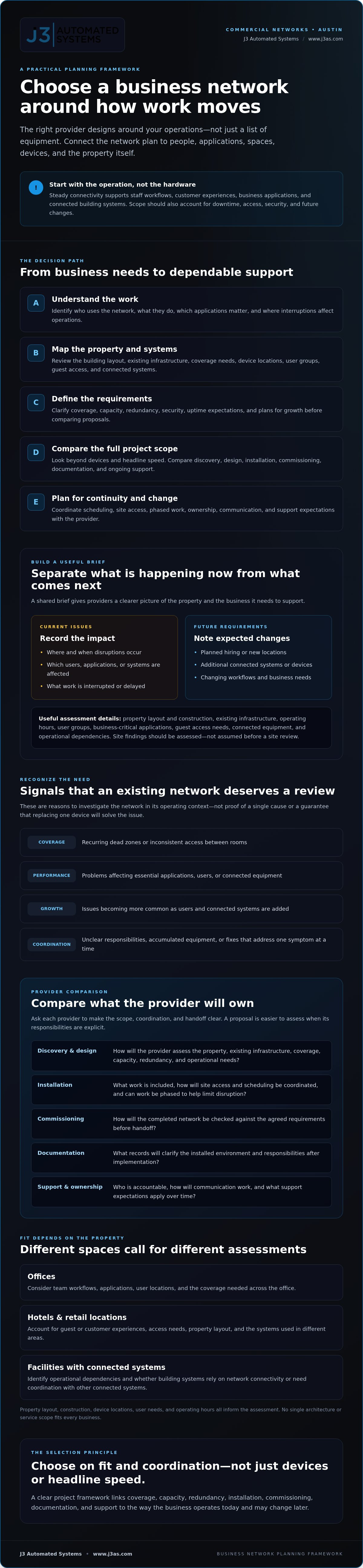
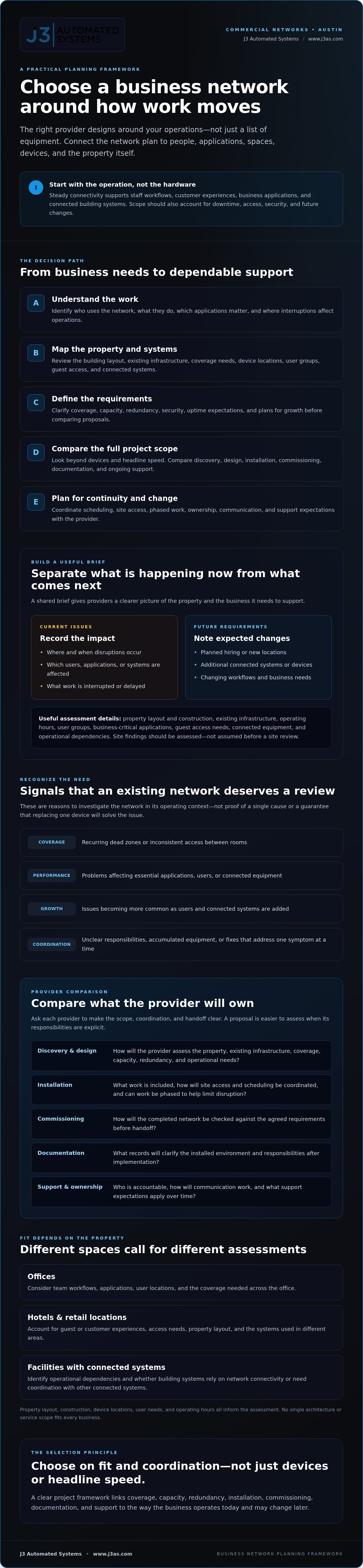
A dependable business network isn’t defined by an equipment list. It’s defined by how well work moves through your property. Choosing commercial networking services Austin businesses can rely on starts with a practical question: which provider will design around your operations, rather than simply install standard components?
Steady connectivity matters for staff, customers, and business systems, but upgrades also need to account for downtime, access, and security. Comparing providers is difficult when project scope is vague or the building’s needs are treated as an afterthought. Start by connecting network requirements to how people use the space today and the changes your business may make later.
This guide explains how to scope a project, evaluate provider capabilities, and plan implementation around your property and continuity needs. You’ll learn what to clarify about coverage, capacity, redundancy, installation, commissioning, and support, and how to assess whether a proposal allows for future growth. A clear framework helps you compare providers on fit and coordination, not just devices or headline speed.
Key Takeaways
- Assess how connectivity supports staff workflows, customer experiences, and connected building systems before defining a project.
- Map users, applications, spaces, devices, and growth plans to create clear network requirements.
- Compare commercial networking services Austin providers offer by discovery, design, installation, commissioning, documentation, and support scope.
- Plan scheduling, site access, and phased work with your provider to help limit disruption during implementation.
- Clarify ownership, communication, and support expectations. Consider whether one accountable integrator can coordinate connected systems.
When Austin Businesses Need Commercial Networking Services
Commercial networking services involve planning and implementing connectivity infrastructure for a business’s people, applications, devices, and operations. For businesses evaluating commercial networking services Austin providers offer, the goal is more than connecting equipment. It’s building a dependable foundation around how the property functions. A computer network links devices so they can communicate and share resources. Commercial planning considers how those connections support a particular organization’s work.
That distinction matters when connectivity problems interrupt daily operations. Staff may lose access to business applications or spend time working around inconsistent connections. Guests may have difficulty using network-dependent services, while connected building systems may not communicate as intended. Equipment added over time can leave coverage gaps, unclear responsibilities, or fixes that address one symptom without considering the wider environment. A business-designed network starts with operational needs, then plans infrastructure to support them.
Which Austin businesses benefit from a professionally designed network?
Offices, hotels, retail locations, and facilities with multiple users or connected systems can benefit from deliberate network planning. The right design depends on the property and its work. An open office has different coverage needs from a hotel with guest areas or a facility where building systems depend on network connectivity. Property layout and construction, device locations, user needs, and operating hours all inform the assessment. No single architecture or service scope fits every business.
What signals that an existing business network needs attention?
Recurring dead zones, inconsistent access between rooms, and performance problems are good reasons to review a network, especially when they affect essential applications or connected equipment. Keep a simple record of where and when issues occur, which users or systems are affected, and what work is disrupted. These details help a provider assess the property and operating context. They don’t establish the cause: coverage, network design, equipment, or other conditions may be involved. Avoid assuming that replacing one device will solve the problem.
An assessment is particularly useful when issues persist, appear in specific areas, or become more common as the business adds users and connected systems. It can help distinguish a localized fault from a broader mismatch between the network and the operation. For Austin businesses, understanding those needs is a stronger starting point for planning resilient networking and coordinating it with building automation or other connected systems when they’re part of the project.
How to Define Commercial Network Requirements Before Comparing Austin Providers
Before reviewing proposals for commercial networking services Austin providers offer, create a shared brief describing what the network must support. Start with the people who use it, then list their applications, the spaces where they work, the devices they rely on, and the business changes you anticipate. A government-backed guide from Invest Northern Ireland also recommends that businesses define your network requirements before selecting a provider.
Keep current problems separate from future requirements. Record recurring disruptions and the work they affect in one list. In another, note planned hiring, new locations, additional connected systems, or changing workflows. This distinction helps providers address immediate needs without designing only around today’s limitations.
What should an Austin commercial network assessment include?
Ask prospective providers to review the property layout, existing infrastructure, coverage needs, and connected systems. Prepare an inventory of user groups, business-critical applications, guest access needs, and operational dependencies. For example, note which teams rely on cloud-based tools and whether building systems depend on network connectivity. Treat site findings and technical recommendations as matters for assessment, not assumptions made before a site review. For organizations exploring advanced connectivity models such as IoT deployments or private cellular infrastructure, visit Virtuser for specialized consulting and turnkey architecture solutions.
How should you document performance, security, and growth needs?
Describe the business impact of an interruption, not just that a connection feels slow. Identify essential workflows, who relies on them, and the periods when an outage would be most disruptive. Share operating hours and uptime expectations so providers can discuss rollout timing, maintenance planning, and continuity measures that may fit the project scope.
Ask how the proposed design would separate access for staff, guests, and connected equipment, and how its security approach will be documented. Providers should explain technical recommendations in relation to your operations. Verify the details rather than treating broad assurances as specifications. If building automation is in scope, review the commercial building management systems guide to understand how network planning can intersect with building systems.
- Users: Who needs access, and what should each group be able to use?
- Applications and devices: Which tools and equipment are essential to daily operations?
- Spaces: Which areas need connectivity, including guest or shared spaces?
- Growth: What changes should the design accommodate?
Send the same written requirements to each provider. A consistent brief gives them a shared basis for proposing discovery, design, implementation, and coordination, making scope differences easier to spot. For a project involving networking and connected building systems, explore J3’s commercial technology services as one potential starting point for discussing how those needs may fit together.
How to Compare Commercial Networking Providers in Austin
Use your documented requirements to compare commercial networking services Austin providers propose. Look beyond equipment lists: proposals can name similar components yet differ in discovery, coordination, testing, documentation, and post-project responsibilities. A defined scope makes proposals easier to compare because each provider is responding to the same operational needs and responsibilities.
| Project stage | What to compare | Questions to ask |
|---|---|---|
| Discovery | Review of workflows, property conditions, existing infrastructure, and connected systems | What information and site conditions will be assessed? |
| Design | Documented recommendations tied to your requirements | What design documents and assumptions will the proposal include? |
| Installation | Defined work, scheduling, access, and coordination responsibilities | Who manages installation, and what work belongs to other parties? |
| Commissioning | Testing, issue resolution, and handoff documentation | How will the installed network be checked against the agreed scope? |
| Support | Clearly stated post-project support and exclusions | What support is included, for what period, and what requires a separate agreement? |
Before approval, ask each provider to identify exclusions, dependencies, responsibilities, and assumptions in writing. Clarify who supplies information or access, who coordinates other trades or vendors, and how scope changes are handled. A proposal should make accountability visible rather than leaving essential tasks between the lines.
Which questions reveal whether a provider understands your operation?
Ask how the provider will translate your workflows into network requirements and a documented design. Who coordinates installation and commissioning? If another party must complete related work, who will identify that dependency and align the schedule? Ask about experience with comparable property types, such as offices or hospitality spaces, and what aspects of that work apply to your site. This tests the provider’s reasoning without assuming every building has the same conditions.
When does integrated technology expertise matter?
Coordination matters when the network must support building automation, AV, or security systems included in the project. The necessary connections and responsibilities vary, so confirm them during discovery rather than assuming integration is included. If security systems are in scope, consult this guide to commercial security system design in Texas. The FTC cybersecurity guide for businesses is also a useful reference when reviewing security considerations in a proposal.
Consider whether a single accountable integrator would simplify coordination across the systems in your project. Explore J3’s commercial technology services as one option when evaluating that approach.
What to Expect During Commercial Network Design and Installation
A commercial networking project should move through defined stages, with clear decisions before work begins and a documented handoff at the end. For businesses considering commercial networking services Austin providers offer, the sequence typically starts with discovery to establish needs and site conditions. Design defines the proposed solution, coordination aligns people and access, installation puts the plan in place, testing checks agreed requirements, and handoff transfers documentation and responsibilities.
- Discovery: Review business needs, property conditions, existing infrastructure, and connected systems.
- Design: Document recommendations, scope, assumptions, and dependencies.
- Coordination: Confirm schedule, site access, responsibilities, and communication channels.
- Installation: Complete the agreed work, considering phased work where appropriate.
- Testing and handoff: Check the installation against agreed requirements and transfer relevant records.
Each stage creates a decision point. Before installation, review the design and confirm who is responsible for related work. Before handoff, confirm what has been tested, what remains open, and who owns each next step.
How can a business plan installation around daily operations?
Identify sensitive work periods, access restrictions, and operational dependencies before setting dates. A retail business may need to protect busy customer hours, while an office may have meetings or workflows that depend on uninterrupted access. Ask whether phased implementation suits your property and project scope. Phasing can help limit disruption, but it isn’t necessary for every project. Agree on how the provider will communicate schedule changes, manage scope changes, and escalate issues.
What should commissioning and handoff cover?
Commissioning should verify the installed network against the project requirements agreed in advance. Confirm which tests will be performed, how results or unresolved issues will be recorded, and what network documentation you’ll receive. Clarify whether handoff includes administrator orientation, who receives access information, and who is responsible for outstanding items. Ask separately what post-installation support is included and what requires another agreement. These details establish a clear transition without implying a particular service level or guaranteed outcome.
Good delivery depends on coordination as much as installation. When network work connects with building automation or other systems, define how teams and responsibilities will align before work begins. That clarity gives staff a more predictable process and the organization a useful record for future changes. Discuss a commercial networking project with J3 when you’re ready to plan the next steps.
Choosing an Austin Networking Partner for Long-Term Reliability
A network’s long-term value depends on more than its initial design. The right partner should make responsibilities clear, explain decisions in a way your team can follow, and provide documentation that remains useful as the property and its operations change. When comparing commercial networking services Austin businesses can choose from, assess how each provider handles the relationship after the scope is approved, not only how it describes installation.
What should an Austin business clarify before signing?
Review the proposal and agreement for specific deliverables, schedule assumptions, responsibilities, exclusions, and acceptance criteria. Ask who owns each task, including coordination with other vendors, and how you’ll be notified if site conditions or project requirements change. Clarify how troubleshooting requests and future expansion will be handled. Distinguish included work from items that require a separate agreement.
Support varies by project, so confirm the precise arrangements rather than relying on broad descriptions. Ask what support is available, how to request it, who responds, and whether service hours or response expectations are documented. Clear answers help your team plan its own responsibilities and avoid assuming that ongoing monitoring or support is included when it hasn’t been specified. Organizations evaluating post-deployment needs may also look to managed IT and training providers like Insoft Services to understand how external network support and cybersecurity consultancy are structured over the long term.
When a network must work with building automation or other connected systems, coordinating the relevant design and implementation can reduce gaps between project teams. Integration needs depend on the systems involved and should be confirmed during discovery. Ask how the provider will document interfaces, dependencies, and ownership so the network scope connects sensibly with the rest of the project.
J3 Automated Systems serves commercial clients in Austin and throughout Texas, with commercial networking among its offerings. Its approach emphasizes mapping needs, engineering a tailored scope, and coordinating implementation. For any project, confirm which assessment, installation, commissioning, and ongoing support elements are included, along with the responsibilities assigned to other parties.
A considered partner selection leaves you with more than a completed installation. It gives your organization a clear understanding of what was designed, who is accountable, and how future changes can be approached. Before choosing, check that the proposed scope fits the property, the operation, and the support your team expects.
Discuss your Austin commercial networking project with J3 to outline your property needs, project scope, and potential next steps.
Build a Network That Can Grow With Your Business
A dependable network begins with a clear understanding of how your people, property, and systems operate. Separate current pain points from future needs, then compare proposals by discovery, engineered scope, coordination, commissioning, documentation, and stated support. This gives you a practical basis for evaluating commercial networking services Austin businesses can use to support daily work and planned growth.
J3 Automated Systems serves commercial clients in Austin and throughout Texas, with resilient networking among its offerings. The team also provides end-to-end engineering and installation across its integrated automation work, which can help coordinate connected technologies when they belong in the project scope. Confirm the specific deliverables, responsibilities, and support arrangements for your needs before moving forward.
Ready to shape a network plan around your property and operations? Discuss your commercial networking needs with J3. A well-scoped conversation is a practical first step toward a more coordinated technology environment.
Frequently Asked Questions
What do commercial networking services include?
Commercial networking services generally involve planning and implementing connectivity infrastructure around a business’s users, applications, devices, and property. Depending on the project, work may include assessing existing conditions, designing a network, coordinating installation, testing agreed requirements, and handing over documentation. Scope varies by site and provider. Clarify whether ongoing support is included or arranged separately, and confirm which tasks belong to the network provider versus other vendors.
How do I choose a commercial networking provider in Austin?
Compare commercial networking services Austin providers by how well the proposed scope fits your operation, not by equipment lists alone. Ask how they’ll assess your property and workflows, document the design, coordinate installation, test the result, and explain responsibilities. Review exclusions, dependencies, communication practices, and support terms before signing. J3 Automated Systems serves Austin and other Texas communities, including San Antonio, New Braunfels, Seguin, Bandera, Boerne, and San Marcos.
Can a business network support building automation and security systems?
A business network may support connected building automation and security systems when the design accounts for their requirements and compatibility. Confirm which systems are in scope, what information their vendors need, and how access and responsibilities will be coordinated. Network connectivity alone doesn’t establish that systems will work together or provide security. Ask the project team to document dependencies, testing expectations, and any work assigned to separate providers.
How can a network installation minimize disruption to business operations?
Plan installation around sensitive work periods, access limits, and workflows that depend on uninterrupted connectivity. Share operating hours and identify systems that must remain available so the provider can discuss scheduling and whether phased work suits the project. Before work starts, establish who communicates schedule changes, manages scope changes, and escalates issues. A phased approach may help manage disruption, but it isn’t appropriate or necessary for every property.
What should a commercial network proposal include?
A useful proposal should define discovery and design scope, planned installation, coordination responsibilities, testing and handoff, schedule assumptions, exclusions, and dependencies. It should explain how the work addresses your documented requirements and what records you’ll receive. Review acceptance criteria and clarify how changes are handled. Ask for precise details about post-installation support, including what is included, how to request it, and what requires a separate agreement.
Does my business need a network assessment before upgrading?
An assessment is valuable when recurring dead zones, inconsistent access, or performance problems affect business workflows, or when the property is changing. It helps identify relevant site conditions, existing infrastructure, coverage needs, connected systems, and operational priorities before recommendations are made. Track where problems occur and what work they interrupt. Symptoms don’t prove their cause, so don’t assume a particular device or upgrade will resolve them without reviewing the environment.
Can one provider design and install a commercial network?
One provider can handle design and installation if those responsibilities are included in its project scope. Confirm who leads discovery, coordinates work by other parties, tests against agreed requirements, and provides documentation at handoff. J3 Automated Systems lists resilient networking among its offerings and provides engineering and installation across its integrated automation work. Ask J3 to confirm the exact networking deliverables and support arrangements for your project.