Commercial Security Infrastructure Design: Engineering Intelligent Protection in 2026
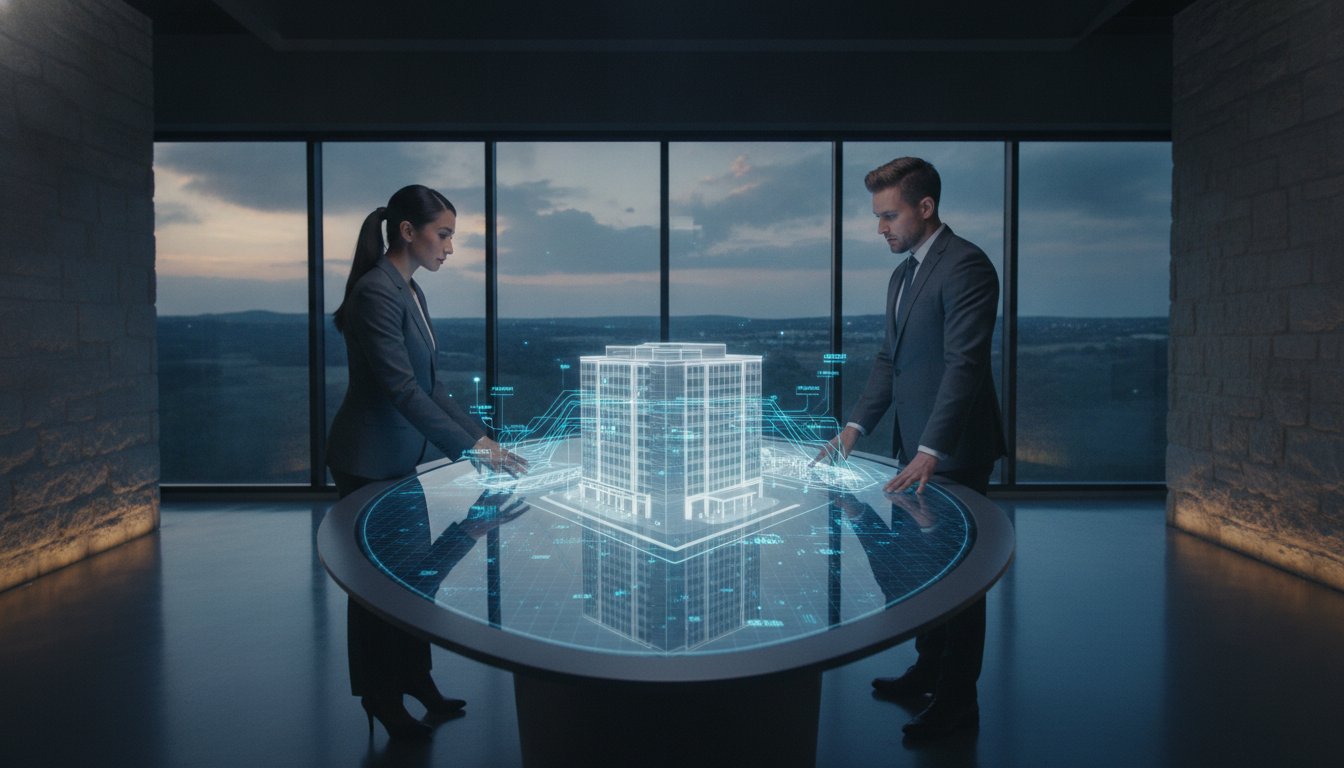
What if the greatest vulnerability in your facility isn't a physical breach, but the invisible friction between the systems meant to protect it? Many stakeholders realize that legacy hardware often creates more noise than clarity. In the specialized field of commercial building security automation Texas, siloed platforms that don't communicate lead to high false alarm rates and mounting operational fatigue. You're likely concerned about whether your current network bandwidth can truly support the weight of 4K surveillance and real-time AI analytics.
We understand that true security requires more than just adding cameras; it demands a sophisticated architectural approach. This article provides the blueprint to master converged security infrastructure, allowing you to build a resilient and future-proof commercial environment. You'll learn how to transition from fragmented tools to a unified security dashboard that simplifies complexity and reduces overhead. We'll examine how to engineer a scalable foundation that supports the intelligent protection standards of 2026 while ensuring your facility remains compliant with the latest Texas data privacy regulations.
Key Takeaways
- Adopt a "secure by design" philosophy that treats protection as a fundamental engineering layer rather than a series of disconnected hardware additions.
- Establish a resilient networking backbone capable of sustaining the high-bandwidth demands of 4K video and real-time AI metadata without compromising system integrity.
- Unlock operational harmony by converging physical security with building management systems to drive automated, energy-efficient responses in lighting and HVAC.
- Navigate the complexities of commercial building security automation Texas by designing for regional climate demands and evolving 2026 state regulatory requirements.
- Transition from passive observation to proactive prevention through the strategic deployment of edge computing and intelligent surveillance analytics.
The Shift to Secure by Design: Why Infrastructure Matters More Than Hardware
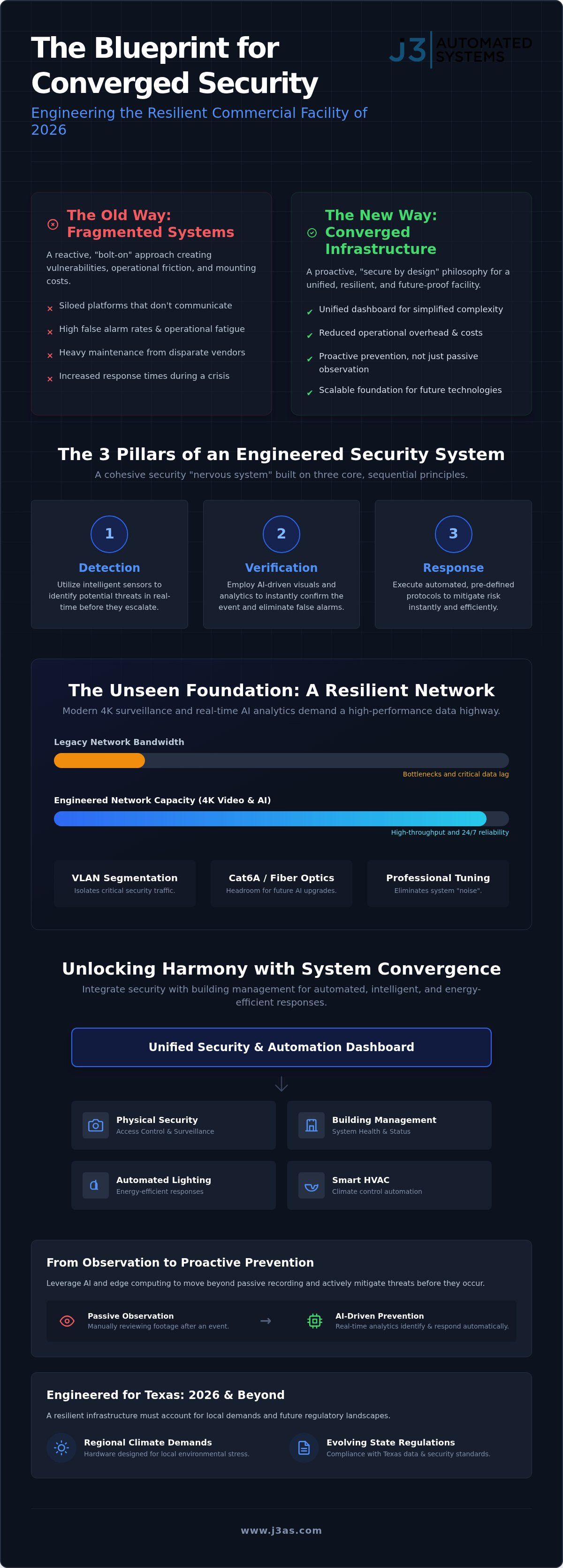
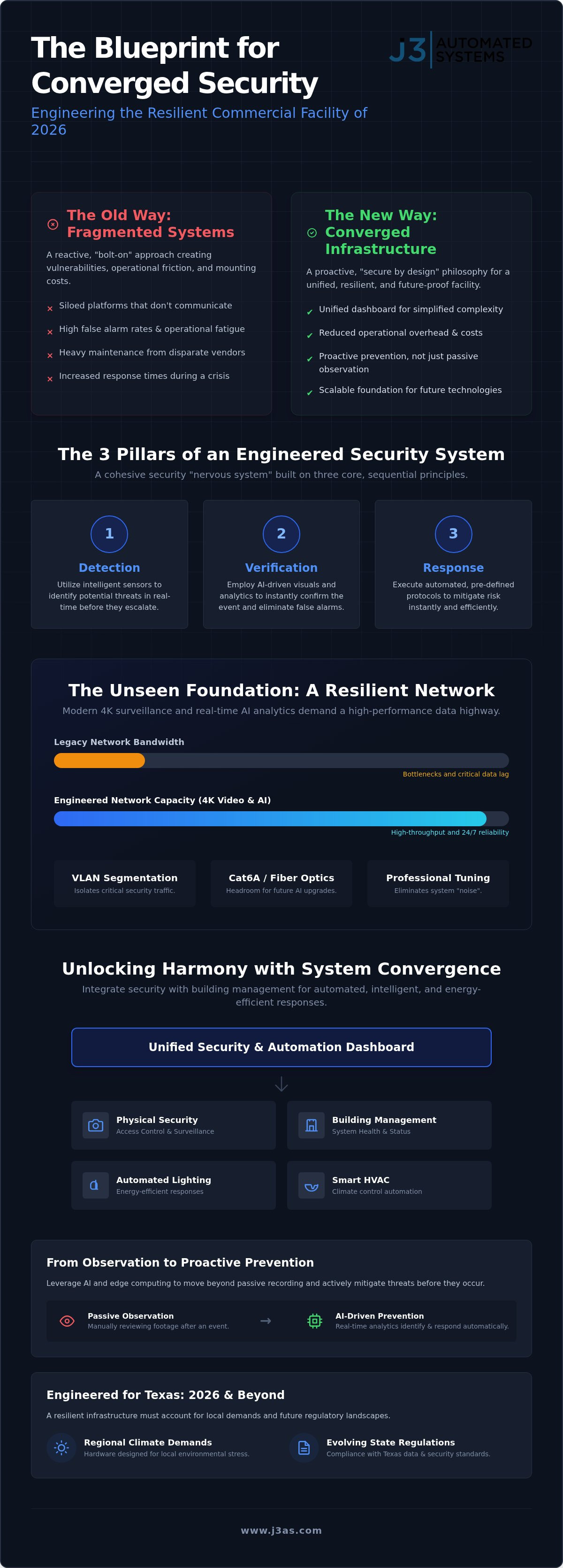
Security has traditionally been treated as a series of "bolt-on" additions. You purchase cameras, install locks, and subscribe to an alarm service, often from different vendors at different times. By 2026, this reactive approach has become a liability. High-stakes environments now require a proactive, engineered strategy where protection is woven into the building's digital and physical fabric from day one. This shift moves the focus away from individual gadgets and toward a robust, unified infrastructure.
Defining Commercial Security Infrastructure Design
Security infrastructure is the converged layer of hardware, software, and networking that functions as a building's unified nervous system. While standalone systems operate in isolation, an integrated ecosystem ensures that every sensor and protocol communicates in real time. This methodology relies on Secure by Design principles to incorporate protection into the foundational architecture of a facility. A truly engineered system rests on three critical pillars. First, Detection uses intelligent sensors to identify potential threats. Second, Verification employs AI-driven visuals to confirm the event. Finally, Response executes automated protocols to mitigate risk instantly.
The Cost of Fragmentation in Large-Scale Facilities
Fragmentation is the primary driver of system failure. When platforms don't share data, information remains trapped in silos, forcing facility managers to manually correlate alerts during a crisis. This friction increases response times and creates vulnerabilities that modern threats are designed to exploit. Beyond safety risks, disparate vendor systems carry heavy maintenance costs. Managing mismatched hardware lifecycles and multiple service contracts creates an unnecessary operational burden that drains resources.
Designing effective commercial building security automation Texas requires a departure from these disjointed methods. A single-accountable-team model reduces project friction by ensuring the engineering and implementation phases are perfectly aligned. This unified roadmap simplifies complexity, allowing you to manage your entire facility from a position of leadership and calm reliability. It's about building a scalable foundation that treats security as an asset rather than an overhead expense.
The Anatomy of a Resilient Security Backbone: Networking and Low Voltage
A sophisticated camera or access control panel is effectively useless if the data it generates cannot reach its destination. While the previous section established the importance of an engineered philosophy, the physical network serves as the literal data highway for every security protocol. In the context of commercial building security automation Texas, this means designing for the heavy payloads of 2026. High-resolution 4K video streams and the constant chatter of AI metadata require massive bandwidth. Without an enterprise-grade foundation, even the most expensive hardware becomes a bottleneck.
Engineering the Invisible Backbone
The principles found in high performance residential networking are now mandatory for commercial environments. A truly resilient security backbone utilizes VLAN segmentation to isolate security traffic from guest Wi-Fi or general office data. This separation ensures that a sudden surge in network usage doesn't lag a critical surveillance feed. Resilient networking also implies 24/7 reliability, where the system is tuned to prioritize security packets above all else, maintaining a fluid stream of information even under heavy load.
Low-Voltage Design for Scalability
Meticulous planning begins with the low-voltage wiring. Structured cabling must precede hardware selection because it dictates the system's ultimate capacity. We advocate for Cat6A or fiber optics to provide the necessary headroom for future AI upgrades. Professional tuning and commissioning of this layer eliminate "noise" in the system, ensuring that every node receives consistent power and signal. If you're planning a new facility, consulting with an integrator during the architectural phase prevents the friction of retrofitting later.
Redundancy is the final piece of the engineering puzzle. Critical security nodes require dedicated Uninterruptible Power Supplies (UPS) and automated failovers. In Texas, where extreme heat and power grid fluctuations are common, these safeguards protect the integrity of your commercial building security automation Texas investment. By engineering for the worst-case scenario, you ensure the system remains operational when it's needed most. This methodical approach transforms a collection of wires into a robust, intelligent platform.
Convergence: Integrating Security with Building Management Systems (BMS)
Integrating security with building management systems represents the final step in removing the friction of manual facility oversight. Historically, cameras and HVAC units lived in separate worlds; today, they function as a single, intelligent entity. This convergence is the hallmark of modern commercial building security automation Texas. When your security sensors double as data points for your BMS, you transform reactive safety measures into proactive operational intelligence.
Security as a Data Source for Building Intelligence
Occupancy sensors, once used purely for intrusion detection, now feed real-time data into commercial building management systems Texas. This allows the building to adjust HVAC setpoints and lighting based on actual room usage, drastically reducing energy waste. Event-driven automation also enhances safety. For instance, if a fire alarm triggers, the system can automatically illuminate emergency egress paths while simultaneously unlocking specific access points for first responders. This level of coordination removes the burden from facility managers, replacing manual checklists with automated reporting and intelligent responses.
Smart Access Control vs. Traditional Locks
Traditional locks and localized keycard systems are increasingly viewed as static vulnerabilities. Cloud-managed access control offers a more fluid alternative, utilizing mobile credentials and biometric verification to ensure only authorized personnel enter sensitive zones. This intelligence extends to the building's exterior. Through automated lighting and shade control, the system can deploy perimeter deterrence protocols. If an unauthorized presence is detected after hours, the building can flood the area with light or adjust shades to provide maximum visibility for surveillance cameras. This integrated approach ensures that every component of the facility works in harmony to protect the environment.
The ROI of this integration is evident. By centralizing security and building health into a single dashboard, Texas businesses reduce operational overhead and eliminate the need for redundant hardware. It's a shift from managing a collection of parts to overseeing a high-performance ecosystem that prioritizes both safety and efficiency.
Intelligent Surveillance: Moving from Observation to AI-Driven Prevention
Cameras were once passive witnesses, recording events for later review. In 2026, the paradigm has shifted toward active prevention. Modern commercial building security automation Texas transforms video feeds into actionable intelligence. By processing data at the edge, systems can identify threats in milliseconds, allowing for intervention before a breach occurs. This transition relies on high-performance hardware paired with the brain of custom software to create a truly proactive environment. It represents a fundamental shift in how we perceive facility protection.
AI and Behavioral Analytics
Artificial intelligence now identifies human intent rather than just flagging pixel movement. While legacy systems triggered alerts for swaying trees or passing shadows, modern classification engines distinguish between a delivery driver and a loiterer with surgical precision. This reduction in false alarms ensures that security personnel only respond to genuine threats. Integrating these feeds with ai business process automation allows for the seamless logging of incidents. Every verified event is automatically categorized, time-stamped, and archived, removing the administrative burden of manual record-keeping.
Bespoke Security Software and Dashboards
Standard off-the-shelf software often fails to capture the unique operational nuances of a large-scale facility. This is where custom web app development San Antonio becomes essential. We engineer dedicated digital backbones that visualize high-level security metrics for executive review. These dashboards provide more than just video; they offer insights into facility traffic patterns, system health, and response times. Custom internal tools also empower security staff by automating dispatch workflows. When a sensor identifies a high-priority event, the system can instantly push the nearest guard's location and live video feed to a mobile interface, ensuring a coordinated and rapid response.
Privacy-first design remains a cornerstone of this evolution. We implement analytics that focus on behavioral patterns while utilizing anonymization protocols to protect individual identities. This ethical approach ensures compliance with the Texas Data Privacy and Security Act while maintaining a rigorous safety posture. If you're ready to move beyond simple observation, contact our engineering team to design a custom surveillance ecosystem.
Engineering Security for Texas: Local Context and Implementation
Implementing commercial building security automation Texas requires more than technical proficiency; it demands an intimate understanding of the regional environment. From the regulatory shifts of late 2026 to the physical demands of the Hill Country climate, a successful deployment must be engineered for local reality. Generic solutions often fail because they ignore the variables that define Texas commerce. We treat every project as a unique architectural challenge, ensuring that your protection is as resilient as the infrastructure it guards.
Texas-Specific Environmental Considerations
Thermal management is the silent priority for any outdoor installation in San Antonio or Austin. Surveillance hardware and networking hubs must be engineered to withstand sustained triple-digit temperatures and intense UV exposure that can degrade standard components. For large-acreage campuses, we prioritize fiber optic backbones and climate-resilient enclosures to prevent signal loss during the region's intense heat cycles and sudden storm patterns. Selecting hardware that resists these environmental stressors ensures your infrastructure remains operational year-round. This level of meticulous planning prevents the frequent hardware failures that plague less rigorous, off-the-shelf installations.
The J3 Engineering Roadmap
We operate on a single accountable team philosophy that eliminates the friction between engineering and implementation. Our approach to commercial security system design Texas begins with a deep discovery phase. Rather than leading with a hardware list, we map your specific business processes and identify the hidden connections between your digital and physical environments. This ensures the final system isn't just a collection of sensors, but a sophisticated tool that enhances your operational flow. We see the complexity so you don't have to.
The final stage is our white-glove commissioning process. We don't just install equipment; we tune the entire ecosystem for peak performance. This includes verifying compliance with the Texas Data Privacy and Security Act of 2026, which carries civil penalties of up to $7,500 per violation for inadequate data protection. We also ensure all protocols align with the latest DPS licensing requirements, including the federal eligibility rules that went into effect on July 2, 2026. This comprehensive handover provides a state of intelligent, effortless operation, leaving you with a system that is both legally compliant and technically superior.
Engineering the Future of Resilient Commercial Environments
The transition toward intelligent protection in 2026 demands a departure from the fragmented hardware lists of the past. True security is a foundational architectural layer, built on a resilient networking backbone and the visionary integration of AI and building management systems. By prioritizing a "secure by design" philosophy, you move from passive observation to proactive prevention, ensuring your facility remains both operationally efficient and physically impenetrable.
Navigating the nuances of commercial building security automation Texas requires an integrator who understands the hidden connections between physical safety and digital intelligence. We provide expert engineering for high-end Texas facilities, offering single-point accountability from the initial discovery phase through to final commissioning. Our team manages the complexity of converged systems so you can lead with absolute confidence and reliable oversight.
If you're ready to evolve from a collection of disparate parts to a unified, future-proof ecosystem, partner with J3 to engineer your commercial security roadmap. Your facility deserves an infrastructure that's as intelligent as the business it protects.
Frequently Asked Questions
What is the difference between a security system and security infrastructure design?
Infrastructure design focuses on the foundational layer of networking and low-voltage wiring that supports hardware, whereas a security system refers to the specific devices like cameras or sensors. Infrastructure is the converged nervous system that ensures long-term scalability. By engineering the backbone first, we ensure that software and hardware communicate without friction. This approach moves beyond simply buying products and shifts toward creating an integrated, engineered environment.
How does integrated security reduce commercial operating costs in Texas?
Integrated commercial building security automation Texas reduces costs by converging security data with building management systems to optimize energy usage. For instance, occupancy sensors used for security can automatically adjust HVAC and lighting levels in unoccupied zones. This eliminates redundant hardware and lowers monthly utility bills. Additionally, centralizing management into a single dashboard reduces the labor hours required for facility oversight and system maintenance across multiple sites.
Can existing commercial buildings be retrofitted for intelligent security infrastructure?
Existing facilities can be retrofitted through a methodical mapping of current low-voltage paths and network capacity. We specialize in identifying where legacy wiring can be upgraded to Cat6A or fiber to support modern AI analytics. While new construction offers more flexibility, a strategic retrofit focuses on high-impact zones to provide immediate intelligence. This process involves a deep discovery phase to ensure new digital layers integrate seamlessly with existing physical structures.
What role does AI play in reducing false alarms for business surveillance?
AI significantly reduces false alarms by utilizing object classification and behavioral analytics to distinguish between genuine threats and environmental noise. Instead of triggering for every moving shadow or passing vehicle, the system identifies specific intent and human forms. This precision ensures that security staff only receive high-priority alerts. When integrated with custom software, these verified events are logged automatically, creating a reliable audit trail without the burden of manual review.
Why is enterprise-grade networking required for modern commercial security?
Enterprise-grade networking provides the massive bandwidth and low latency required to carry 4K video streams and real-time AI metadata. Consumer-grade hardware often fails under the weight of constant surveillance traffic, leading to dropped frames and system instability. A resilient network utilizes VLAN segmentation to isolate security data, ensuring it remains private and prioritized. This foundation is non-negotiable for facilities in San Antonio and Austin that require 24/7 reliability and future-proof scalability.
How do I choose between cloud-based and on-premise security management?
The choice depends on your facility's specific latency requirements and data privacy protocols. Cloud-based systems offer superior remote access and simplified updates, which is ideal for multi-site management. On-premise solutions provide maximum control over data residency and function even during internet outages. Many premier Texas firms opt for a hybrid approach, using edge computing for real-time processing while leveraging the cloud for long-term storage and executive-level analytics.
What are the benefits of integrating security with my Building Management System (BMS)?
Integration creates a unified building intelligence layer where safety protocols and operational efficiency work in harmony. When security events trigger automated responses in lighting or HVAC, you enhance both occupant safety and energy conservation. For example, a triggered alarm can automatically illuminate emergency exits while shutting down non-essential systems. This convergence simplifies the user experience by providing a single dashboard for all facility health metrics, removing the friction of disparate platforms.
How does J3 Automated Systems handle the engineering of complex converged systems?
J3 Automated Systems employs a single accountable team to manage every phase from discovery to commissioning. We don't just install hardware; we map your business processes to engineer a custom digital backbone. This master of complexity approach ensures that AI integration, resilient networking, and physical automation function as a single entity. Our deep roots in the Texas Hill Country allow us to provide high-touch support and local expertise for sophisticated commercial environments.