Commercial Systems Integration in Texas: Engineering Unified Operational Excellence
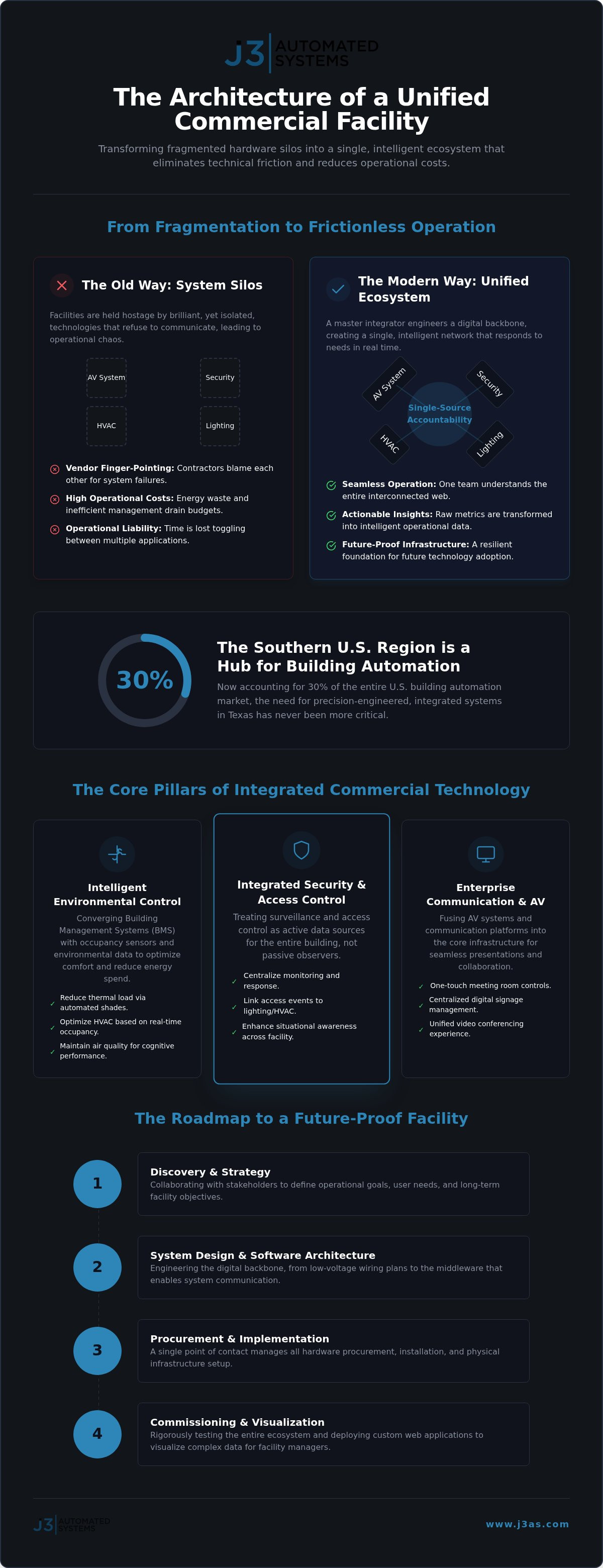
The most sophisticated commercial environments are often held hostage by a collection of brilliant, yet isolated, technologies that refuse to speak the same language. For many facility managers, the promise of a smart building has devolved into a daily struggle with system ghosts and the logistical burden of coordinating a dozen different vendors. True commercial systems integration Texas requires more than just installing hardware; it demands a master-level engineering discipline that bridges the gap between physical space and digital intelligence. With the Southern region now accounting for 30% of the U.S. building automation market, the need for precision in these complex environments has never been more critical.
You likely understand the exhaustion of managing separate platforms for AV, security, and HVAC, only to find that your operational costs remain stubbornly high. This article explores how a single, accountable partner can unify these disparate threads into a frictionless ecosystem. We'll examine the shift toward AI-driven optimization, the impact of Texas-specific data privacy regulations, and the methodology behind building a future-proof infrastructure that transforms your facility from a collection of parts into a responsive, intelligent asset.
Key Takeaways
- Understand the transition from fragmented hardware silos to unified ecosystems that synchronize physical environments with digital intelligence.
- Discover how professional commercial systems integration Texas eliminates technical friction by providing a single point of accountability for design, procurement, and commissioning.
- Learn the engineering methods used to converge Building Management Systems with environmental controls to actively reduce thermal loads and energy spend.
- Follow a structured roadmap from discovery to software architecture to ensure your facility infrastructure remains resilient and future-proof.
- Explore the role of custom web applications in visualizing complex building data, transforming raw metrics into actionable operational insights.
Beyond the Silos: Defining Modern Commercial Systems Integration
Modern facilities in the Lone Star State are evolving beyond simple automation. In the past, "connected" meant a device merely had an IP address; today, it means that device is a conscious participant in a larger operational narrative. This shift toward a unified ecosystem is the hallmark of professional System Integration. It's the deliberate synchronization of disparate hardware and software into a single, intelligent network that responds to human needs in real time. For 2026 commercial properties, the goal isn't just connectivity. It's the total elimination of technical friction.
The Fragmentation Problem in Texas Facilities
Managing a facility along the San Antonio to Austin corridor often feels like conducting an orchestra where every musician is playing a different score. When your HVAC, lighting, security, and AV systems exist in silos, your operational overhead balloons. You don't just lose money on energy; you lose time. Every moment spent toggling between five different applications is an operational liability. This fragmentation leads to vendor finger-pointing, where the security contractor blames the network provider for a camera lag, while the HVAC team claims the building management system is at fault. These technical ghosts don't just frustrate managers. They erode tenant satisfaction and dampen employee productivity by creating environments that are reactive rather than intuitive. In the high-stakes environment of commercial systems integration Texas, these inefficiencies are no longer acceptable.
The Architecture of a Unified Ecosystem
The solution lies in the construction of a robust Digital Backbone. This begins with the physical layer: resilient networking and high-performance low-voltage wiring. Without this foundation, even the most advanced AI workflows will stumble. Once the physical layer is secure, software middleware acts as a bridge, translating various protocols into a "single pane of glass" for facility management. Systems integration is the engineering of harmony between physical space and digital logic. By consolidating these functions, commercial systems integration Texas transforms a building from a series of isolated components into a fluid, responsive asset. This architecture allows for a single point of accountability, ensuring that when a system requires adjustment, there's one team that understands the entire interconnected web. This holistic approach ensures that your infrastructure is as intelligent as the business it houses.
The Core Pillars of Integrated Commercial Technology
High-performance buildings rely on a trio of foundational pillars: environmental control, intelligent security, and enterprise communication. While these were once managed through disparate panels, modern commercial systems integration Texas fuses them into a single, cohesive nervous system. This orchestration ensures that every watt of power and every byte of data serves a specific operational purpose, moving the facility from a state of manual effort to one of intelligent, effortless operation.
Intelligent HVAC and Environmental Automation
Climate control in the South is a matter of both comfort and fiscal responsibility. By converging Building Management Systems (BMS) with occupancy sensors, facilities move beyond the limitations of static schedules. Sophisticated Building Controls allow the infrastructure to anticipate needs, cooling high-traffic boardrooms before a meeting begins and drifting into energy-saving modes when zones are vacant. In the intense Texas heat, the synergy between automated shades and HVAC systems is vital. Intelligent shades track the sun’s position to mitigate solar gain, significantly reducing the thermal load and preventing the cooling system from overworking. Integrating air quality sensors further elevates the environment, ensuring carbon dioxide and humidity levels remain optimal for cognitive performance and long-term health.
Integrated Security and Access Control
Security is no longer a passive observer. Modern commercial security system design Texas treats surveillance and access control as active data sources for the entire building. When an employee scans a biometric reader, the system doesn't just unlock a door; it can simultaneously disarm the alarm, activate the lighting path, and adjust the local climate. This level of automation removes the burden from the end-user while ensuring the facility remains secure and efficient. AI-enhanced threat detection now lives in the cloud, providing real-time alerts that distinguish between routine movement and genuine anomalies, allowing for a proactive response rather than a reactive investigation.
Enterprise-grade AV rounds out this ecosystem by transforming common areas and boardrooms into high-fidelity communication hubs. These systems must be as resilient as the networking that supports them, offering one-touch control that eliminates technical friction during critical presentations. Achieving this level of harmony requires a partner who understands the hidden connections between physical hardware and digital workflows. If you're ready to move beyond fragmented utilities, exploring a unified automation strategy can redefine your operational efficiency and future-proof your infrastructure.
The Master Integrator: Single-Source Accountability vs. Vendor Chaos
The traditional approach to facility technology often results in a fragmented mosaic of hardware. In this outdated model, a business might hire five separate contractors: one for security, another for AV, a third for HVAC, and additional specialists for networking and lighting. This siloed strategy creates a culture of vendor chaos, where disparate systems are forced to coexist without ever truly communicating. When a failure occurs, the result is inevitably a cycle of finger-pointing that leaves the facility manager caught in the middle. Choosing a master integrator shifts this dynamic entirely, replacing a collection of vendors with a single, visionary partner who takes total responsibility for the project lifecycle.
J3 Automated Systems operates as a deep-thinking consultant rather than a mere equipment vendor. We see the hidden connections between your digital workflows and your physical environment, ensuring that every piece of technology is a deliberate component of a unified roadmap. In the competitive landscape of commercial systems integration Texas, this level of technical authority is what separates a functional building from an exceptional one. By centralizing design, procurement, and commissioning, we provide a calm reliability that allows you to focus on your core business while we manage the technical complexity.
Eliminating the 'Complexity Tax'
Hiring multiple specialists doesn't just increase management time; it creates a "complexity tax" through redundant hardware and overlapping labor costs. Each independent contractor installs their own proprietary sensors, cabling, and controllers, leading to a crowded infrastructure that's difficult to maintain. A unified engineering phase for commercial building management systems Texas eliminates these redundancies. As research into AI-Optimized Building Controls suggests, the future of efficiency lies in systems that learn and adapt collectively rather than in isolation. By streamlining the engineering process, we reduce initial capital expenditure and lower long-term operational overhead, providing a single point of contact for all future support needs.
Seamless Commissioning and Tuning
It's vital to recognize that "installing" a system isn't the same as "integrating" one. Physical installation is merely the placement of hardware; integration is the meticulous calibration of that hardware to match your specific business logic. Our white-glove approach to commissioning ensures that every software trigger and physical component is perfectly tuned before the hand-off. We don't just hand you a manual and walk away. We provide comprehensive staff training that empowers your team to utilize the full potential of your new ecosystem. This methodical transition ensures that the sophisticated technology we've engineered feels intuitive and effortless from day one, removing the burden of technical friction from your daily operations.
The Integration Roadmap: Engineering Your Facility’s Future
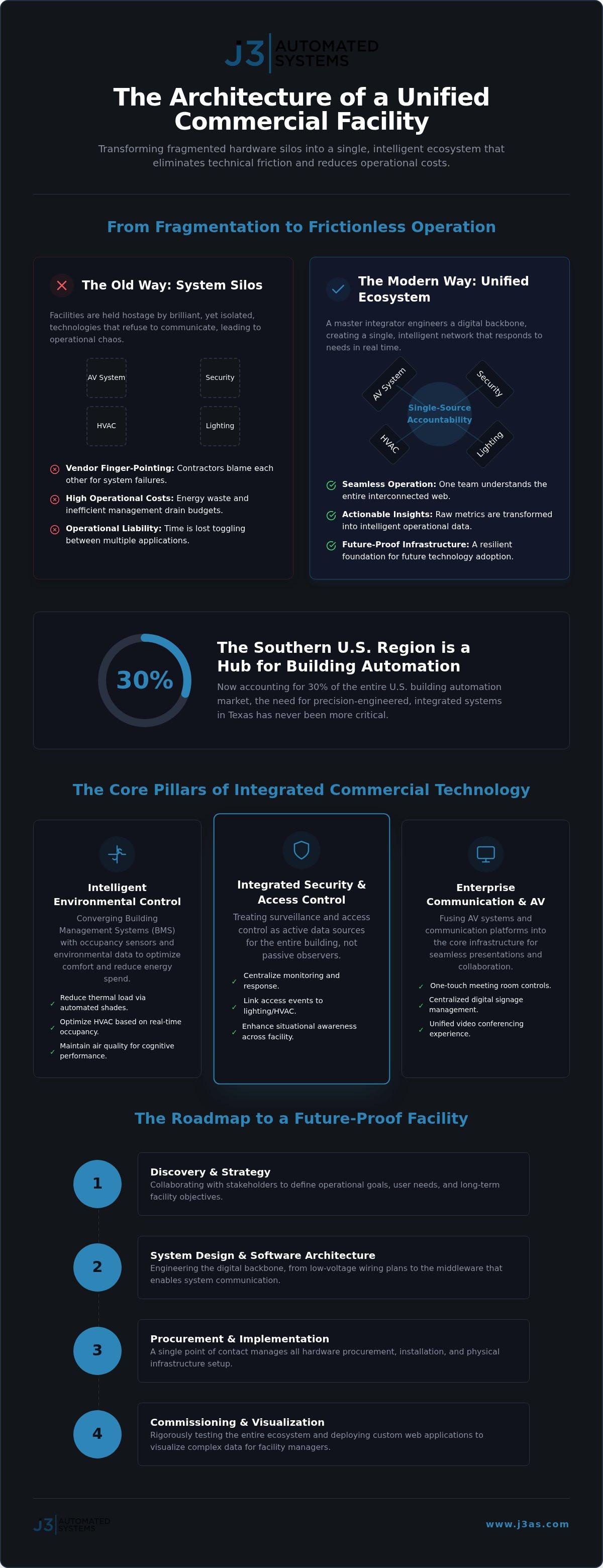
A sophisticated facility is the result of meticulous planning rather than accidental assembly. Transitioning from a fragmented environment to a unified ecosystem requires a methodical, five-phase journey that prioritizes long-term functionality over quick fixes. This roadmap ensures that every investment in commercial systems integration Texas serves a clear operational purpose, moving through discovery, engineering, procurement, software deployment, and final commissioning. By following this structured progression, businesses can eliminate technical friction and build an infrastructure that is both resilient and adaptable.
Discovery: Mapping the Human Element
The engineering process begins by looking past the hardware to understand the people who inhabit the space. During the discovery phase, we identify how staff and tenants actually interact with their environment, mapping out the specific workflows that drive daily operations. This isn't a surface-level survey; it's a deep dive into defining key performance indicators for energy savings, security response times, and AV uptime. We align every technological choice with your brand’s aesthetic and operational identity, ensuring the final result feels like a natural extension of your business. This phase transforms abstract goals into a concrete technical brief, preventing the "scope creep" that often plagues unmanaged projects.
Engineering the Digital Backbone
Once the human requirements are clear, we design the physical and logical architecture. We apply the same rigorous standards found in high performance residential networking to commercial scales, creating a robust Digital Backbone capable of handling massive data loads without latency. This architecture is built for scalability, ensuring that as your business grows, your systems can expand without requiring a total overhaul. We integrate ai business process automation to bridge the gap between raw building data and administrative tasks, allowing the facility to handle routine adjustments autonomously. This engineering phase is where physical space meets digital logic, creating the foundation for a truly intelligent network.
The final phases of the roadmap focus on white-glove implementation and software tuning. Our team manages hardware procurement and installation with surgical precision, ensuring that the physical components are perfectly calibrated to the custom software environment. During commissioning, we verify every trigger and automation sequence, providing continuous support to ensure the system remains optimized. This holistic approach to commercial systems integration Texas removes the burden of technical management from your shoulders, delivering a finished product that operates with quiet brilliance. If you're ready to define your facility's future, contact J3 Automated Systems to begin your discovery phase today.
Future-Proofing Texas Properties with J3 Automated Systems
The transition from a "dumb" building to an intelligent asset represents a fundamental shift in how property owners perceive long-term value. Rather than viewing technology as an additive expense, visionary leaders recognize it as the core driver of operational excellence and property appreciation. As the premier partner for commercial systems integration Texas, J3 Automated Systems specializes in this transformation across the San Antonio and Austin corridor. We move beyond basic connectivity to engineer environments that sense, learn, and act autonomously. By integrating AI to automate repetitive administrative tasks based on real-time occupancy data, we allow your staff to focus on high-value work while the building manages its own operational footprint.
Bespoke Solutions for San Antonio and Austin
Operating in Central Texas presents unique environmental and economic challenges that off-the-shelf solutions often fail to address. Our intelligent HVAC automation is engineered specifically to combat the intense heat and humidity of the region, ensuring consistent comfort without the energy spikes common in legacy systems. For the burgeoning tech and professional services sectors in Austin and San Antonio, we tailor enterprise AV environments that support global collaboration with zero technical friction. J3's local Texas expertise serves as the essential bridge between global technology standards and regional operational requirements. This localized approach ensures that your infrastructure is compliant with Texas-specific building codes while remaining resilient against the specific climate stressors of the South.
The Digital Transformation Advantage
True future-proofing requires a departure from reactive maintenance in favor of a proactive, data-driven methodology. Through custom web app development San Antonio, we provide the tools necessary to visualize and control complex building data through a single, intuitive interface. This digital transformation allows facility managers to identify abnormal patterns in energy use or equipment behavior before they lead to costly failures, significantly extending the lifecycle of your physical infrastructure. This shift creates a unique competitive advantage, reducing operational overhead while increasing the long-term marketability of the property to high-tier tenants.
Engineering a unified ecosystem is a commitment to precision and long-term functionality. It's the removal of technical burden and the creation of a harmonious environment that supports your specific business goals. When you're ready to move past the chaos of fragmented systems and vendor finger-pointing, our team is here to lead the way. Partner with J3 Automated Systems to engineer your unified commercial roadmap and secure your facility's place in the future of intelligent architecture.
Architecting an Intelligent Future for Texas Business
Transitioning from fragmented hardware to a unified ecosystem isn't just about technical upgrades; it's about reclaiming operational control. By moving beyond vendor silos and embracing a single point of accountability, facilities along the San Antonio to Austin corridor can finally achieve the frictionless performance that modern business demands. Professional commercial systems integration Texas ensures that your infrastructure is as responsive as it is resilient, bridging the gap between physical space and digital logic. This shift transforms a building from a collection of parts into a strategic asset that enhances productivity and reduces overhead.
J3 Automated Systems delivers this transformation through end-to-end engineering that spans from low-voltage foundations to sophisticated AI workflows. We specialize in high-end Texas commercial and residential properties, offering a single accountable team for both design and installation. This holistic approach removes the technical burden from your shoulders, leaving you with an intelligent environment that operates with quiet brilliance. Schedule a Consultation with the Master Integrators at J3 Automated Systems to begin engineering your unified roadmap. Your facility's future starts here.
Frequently Asked Questions
What is the difference between a building management system (BMS) and systems integration?
A Building Management System (BMS) typically focuses on the automated control of mechanical and electrical utilities, such as HVAC and lighting. Integration is the broader engineering discipline that unifies the BMS with security, AV, and resilient networking. While a BMS acts as a utility controller, commercial systems integration Texas creates a single digital nervous system. This holistic approach ensures every system communicates through a common language, removing the technical friction of isolated platforms.
Can you integrate existing legacy hardware into a new unified system?
Existing legacy hardware can often be integrated into a unified network through software middleware and custom API development. We begin by auditing your current infrastructure to determine which components remain resilient and which represent an operational liability. By bridging older hardware with modern digital logic, we extend the lifecycle of your current assets while preparing the facility for future technological shifts. This prevents the need for a total "rip and replace" strategy during the initial upgrade.
How much can commercial systems integration reduce energy costs in Texas?
Integrated automation can reduce commercial energy expenditure by 15% to 30% depending on the facility's baseline efficiency. In the intense Texas climate, the synergy between automated shades and HVAC controls is particularly effective. By tracking the sun's position and adjusting thermal barriers in real time, the system prevents solar gain before it taxes the cooling infrastructure. These automated adjustments, informed by occupancy sensors, ensure you never pay for climate control in vacant zones.
Why is a master integrator better than hiring multiple specialized contractors?
A master integrator provides a single point of accountability for the entire technology lifecycle, from initial design to final commissioning. Hiring multiple contractors often leads to redundant hardware and a culture of finger-pointing when systems fail to communicate. Our unified engineering phase ensures that your security, AV, and environmental controls are designed as a single ecosystem. This eliminates the "complexity tax" of overlapping labor and provides a streamlined support path for your facility team.
Does systems integration include custom software or AI business tools?
Professional systems integration frequently includes custom web applications and AI business tools to bridge the gap between building data and administrative tasks. J3 Automated Systems develops bespoke tools that visualize facility metrics, allowing managers to move from reactive repairs to proactive maintenance. We also integrate AI workflows that automate repetitive tasks, such as generating occupancy reports or adjusting climate schedules based on historical meeting data, transforming your building into a truly intelligent asset.
What cities in Texas does J3 Automated Systems serve for commercial projects?
J3 Automated Systems provides comprehensive integration services across the Central Texas corridor. We serve clients in San Antonio, Austin, New Braunfels, and San Marcos, as well as the surrounding communities of Seguin, Bandera, and Boerne. Our local presence allows us to offer high-touch, white-glove support and a deep understanding of regional building codes. This geographic focus ensures that our engineering solutions are tailored to the specific climate and operational needs of Texas businesses.
What is the typical timeline for a commercial integration project?
The timeline for a commercial systems integration Texas project varies based on the facility's scale and the complexity of the digital architecture. A typical lifecycle moves through distinct phases: discovery and process mapping, system engineering, hardware procurement, and final commissioning. While smaller retrofits may conclude in a few months, large-scale new constructions or total digital transformations often span six months to a year. We provide a detailed roadmap during discovery to ensure every milestone aligns with your operational goals.
How does integrated technology improve the security of a commercial facility?
Integrated technology elevates security from a passive observer to an active, responsive participant in facility management. When an access control event occurs, the system can automatically trigger lighting paths, orient surveillance cameras, and alert the appropriate personnel through a unified dashboard. By combining biometric access with AI-enhanced threat detection, we provide a proactive defense that distinguishes between routine activity and genuine anomalies. This orchestration removes the burden of manual monitoring while significantly improving response times.