Custom AI Tools for SMB: Engineering Bespoke Intelligence into Modern Workflows

If 89% of small businesses are now utilizing artificial intelligence, why does it feel like your team is working harder just to manage the tools meant to save them time? Most leaders feel the weight of SaaS fatigue, watching subscription costs climb while their proprietary data remains trapped in disconnected silos. You've likely realized that generic AI responses often lack the necessary business context, creating a layer of manual friction rather than removing it. Investing in custom ai tools for smb isn't just about adding a new feature; it's about reclaiming ownership of your data and engineering a unified system that understands your specific operational DNA.
In this article, we'll examine how bespoke intelligence provides a sustainable competitive advantage by eliminating the limitations of off-the-shelf software. You'll discover how a structured, integrated approach can achieve an average ROI of 3.7x while significantly reducing the burden of administrative labor. We will bridge the gap between fragmented digital processes and a state of intelligent, effortless operation, providing a clear roadmap for your business's automation journey.
Key Takeaways
- Recognize the limitations of the "SaaS ceiling" and how custom ai tools for smb offer a proprietary advantage by aligning technology with your specific business logic.
- Distinguish between generic automation and Intelligent Process Automation (IPA) to remove manual friction from your administrative and forecasting workflows.
- Assess the long-term financial benefits of shifting from high-cost subscriptions to an ownership model that offers superior flexibility and architectural control.
- Examine real-world applications in the Texas corridor, from automated project estimation in construction to intelligent document classification for professional firms.
- Master the roadmap for a friction-less implementation, beginning with meticulous process mapping and ending with a resilient, engineered data foundation.
The Shift from SaaS to Bespoke: Why Custom AI Tools for SMB are Essential in 2026
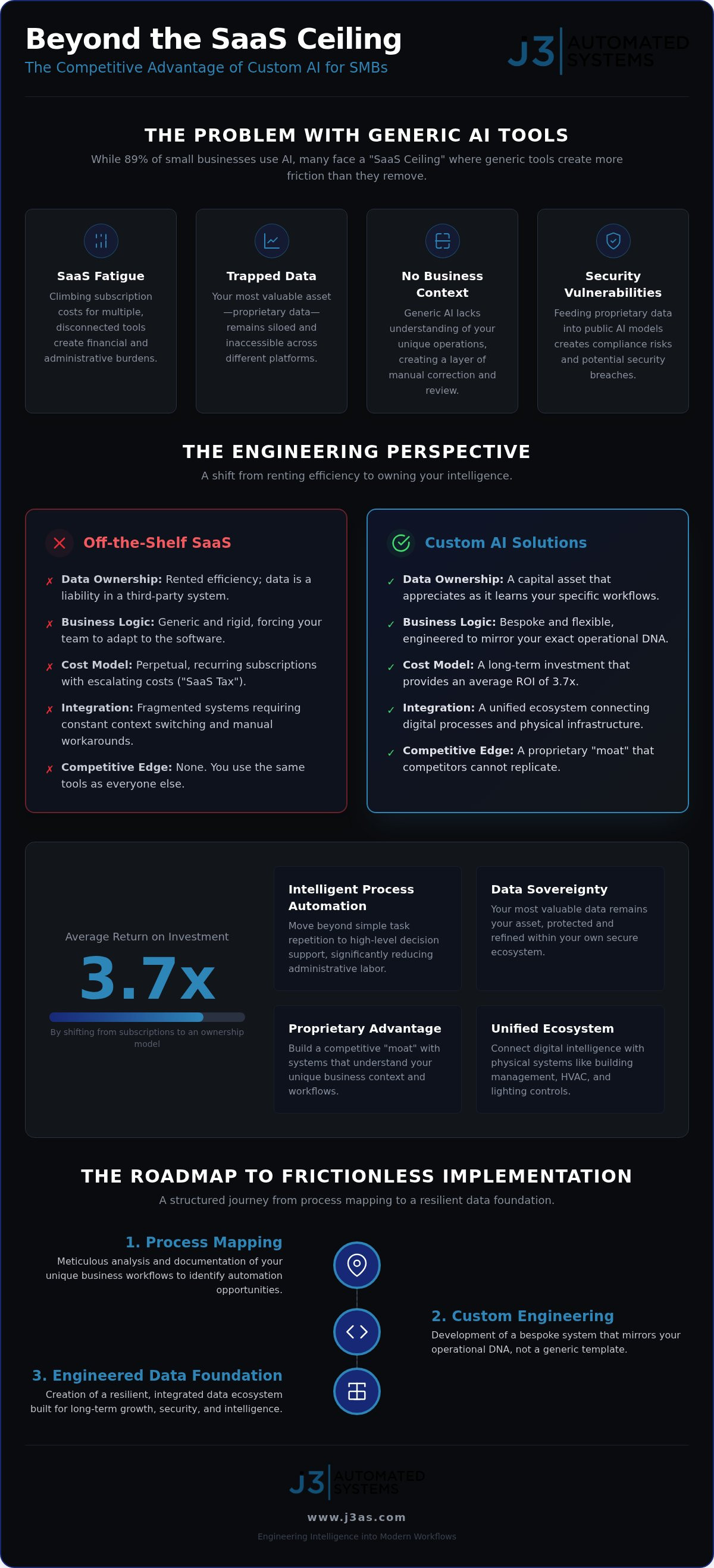
The era of the generic AI subscription is reaching a point of diminishing returns. While off-the-shelf software provided an accessible entry point, many Texas businesses are now hitting the "SaaS ceiling." This is the point where generic tools no longer adapt to your unique operational logic, forcing your team to work around the software rather than with it. Engineering custom ai tools for smb represents a pivot toward proprietary intelligence. These are not merely wrappers for existing models; they are engineered systems designed to own your business context and data. By integrating AI into your core stack, you facilitate Intelligent Process Automation, which goes beyond simple task repetition to provide high-level decision support.
Ownership is the primary differentiator in a competitive market. When you rely on third-party platforms, you're essentially renting your efficiency. Developing custom ai tools for smb ensures that your training data remains your most valuable asset, protected and refined within your own ecosystem. This data sovereignty allows you to build a "moat" around your operations that competitors using generic tools simply cannot replicate. It transforms AI from a monthly expense into a capital asset that appreciates as it learns your specific workflows.
The Hidden Costs of Generic AI Subscriptions
The cumulative "SaaS tax" is often obscured by low monthly entry points. Over a five-year period, the costs of multiple disconnected subscriptions can far exceed the investment required for a bespoke solution. Beyond the financial ledger, there's a significant productivity drain caused by context switching. When employees must jump between five different AI apps to complete a single project, the mental friction erodes the very efficiency the tools were supposed to provide. Security remains the most pressing concern; feeding proprietary data into public AI models creates vulnerabilities that many firms can't afford to risk, especially as data privacy regulations become more stringent.
Bridging the Gap Between Digital and Physical Automation
A truly intelligent business doesn't stop at the edge of the screen. Custom AI tools can be engineered to interact directly with physical environments, such as commercial building management systems or automated lighting and HVAC controls. This holistic approach ensures that your digital intelligence and physical infrastructure work in harmony. As discussed in our AI Business Process Automation pillar, the ultimate goal is a unified ecosystem. J3 acts as the single accountable team in this journey, mapping your business processes to create a roadmap that spans from software code to the hardware in your facility. This high-touch, white-glove service ensures that every integration is purposeful, resilient, and built for the long term.
Core Categories of Custom AI Solutions for Small and Mid-Sized Businesses
Developing custom ai tools for smb requires a shift from viewing software as a utility to viewing it as a strategic asset. While generic platforms offer a one-size-fits-all approach, bespoke solutions are engineered to mirror the exact logic of your unique operation. Intelligent Process Automation (IPA) serves as the connective tissue between disparate administrative tasks, ensuring that data flows without manual intervention. For firms dealing with high volumes of documentation, proprietary Natural Language Processing (NLP) models provide the ability to analyze specialized documents with a level of accuracy that off-the-shelf tools cannot match. These systems go beyond simple keyword matching; they understand the context and intent behind your specific business language.
The implementation of custom ai tools for smb also allows for predictive analytics that move beyond historical reporting to offer proactive insights. Whether you're managing inventory for a regional distribution center or forecasting demand for a professional services firm, these tools provide a clear ROI by reducing waste and optimizing resource allocation. To ensure these systems remain secure and trustworthy, J3 aligns every project with the NIST AI Risk Management Framework. This rigorous approach provides a foundation for data integrity that protects your most valuable proprietary information while enabling seamless growth.
Internal Business Intelligence Dashboards
Static spreadsheets often act as the graveyard of actionable data. By engineering custom web apps in San Antonio, we create real-time, AI-driven visualizations that pull data from fragmented legacy systems. This allows leadership to see the hidden connections between different departments, moving from reactive reporting to proactive strategy. If you're looking to unify your data streams, consulting with a systems integrator can help define the path forward.
Automated Administrative and Reporting Tools
Administrative friction is a silent drain on profitability. We develop custom tools for automated contract review and compliance checking that eliminate hours of manual labor. For field service providers in Central Texas, intelligent scheduling systems can optimize routes and resource allocation in real time. You can automate repetitive administrative tasks using bespoke logic that reflects your specific operational nuances, ensuring that your team remains focused on high-value work.
Custom Development vs. Off-the-Shelf Subscriptions: An Engineering Perspective
Choosing between a subscription model and a bespoke build is a fundamental architectural decision. While the low entry cost of SaaS is seductive, it often leads to a fragmented ecosystem that demands your team adapt to the software's limitations. Engineering custom ai tools for smb shifts this dynamic. It allows the technology to wrap around your existing, proven workflows. From an engineering perspective, this is the difference between renting a prefabricated unit and commissioning a custom-built facility designed for your specific load requirements. You aren't just buying a feature; you're building a foundation.
The Total Cost of Ownership (TCO) for off-the-shelf tools often balloons as you add users and specialized modules. Conversely, a custom solution represents a capital investment in a proprietary asset. This shift is particularly relevant when considering the intersection of AI and Fintech for Small Business, where the ability to control your data and financial logic provides a distinct edge. By building natively rather than relying on brittle API-based connections, you ensure that your systems remain resilient as your San Antonio or Austin enterprise scales. Native functionality eliminates the "duct tape" approach of linking disparate apps, resulting in a more stable and high-performance environment.
When to Buy: The Case for Off-the-Shelf Tools
Commodity tasks don't always require a custom-engineered solution. If a process doesn't provide a competitive advantage or involve proprietary logic, generic tools are often the most pragmatic choice. Standard communication platforms like Slack or Teams are excellent examples of where the market has already perfected the interface. These tools can also serve as effective environments for rapid prototyping. You can test a concept with a generic AI assistant before committing to the deeper engineering required for custom ai tools for smb that handle your core business functions.
When to Build: The Case for Bespoke Engineering
You should build when the process in question defines your brand's unique value. If your workflow involves complex integration challenges that simple "Zapier-style" connections can't handle, bespoke engineering is the only way to maintain system integrity. This approach provides a white-glove user experience for both your employees and your clients, removing the friction of awkward software workarounds. A custom-built AI doesn't just process data; it acts as a dedicated steward of your business's specific operational philosophy, ensuring that every automated interaction feels intentional and polished.
Practical Examples: Custom AI Tools for Texas-Based SMBs
The true value of engineering resides in its application to specific, real-world challenges. Within the high-growth San Antonio-Austin corridor, businesses are moving beyond generic assistants to implement custom ai tools for smb that address the unique pressures of the Texas market. These solutions aren't just software upgrades; they're architectural shifts that allow a firm to scale without a linear increase in headcount. For multi-location hospitality and retail groups, this means deploying intelligent inventory systems that predict demand across different zip codes, accounting for local events and seasonal shifts. In the healthcare sector, private practices are utilizing bespoke triage automation to manage patient intake, ensuring that urgent cases are identified immediately while reducing the administrative burden on front-desk staff.
Professional services, including accounting and legal firms, find significant relief through document classification systems. These tools are trained on the firm's own historical records to identify, tag, and file complex paperwork with precision. Unlike public models, these proprietary systems maintain strict data silos, ensuring that sensitive client information never leaves the controlled environment. By removing the manual friction of data entry and filing, these organizations can pivot their most expensive talent toward high-level strategy and client relations. If you're ready to see how these systems can be integrated into your specific facility, contact J3 Automated Systems to begin your discovery phase.
Example: Intelligent Estimating for San Antonio Contractors
Precision is the difference between a profitable project and a loss in the construction industry. We engineer custom AI models that analyze a contractor's historical project data to predict future material costs with remarkable accuracy. These systems don't operate in a vacuum; they integrate real-time weather data and local labor trends into every bid calculation. By automating the "take-off" process, contractors report reducing the time spent on manual estimation by as much as 70%. This allows leadership to submit more bids in less time, securing a sustainable competitive advantage in a crowded market.
Example: Automated Client Onboarding for Austin Law Firms
First impressions in the legal field are often marred by tedious paperwork. We develop custom web apps for Austin law firms that utilize Natural Language Processing to extract critical data from initial intake forms. The system performs automatic conflict checking against existing databases and generates initial engagement letters based on the firm's proprietary templates. This high-touch, white-glove approach ensures that new clients feel prioritized while the firm maintains the highest security standards for sensitive information. It transforms a formerly manual process into a seamless, intelligent workflow that reflects the firm's professional stature.
The Roadmap to Implementation: Engineering Your AI Ecosystem Without Friction
Successful integration of intelligence into a business environment requires more than just code; it demands a methodical project lifecycle. A well-engineered roadmap ensures that every investment in custom ai tools for smb translates into measurable operational gains rather than technical debt. This journey begins with a deep dive into the current state of your organization. We follow a four-phase progression designed to move from conceptual complexity to a state of intelligent, effortless operation.
- Phase 1: Discovery and Process Mapping. We conduct an exhaustive audit of your existing workflows. By utilizing Business Process Mapping, we visualize exactly how data moves through your firm and where manual friction exists.
- Phase 2: Architectural Engineering. Our team establishes a resilient data foundation. This phase involves setting up the secure environments and proprietary data structures required to support your bespoke models.
- Phase 3: Iterative Development. We build the toolset in cycles, allowing for constant User Experience (UX) tuning. This ensures the final interface feels natural to your team and requires minimal retraining.
- Phase 4: System Commissioning. We move the system into production while maintaining rigorous performance monitoring. This white-glove transition ensures that the new intelligence integrates perfectly with your physical and digital infrastructure.
Why Process Mapping Must Precede Tool Selection
Automating a broken process only accelerates failure. Many firms fall into the trap of selecting a software solution before they truly understand the problem they're trying to solve. J3 identifies the highest-impact automation opportunities by first defining clear KPIs for success. Whether the goal is reducing the time spent on manual reporting or improving the accuracy of project bids, we establish these metrics before the first line of code is written. This architectural rigor ensures that your custom ai tools for smb are built on a foundation of logic rather than hype.
Ensuring Seamless Integration with Existing Systems
The most sophisticated AI tool is useless if it exists in a vacuum. J3 acts as the single accountable team for both digital and physical automation, bridging the gap between your web apps and your facility's hardware. This holistic perspective removes the burden from your internal staff, allowing them to embrace AI as a collaborative partner rather than a replacement. We focus on creating a harmony between your legacy software and new bespoke intelligence, ensuring a fluid transition that respects your established culture. If you're ready to move beyond fragmented subscriptions, consult with J3 to engineer your custom AI roadmap and claim your proprietary competitive advantage.
Claiming Your Proprietary Advantage in the Intelligence Era
The transition from generic software to bespoke intelligence is no longer just a technical upgrade; it's a strategic necessity for Texas enterprises looking to secure their future. By investing in custom ai tools for smb, you move beyond the limitations of the SaaS ceiling and reclaim ownership of your operational logic. This shift replaces fragmented manual effort with a state of intelligent, effortless operation, ensuring your proprietary data remains a protected capital asset rather than a monthly subscription expense.
J3 Automated Systems provides the intellectual rigor and technical authority required to navigate this transformation. As a single accountable team for both digital and physical automation, we prioritize bespoke engineering that fosters long-term operational harmony for high-end Texas enterprises. From the initial discovery to the final commissioning of your unified ecosystem, we maintain a white-glove commitment to your business's unique vision. Schedule a Strategic Consultation with J3 Automated Systems today to begin mapping your journey toward a seamless, automated future. Your roadmap to complexity simplified starts here.
Frequently Asked Questions
What is the typical ROI timeframe for a custom AI tool for an SMB?
Return on investment is often realized within the first 12 to 18 months of operation. According to McKinsey (2026), the average ROI for small businesses implementing AI is 3.7x. This return is driven by a combination of direct labor savings and increased operational throughput. Business owners utilizing these intelligent systems report saving an average of 7 hours per week on administrative tasks, allowing leadership to pivot toward higher-value strategic initiatives.
Do I need a large data set to build a custom AI tool for my business?
You don't necessarily require a massive data repository to begin. Modern engineering techniques, such as Retrieval-Augmented Generation, allow us to build custom ai tools for smb using your existing internal documents and databases. We prioritize the quality and structure of your data over sheer volume. This approach ensures the tool provides contextually accurate responses and relevant insights from the first day of commissioning.
How does custom AI protect my business's proprietary data better than ChatGPT?
Custom solutions utilize private API instances and isolated data silos to ensure your information remains under your exclusive control. Unlike public platforms like ChatGPT, which may use your inputs to train their underlying models, a bespoke tool guarantees data sovereignty. This architecture protects your proprietary logic and sensitive client information, ensuring that your most valuable data assets are never exposed to the public domain.
Can custom AI tools integrate with my existing physical building management systems?
Yes, a primary advantage of our integrated approach is the ability to bridge digital intelligence with physical infrastructure. We can engineer custom ai tools for smb that communicate directly with building management systems to optimize HVAC performance, lighting schedules, and energy consumption. This creates a unified ecosystem where your software intelligence actively manages your physical environment to reduce overhead and manual friction.
What is the difference between a custom AI tool and a standard web application?
A standard web application follows fixed logic to execute specific, pre-defined tasks. In contrast, an AI-driven tool utilizes probabilistic reasoning and machine learning to handle nuance and variability. While a standard app might store and display data, a custom AI tool analyzes that data to provide predictive insights, automate complex decision-making, and learn from new information to improve its own performance over time.
Does J3 provide ongoing support and tuning after the initial implementation?
J3 acts as a dedicated steward of your technology, providing comprehensive support and iterative tuning well after the initial implementation. We monitor system performance to ensure your tools adapt as your business logic and market conditions evolve. This ongoing partnership ensures that your automation remains resilient, secure, and continues to deliver a high level of precision throughout its operational lifecycle.
How do I know if my business process is ready for AI automation?
A process is generally ready for automation if it is repetitive, data-heavy, and relies on consistent logic. We identify these opportunities during our initial process mapping phase, looking for bottlenecks where manual labor is currently required to bridge disconnected systems. If your team spends significant time on document classification or data entry, those workflows are prime candidates for bespoke intelligence integration.
What are the most common mistakes SMBs make when implementing AI?
The most frequent error is attempting to automate a broken or inefficient process without first mapping the underlying logic. Businesses also frequently suffer from SaaS fatigue by adding disconnected tools that create data silos rather than a unified system. Finally, failing to define clear KPIs for success can lead to projects that exceed their budget without delivering the expected long-term operational value.