Custom Home Theater Design San Antonio: Engineering the Private Cinema Experience
A true private cinema is an exercise in architectural physics, not an assortment of boxed electronics. When evaluating custom home theater design San Antonio estates demand, you quickly realize that simply assembling flagship components never guarantees reference-grade performance. Without precise acoustic planning, even the finest systems suffer from muffled dialogue, resonant bass bloat, and the frustrating friction of mismatched remotes.
You shouldn't have to compromise your home's interior design or wrestle with complex settings just to enjoy an evening screening. Discover how architectural acoustics, spatial audio calibration, and unified controls transform luxury San Antonio residences into authentic private cinemas. In the sections ahead, we explore the engineering principles, hidden acoustic treatments, and integrated control frameworks required to build an effortless, reference-quality viewing environment.
Key Takeaways
- Distinguish between multi-purpose media rooms and dedicated private cinemas to align room boundaries, noise isolation, and performance goals.
- Discover how proper custom home theater design San Antonio homeowners invest in uses room dimensions and hidden acoustic treatments to eliminate standing waves and muddy bass.
- Avoid common retail pitfalls by specifying matched amplification and speaker sensitivities that preserve reference-level dynamic range without distortion.
- Integrate architectural lighting, motorized shading, and environmental controls into a unified interface for frictionless, one-touch room activation.
- Explore the end-to-end engineering lifecycle required to take a luxury screening space from architectural modeling to precision acoustic calibration.
Defining Custom Home Theater Design: Media Rooms vs. Dedicated Private Cinemas
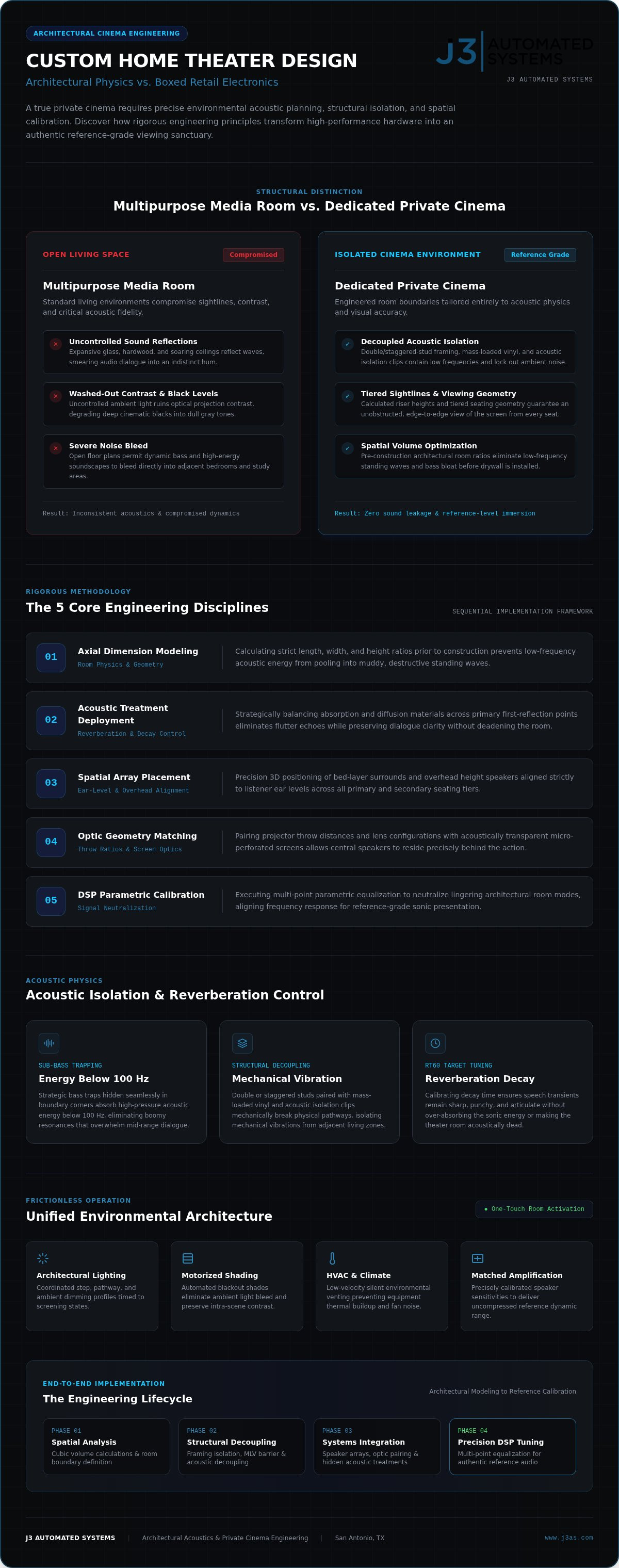
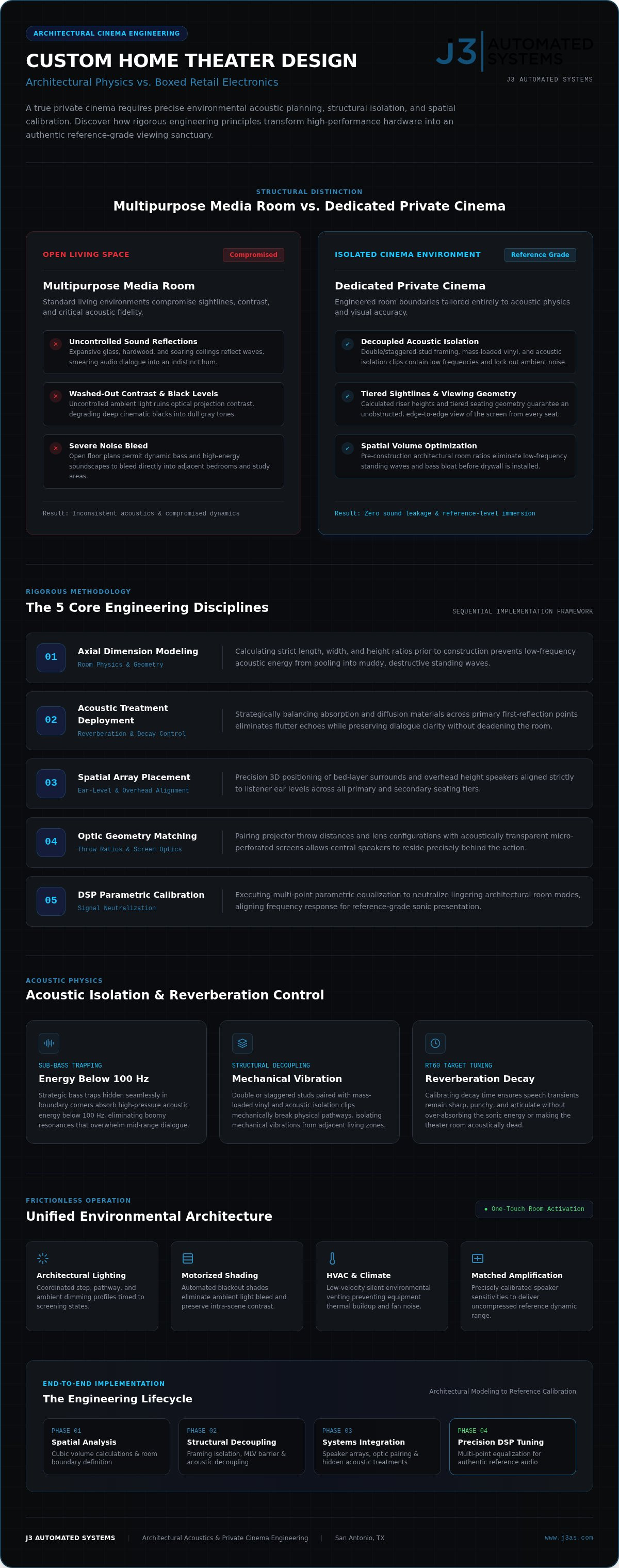
Achieving a true cinematic experience requires understanding the difference between an upgraded living space and an engineered screening room. Many homeowners assume that purchasing premium audiovisual components is enough to replicate the magic of commercial film exhibition. Yet, the foundational environment dictates performance far more than any individual component on a specification sheet. While a standard home theater setup often refers to an open-concept living area with a large display and a soundbar, rigorous custom home theater design San Antonio luxury residences demand starts with architectural physics. Calculating cubic volume, planning room boundaries, and addressing isolation must happen long before selecting speaker brands or display models.
The Limitations of Multipurpose Living Room Entertainment
Open-concept media rooms present severe compromises for critical viewing. Expansive glass windows, hardwood flooring, and soaring ceilings reflect sound waves uncontrollably, smearing audio dialogue into an indistinct hum. Uncontrolled ambient light ruins perceived black levels on projection surfaces, turning rich contrast into washed-out gray tones. Additionally, open floor plans lack sound containment. Bass frequencies and dynamic action sequences inevitably bleed into adjacent bedrooms and study areas, creating household disruption rather than an immersive escape.
Key Characteristics of a Dedicated Private Screening Room
Dedicated screening rooms eliminate these compromises by creating an isolated environment tailored entirely to visual and acoustic fidelity. By controlling every boundary, an engineered private cinema achieves what multipurpose rooms cannot:
- Acoustic Isolation: Double-stud or staggered-stud framing, mass-loaded vinyl, and acoustic isolation clips decouple the cinema from the rest of the residence, containing high-energy low frequencies while keeping out ambient home noise.
- Precise Sightlines: Calculated riser heights and tiered seating geometry ensure every viewer has an unobstructed, ergonomic view of the screen edge-to-edge.
- Spatial Volume Optimization: Architectural room ratios are calculated prior to construction to prevent low-frequency acoustic energy from pooling into muddy standing waves.
Transforming a room into a pristine sanctuary requires viewing the entire space as a unified system. For a deeper look at the foundational architecture behind these environments, examine our guide to cinema grade home theater design. When you invest in bespoke custom home theater design San Antonio properties require, you engineer an authentic escape that respects both structural aesthetics and acoustic reality.
Core Engineering Disciplines: Room Acoustics, Sightlines, and Spatial Audio Calibration
Achieving reference performance requires a structured engineering process rather than an ad-hoc equipment purchase. Retail electronics retailers often focus on receiver wattage, but true immersion is born from acoustic physics, structural alignment, and signal processing. High-caliber custom home theater design San Antonio estates require follows five sequential disciplines:
- Axial Dimension Modeling: Calculating room length, width, and height ratios to prevent destructive low-frequency standing waves.
- Acoustic Treatment Deployment: Balancing absorption and diffusion across first-reflection points to control reverberation decay.
- Spatial Array Placement: Aligning bed-layer and overhead speakers with listener ear levels across all primary seats.
- Optic Geometry Matching: Pairing projector throw distances with acoustically transparent micro-perforated screens.
- DSP Calibration: Tuning multi-point parametric equalization to neutralize architectural room modes.
Acoustic Isolation and Reverberation Control (RT60)
Acoustic treatment controls decay time so speech remains crisp without deadening the room. Balanced room acoustics preserve transient sonic detail while eliminating destructive flutter echoes. Strategic bass traps hidden in boundary corners capture energy below 100 Hz, while decoupled framing isolates mechanical vibrations. Target reverberation time (RT60) between 0.2 and 0.4 seconds guarantees dialogue clarity and tight, impactful bass transients.
Display Geometry and Micro-Perforated Projection Screens
Cinematic viewing demands precise visual ergonomics. Following SMPTE and CEDIA guidelines, viewing angles should span 40 to 45 degrees for genuine immersion. Micro-perforated projection screens allow left, center, and right speakers to hide directly behind the image plane. Matching a 2.39:1 CinemaScope aspect ratio ensures native widescreen presentation while anchoring audio tracks directly to onscreen characters.
Spatial Audio Standards: Dolby Atmos and Immersive Sound Formats
Modern immersive audio tracks rely on object-based metadata to place sonic effects in three-dimensional space. By following official Dolby Atmos installation guidelines, integrators map listener-level bed speakers, overhead height arrays, and balanced subwoofers. In luxury San Antonio properties, deploying four subwoofers across room nodes cancels acoustic nulls, delivering identical, distortion-free low-end impact to every seat. This rigorous spatial engineering complements luxury home audio solutions across an entire estate.
Homeowners ready to elevate their viewing can schedule a system review through J3 Automated Systems to align architectural boundaries with precision acoustic targets.
Engineered Architecture vs. Retail Equipment: Avoiding Common Specification Pitfalls
A collection of high-end consumer electronics does not constitute a cinema system. When homeowners shop retail showrooms, they often assemble hardware based on brand prestige rather than architectural synergy. This retail approach creates systemic friction. An authentic custom home theater design San Antonio estates require approaches the entire technology stack as an interconnected engine. Every amplifier output, digital connection, and thermal exhaust pathway must be mathematically matched before running a single foot of wire.
Consider the electrical relationship between amplification and speaker transducers. Retail audio/video receivers boast high output wattages, yet they frequently collapse when driving complex multi-driver speaker arrays. When an amplifier cannot deliver stable current into low impedance loads, harmonic distortion spikes and dynamic range shrinks. Dialogue flattens during complex film climaxes. Adhering to standards like the CEDIA Immersive Audio Design Recommended Practice ensures power supplies, speaker sensitivities, and listening distances maintain reference sound pressure levels without distortion.
The Pitfalls of Standalone Consumer Electronics Bundles
Off-the-shelf electronics rarely endure the demands of modern media delivery. Long runs of passive HDMI cabling between consoles and projectors cause intermittent handshaking blackouts, audio drops, and HDCP compliance errors. True custom home theater design San Antonio integrators build replaces fragile consumer interconnects with active fiber-optic transport lines capable of continuous 48 Gbps data transfer, ensuring uncompressed 8K video transmission.
Thermal Management and Equipment Rack Infrastructure
Cinema hardware produces tremendous heat. Stuffing commercial-grade amplifiers, media servers, and processors into enclosed millwork without active ventilation guarantees premature component failure. Professional systems depend on disciplined infrastructure:
- Active Thermodynamic Exhaust: Centralized steel equipment racks utilize thermostatically controlled CFM fans to force cool air past heat sinks and expel hot exhaust away from sensitive circuitry.
- Structured Wire Management: Labeled patch bays and decoupled signal wiring prevent electromagnetic interference while speeding up future diagnostics.
- Pure Sine-Wave Power Protection: Enterprise-grade uninterruptible power supplies (UPS) isolate sensitive laser projection light engines and digital signal processors from Texas electrical grid fluctuations and voltage sags.
Engineering these back-end systems ensures your private cinema functions flawlessly for years, operating quietly behind finished acoustic walls without user intervention.
Integrating Environmental Controls: Lighting, Shading, and Dedicated Infrastructure
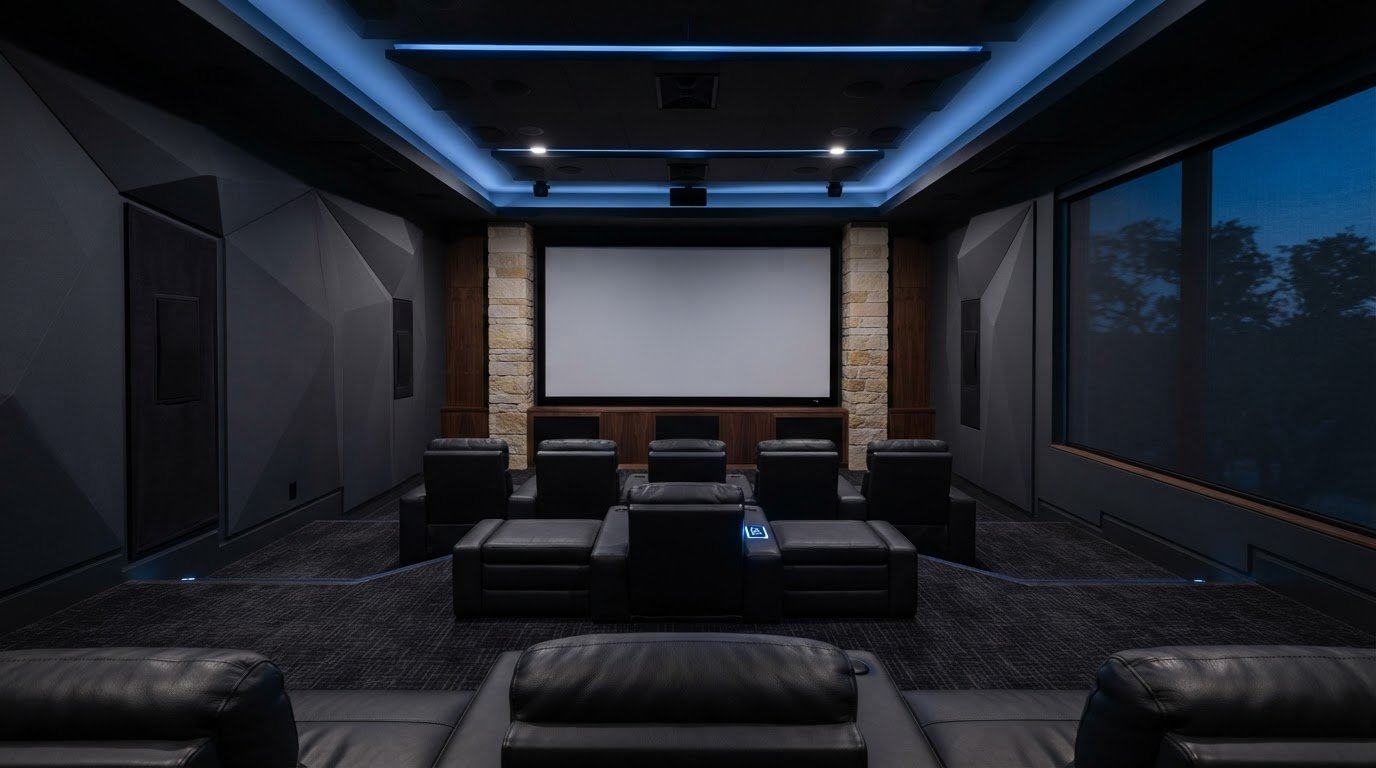
Immersion breaks the moment a stray beam of light hits the screen or an audible hum creeps into the surround speakers. While audio and visual processing form the core of entertainment, environmental control defines the atmosphere. Elite custom home theater design San Antonio estates demand unites automated lighting, motorized blackout shading, and isolated electrical infrastructure into one coordinated ecosystem. When you press play, the architecture responds in unison.
Controlling ambient light requires dual-track engineering. Automated blackout drapery and side-channel motorized shades seal exterior window boundaries, dropping lux levels to absolute black. At the same time, dedicated low-voltage wiring pathways eliminate the operational friction of dealing with separate controls for shades, fixtures, and playback gear.
Architectural Lighting Scenes and Safety Illumination
Cinema lighting is a deliberate visual transition, not an on-off switch. Commercial-grade control platforms use micro-dimming curves down to 0.1% to prevent harsh, abrupt visual shifts. Custom scenes orchestrate the experience automatically:
- Walk-In: Soft sconce illumination and architectural cove lighting welcome guests without casting glare onto the screen.
- Feature Presentation: Overhead loads slowly fade over six seconds as side fixtures soften to black, pulling visual attention entirely into the film.
- Intermission & Safety: Pausing the media raises discrete, low-glare floor step lights and aisle markers to allow safe passage without washing out paused frames.
Isolated Power and High-Performance Networking
Electrical stability remains the hidden backbone of cinema fidelity. High-power multi-channel amplifiers demand dedicated 20-amp circuits isolated from refrigerators, air conditioners, and pool pumps. This dedicated power architecture eliminates 60 Hz ground-loop hums that plague residential AV setups. Similarly, streaming uncompressed 4K and 8K media files requires enterprise data pipelines. Deploying shielded Cat6A and fiber lines guarantees zero buffering during playback, anchoring the room to high-performance residential networking.
When environmental controls and dedicated backbones align, technology fades into the background. For estate owners seeking seamless integration across lighting, acoustics, and automation, consult with the engineers at J3 Automated Systems to build your private cinema infrastructure from the ground up.
The J3 Engineering Lifecycle: From Concept Modeling to Precision Calibration
A reference-grade cinema room is never assembled by chance. It requires a repeatable engineering lifecycle that treats every structural surface, digital path, and acoustic panel as part of an integrated whole. Rather than selling boxed electronics, J3 Automated Systems serves as an accountable technology architect for discerning homeowners across San Antonio and the Texas Hill Country. By executing a rigorous methodology from initial discovery to final tuning, the engineering team eliminates unexpected performance issues before construction begins.
Discovery, 3D Acoustic Modeling, and Interior Coordination
Precision begins long before running wire or ordering hardware. Our systems engineers collaborate directly with interior designers, architects, and custom homebuilders to align technical performance with architectural vision. Using advanced 3D spatial simulations, we model the room's boundary physics to map potential low-frequency standing waves and flutter reflections. Acoustic treatments, bass traps, and speakers are then integrated behind acoustically transparent, custom-stretched fabric systems. This hidden deployment satisfies high-end aesthetic standards while delivering uncompromising acoustic control.
System Commissioning, Tuning, and Unified Interface Control
Physical installation accounts for only half of the cinematic equation. Once components are racked, wired, and powered, comprehensive commissioning brings the room to reference standards:
- Electroacoustic Tuning: We deploy multi-point acoustic measurement microphones across all seating tiers, applying parametric equalization and finite impulse response (FIR) filters to balance sound pressure evenly across every seat.
- Display Profiling: Video projectors and displays undergo scientific calibration, adjusting greyscale tracking to the D65 white point and tuning HDR tone curves for precise shadow detail.
- Unified Room Orchestration: Audio processors, video switchers, motorized shades, and Lutron architectural lighting converge onto a single intuitive touch interface.
Room activation becomes effortless. Selecting a movie lowers the screen, dims the lighting scenes, closes motorized blackout drapes, and powers the audio processors in perfect sequence. When you're ready to bring authentic cinematic performance to your residence, partner with J3 Automated Systems to engineer your private cinema through disciplined, end-to-end custom home theater design San Antonio homeowners rely on.
Architecting Your Bespoke Private Cinema Experience
A transcendent screening room doesn't emerge from haphazard equipment purchases. It comes to life when acoustic modeling, visual ergonomics, and environmental automation function in complete harmony. By replacing component clutter with disciplined physics, you eliminate destructive room reflections, system distortion, and operational friction, unlocking the filmmaker's authentic vision in your own home.
Achieving this level of performance requires single-point accountability across AV, lighting, and enterprise networking. J3 Automated Systems provides end-to-end engineering and calibration tailored specifically for premier San Antonio and Hill Country properties. When every structural surface, digital path, and speaker angle is executed with intention, the custom home theater design San Antonio estates demand becomes an effortless sanctuary for family and guests.
Ready to bring reference-grade cinema into your living space? Schedule a private cinema consultation with J3 Automated Systems today to begin shaping your bespoke private screening environment.
Frequently Asked Questions
What is the ideal room size for a custom home theater in San Antonio?
While dimensions vary based on seating rows, an ideal dedicated cinema room typically measures at least 20 feet long by 15 feet wide with 9- to 10-foot ceilings. These dimensional proportions prevent destructive room modes where low-frequency bass energy clusters. In larger luxury estates across San Antonio and Boerne, proper ceiling height remains essential to accommodate tiered seating platforms and overhead Dolby Atmos speakers without compromising sightlines or head clearance.
How does professional acoustic treatment differ from basic wall paneling?
Basic wood or decorative fabric paneling merely reflects or superficially absorbs high frequencies, leaving bass unchecked. Engineered acoustic treatment utilizes calculated combinations of tuned membrane bass traps, absorptive cores, and quadratic residue diffusers hidden behind architectural fabrics. This targeted deployment controls reverberation across all audible octaves, guaranteeing clear dialogue and tight, tactile bass rather than a hollow or boomy room response.
Can high-end home theaters be integrated into existing Texas Hill Country homes?
Yes, existing residences can readily accommodate reference-grade systems through thoughtful architectural retrofitting. Systems engineers run concealed low-voltage pathways, install decoupled false walls, and utilize room-within-a-room construction methods to isolate noise. For homeowners investing in custom home theater design San Antonio and Hill Country properties present unique limestone and radiant barrier challenges, which precision acoustic modeling solves without compromising existing structural foundations.
Why is an acoustically transparent screen necessary for realistic cinematic dialogue?
Commercial theaters position screen-channel speakers directly behind the film display so dialogue anchors naturally to the actors' lips. In home installations using solid projection screens, center-channel speakers must sit above or below the frame, pulling the listener's brain away from the visual action. Micro-perforated or woven acoustically transparent fabrics let sound pass through freely without high-frequency attenuation, restoring spatial coherence.
How do automated lighting and motorized shades enhance the home theater experience?
Beyond aesthetics, automated controls preserve visual dynamic range. Motorized side-channel blackout shades eliminate external light bleed that washes out deep black levels on projection surfaces. Meanwhile, architectural lighting scenes execute smooth 0.1% dimming transitions, guiding viewers safely to their seats before gracefully darkening the space. Unifying these environmental elements ensures the room prepares itself automatically the moment a movie begins.
What infrastructure should be pre-wired during a luxury home renovation or new build?
Proper rough-in infrastructure includes shielded Cat6A data cabling, OM4 fiber optic links, and dedicated 20-amp electrical circuits homerun to a centralized equipment rack. Integrators also pull heavy-gauge speaker wire in conduit to anticipated speaker and subwoofer locations. Pre-wiring these high-bandwidth pathways during construction guarantees that your custom home theater design San Antonio build remains fully future-proofed for evolving video resolutions.
How does J3 Automated Systems ensure long-term reliability and easy system operation?
J3 Automated Systems engineers centralized AV rack topographies featuring active thermal management and enterprise-grade power conditioning to prevent hardware strain. By unifying audio, video, lighting, and shading into a single intuitive touch interface, complex multi-component systems activate with one touch. Our systems-first approach eliminates remote clutter and fragile consumer cabling, providing premier Texas homeowners with an accountable, long-term entertainment environment.