Custom Software Development for Business Automation: Engineering Your Digital Backbone

Did you know that 60% of employees could reclaim nearly a third of their workweek if their repetitive tasks were automated? For many leaders, this latent potential remains locked behind a wall of disconnected tools and manual data entry. This fragmentation creates persistent administrative friction, limiting your ability to scale and obscuring real-time visibility into your operational performance. Investing in custom software development for business automation isn't just about replacing a spreadsheet. It's about engineering a digital backbone that supports your specific vision with precision.
You likely recognize that your current systems are reaching their structural limits, leaving your team to bridge the gaps with manual effort. This guide demonstrates how bespoke software engineering and AI integration eliminate those bottlenecks to drive high-tier operational efficiency. We will explore the process of transforming fragmented workflows into seamless, proprietary tools that provide a lasting competitive advantage through local, high-touch engineering support.
Key Takeaways
- Identify the invisible financial and psychological drain caused by "swivel-chair" manual data syncing between disconnected software tools.
- Explore how custom software development for business automation bridges the gap between physical environments and digital workflows to create a unified operational backbone.
- Compare the five-year total cost of ownership and pivot flexibility of proprietary engineering against the inherent limitations of off-the-shelf SaaS products.
- Follow a structured four-step roadmap to discover operational friction points and prototype architectural solutions that scale alongside your business.
- Understand the strategic advantage of a single, Texas-based partner capable of integrating AI, internal web tools, and commercial building automation.
The High Cost of Administrative Friction: Why Fragmented Tools Stifle Growth
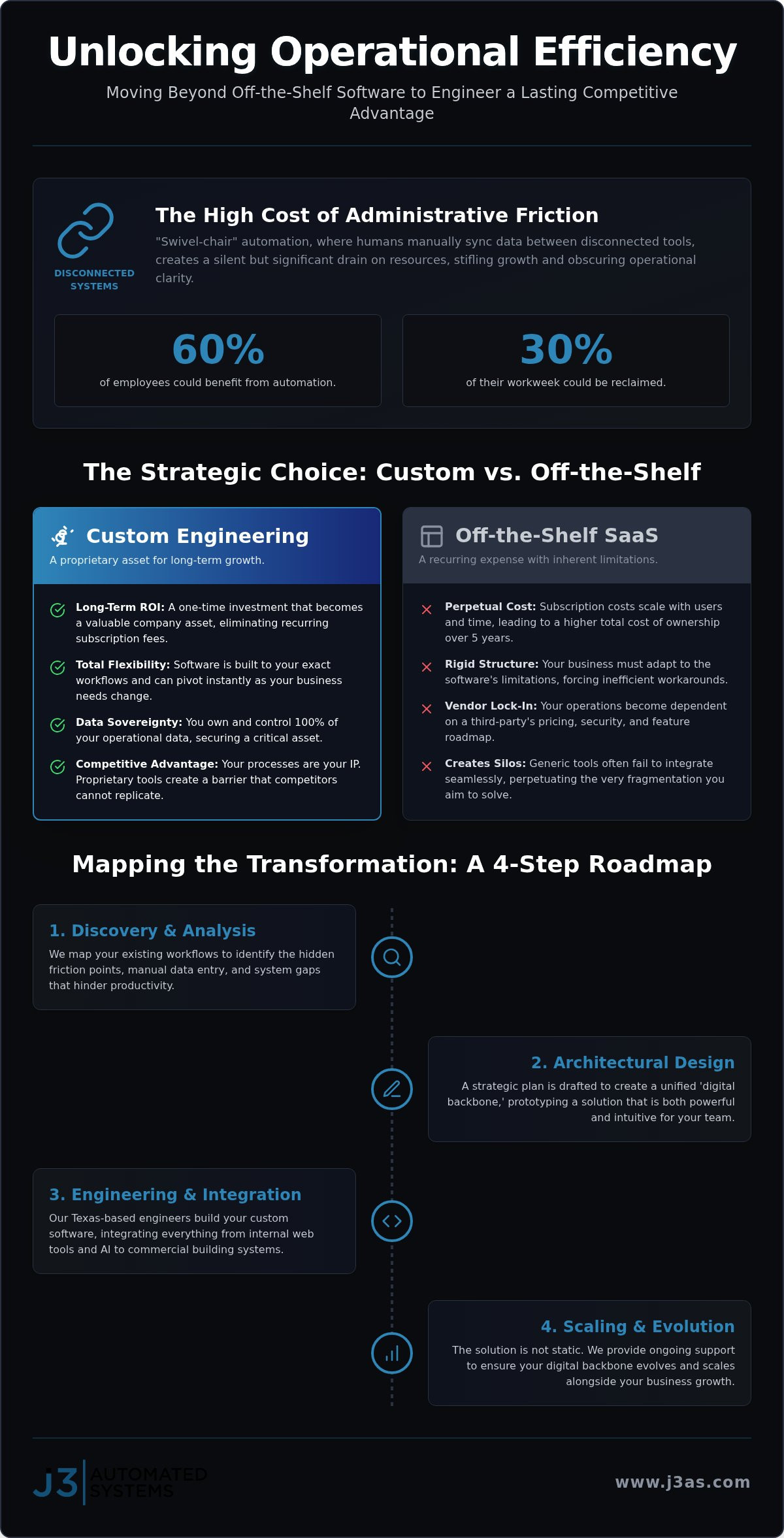
Operational friction often manifests as a quiet, persistent drain on resources. It appears in the moments when a team member manually copies data from a CRM into an accounting tool, or when a project manager spends hours reconciling disparate spreadsheets. This "swivel-chair" automation, where humans serve as the glue between disconnected platforms, represents a failure of systems architecture. Business process automation (BPA) aims to rectify these inefficiencies, yet many organizations find themselves trapped in a cycle of manual intervention that stifles growth and obscures operational clarity. The transition from "doing work" to "managing systems" is the primary lever for scaling a modern enterprise without a linear increase in overhead.
The financial burden is clear, but the psychological cost is equally damaging. When high-skilled personnel are relegated to repetitive data entry, job satisfaction declines and turnover risks increase. Research indicates that approximately 60% of employees could save 30% of their time if their work was automated, highlighting the massive scale of current inefficiency. This fragmentation prevents leadership from seeing the full picture. Without a unified stream of data, making high-level strategic decisions becomes an exercise in guesswork rather than a data-driven certainty.
Recognizing the Ceiling of Off-the-Shelf Software
Standard SaaS products offer a seductive, low-barrier entry point, yet they frequently create more silos than they solve. As a business scales, the cost of monthly subscriptions and the inevitable workarounds required to make generic tools talk to one another can quickly exceed the investment required for custom software development for business automation. Relying on third-party platforms also introduces a layer of risk; you're building your core operations on infrastructure you don't control. For Texas executives, this lack of sovereignty over digital assets can become a significant bottleneck when the market demands a rapid pivot or a unique service model that off-the-shelf tools simply cannot support. Generic platforms often impose technical debt by forcing your unique business logic into a rigid, pre-defined box.
The ROI of Eliminating Operational Friction
True efficiency is found when a business removes the burden of manual syncing. By investing in bespoke engineering, companies reclaim thousands of hours previously lost to administrative drudgery. This reclaimed time allows senior staff to focus on high-value initiatives that actually drive revenue. Beyond the immediate payroll savings, the removal of friction creates a sense of harmony within the workplace. Employees stay longer when their tools work for them, rather than against them. In the context of commercial operations, this shift transforms software from a recurring expense into a proprietary asset that provides a measurable, long-term competitive advantage. It's the difference between renting a tool and owning the engine of your growth.
Engineering the Digital Backbone: How Custom Web Apps Drive Operational Fluidity
A digital backbone isn't a single piece of software. It's a custom-engineered ecosystem that unifies every process within your organization into a single source of truth. While many development firms focus solely on the digital realm, a sophisticated approach recognizes that modern business often bridges the physical and the virtual. For a Texas enterprise, this means integrating commercial building automation systems, like HVAC or lighting, directly into the internal tools that manage staff and logistics. This holistic perspective ensures that your environment and your operations move in perfect harmony. It removes the friction that occurs when physical assets and digital workflows exist in isolation.
Achieving this level of integration requires a "white-glove" philosophy. Before writing a single line of code, deep discovery must take place to map the hidden connections between your departments. This meticulous planning transforms software from a generic tool into a proprietary asset, creating a lasting competitive advantage that off-the-shelf products cannot replicate. By understanding the strategic benefits of automation, leaders can move from simply augmenting human roles to fundamentally re-engineering how work happens. This is the core of custom software development for business automation; it's the creation of a resilient structure that supports your specific vision without compromise.
Bespoke Internal Tools vs. Public-Facing Apps
While public-facing portals are common, the most significant gains often come from tools designed specifically for your internal team. These bespoke applications provide real-time operational visualization through custom dashboards, allowing managers to see bottlenecks before they impact the bottom line. By prioritizing custom web app development San Antonio businesses can ensure their local operations are supported by high-touch engineering that understands the regional market. These tools empower your staff to act with precision, turning manual data entry into a relic of the past and allowing your team to focus on high-value initiatives.
AI Integration: Moving from Reactive to Proactive Operations
The next evolution of the digital backbone involves moving beyond simple scripts to AI business process automation. This isn't about basic chatbots; it's about Agentic AI that autonomously navigates complex administrative tasks within your custom toolset. These intelligent agents can manage scheduling, flag inventory anomalies, or optimize energy usage across a facility. To maintain reliability, we engineer strict "guardrails" that ensure AI operates within your specific business logic. This proactive stance allows your organization to anticipate needs rather than simply reacting to crises. If you're ready to see how these systems can unify your property and your processes, consider partnering with a visionary integrator to map your evolution.
The Strategic Choice: Custom Engineering vs. Off-the-Shelf SaaS
Choosing between a subscription-based model and a proprietary build is a fundamental strategic decision. While off-the-shelf SaaS provides immediate access, it often masks a higher total cost of ownership over a five-year horizon. Subscription fees scale with your headcount, creating a "growth tax" that penalizes success. In contrast, custom software development for business automation represents a capital investment in a permanent asset. You own the code, you own the logic, and you own the data sovereignty that protects your most sensitive operational secrets. This shift from renting a service to owning an engine of growth provides the stability needed for long-term planning.
A "Visionary Integrator" looks beyond the immediate fix. We view software as a living architecture that must evolve as your Texas business pivots to meet new market demands. This approach prioritizes long-term functionality over the quick, brittle patches often found in generic software ecosystems. By building your own digital backbone, you eliminate the risk of a third-party vendor discontinuing a feature or changing their pricing structure without notice. You aren't just buying a tool; you're securing a partnership dedicated to the precise engineering of your operational future.
When to Invest in Custom Software Development
Deciding to build rather than buy is necessary when your operations involve high-volume, repetitive tasks that generic tools simply cannot handle with precision. In the competitive commercial sectors of San Antonio and Austin, niche industry requirements often demand workflows that don't exist in the standard SaaS market. This is particularly true for organizations requiring deep integration with commercial building management systems Texas. When your digital tools must talk to your physical environment, custom engineering is the only way to ensure a seamless, reliable connection that generic platforms can't provide.
The Pitfalls of Low-Code for Enterprise-Grade Systems
Low-code platforms often promise speed, but they frequently deliver performance bottlenecks and rigid scaling limits. These "no-code" architectures are built on generic foundations that can't handle the complexity of enterprise-grade logic. Beyond the technical limitations, there is a hidden platform tax; per-user licensing fees can balloon as your team expands, often making the "cheaper" option the most expensive in the long run. Security also remains a paramount concern. Proprietary business data is safest when housed within a system designed specifically for your security protocols, rather than being stored in a multi-tenant environment where you have limited control over the underlying infrastructure.
Mapping the Transformation: A 4-Step Roadmap for Business Automation
Executing a digital transformation requires more than technical skill; it demands a structured, architectural approach that respects your organization's unique DNA. A successful deployment of custom software development for business automation moves through a deliberate lifecycle, ensuring that every line of code serves a specific operational purpose. This journey begins with deep discovery and concludes with a state of operational harmony where systems work invisibly to support your team. By following a rigorous roadmap, we transform fragmented manual effort into a unified, high-performance engine.
Phase 1: Discovery and Process Mapping
Precision begins with understanding. J3 Automated Systems acts as a single accountable partner to map your business DNA, identifying the hidden connections between your physical environment and digital workflows. We don't start with code; we start by identifying the #1 administrative bottleneck that currently stifles your team's output. This phase is about alignment. We ensure that your software goals directly support long-term commercial growth in the Texas market. By defining the "why" before the "how," we create a blueprint that targets actual friction rather than perceived symptoms.
Phase 2: Engineering and Prototyping
Once the map is finalized, the process moves into Engineering and Prototyping. This is where the architectural blueprint for your digital backbone takes shape. We build a structural framework that accounts for every variable, from data security to user interface fluidity. This stage allows stakeholders to visualize the solution and refine the logic before full-scale development begins, ensuring the final product is both intuitive and resilient.
Phase 3: Seamless Integration with Existing Systems
The most sophisticated tools are useless if they exist in a vacuum. We avoid the "rip and replace" trap through intelligent API engineering, connecting your new custom tools to the technology stack you already rely on. This integration extends beyond the screen. For modern estates and commercial hubs, ensuring that high performance residential networking supports your new digital tools is essential for maintaining low-latency, mission-critical operations. This phase includes white-glove support and training, ensuring that team-wide adoption is as seamless as the software itself.
Phase 4: Commissioning and Support
The final stage, Commissioning and Support, ensures long-term resilience. We don't simply hand over the keys; we provide ongoing stewardship to maintain operational harmony as your business evolves. If you're ready to eliminate administrative friction and engineer a more intelligent future, contact our engineering team to begin your discovery process. This methodical transition ensures that your investment in custom software development for business automation yields a permanent, proprietary asset that scales with your ambition.
J3 Automated Systems: Your Texas Partner for Intelligent Evolution
Proximity breeds accountability. For mission-critical systems, the advantage of a local, Texas-based engineering firm cannot be overstated. J3 Automated Systems serves the vital commercial corridor from San Antonio to Austin, providing the high-touch support that offshore or generic national vendors simply cannot match. When your operational backbone requires precision, having a partner who understands your regional market and can be present for complex integrations is vital. We don't just deliver code; we provide a holistic approach to automation that bridges the physical and digital divide. This regional focus ensures that your business remains resilient in an increasingly competitive landscape.
Our expertise extends well beyond the digital screen. We see the hidden connections between your commercial building automation and your internal web applications. This unified perspective ensures that your physical environment and your digital workflows operate as a single, intelligent organism. By acting as a single accountable partner, we eliminate the friction of managing multiple vendors who often speak different technical languages. You receive one roadmap, one dedicated team, and one integrated result tailored specifically to the structural needs of your enterprise. This commitment to custom software development for business automation transforms your technology from a series of tools into a unified engine of growth.
A Visionary Approach to Custom Software
Moving beyond the role of an equipment vendor, J3 Automated Systems positions itself as a strategic consultant. We craft internal tools that mirror the white-glove service you provide to your own clients, ensuring that your technology reflects the sophistication and precision of your brand. We specialize in simplifying the immense complexity of modern systems, allowing you to focus on high-level leadership while we manage the underlying architecture. This dedicated stewardship ensures that your proprietary assets remain functional and relevant long after the initial deployment. We don't just build systems; we curate an experience of operational harmony for the sophisticated business owner.
Next Steps for Your Automation Journey
The transition toward the "Autonomous Enterprise" is no longer a future concept; in 2026, it's a Texas reality. Businesses that fail to integrate intelligent automation today will find themselves struggling against competitors who have already removed administrative friction through bespoke engineering. Your journey begins with a meticulous discovery session to map your operational roadmap and identify the high-value targets for automation within your current stack. This process uncovers the latent potential within your team by removing the burden of manual effort. Consult with J3 Automated Systems to engineer your digital backbone and secure your place at the forefront of regional innovation.
Architecting Your Operational Legacy
Engineering a digital backbone is the definitive step toward operational harmony. By moving beyond the constraints of generic software, you transform fragmented workflows into a seamless, proprietary engine that scales with your ambition. We've explored how the strategic implementation of custom software development for business automation removes administrative friction, allowing your team to focus on high-value leadership rather than manual data entry. Whether you're integrating AI to manage complex processes or unifying your commercial building systems with bespoke web tools, the result is a resilient asset that provides a lasting competitive advantage.
J3 Automated Systems offers the intellectual rigor and local accountability required for such mission-critical transformations. With deep roots in the San Antonio and Austin commercial automation sectors, our single accountable team provides the bespoke AI and web application expertise needed to bridge the gap between physical environments and digital logic. It's time to replace complexity with clarity and burden with effortless operation. Engineer your business's future with J3 Automated Systems. Your path to a more intelligent, autonomous enterprise begins with a single, well-mapped discovery.
Frequently Asked Questions
What is the difference between custom software and off-the-shelf automation tools?
Custom software is engineered to mirror your specific business logic, whereas off-the-shelf tools force you into pre-defined, generic workflows. Proprietary engineering eliminates the "growth tax" of per-user licensing fees and provides total data sovereignty. In the Texas commercial sector, this distinction often determines whether a system can integrate with physical building automation or if it remains a disconnected digital silo.
How long does custom software development for business automation typically take?
While every project is unique, the development lifecycle usually spans several months, moving from discovery to full commissioning. A typical complex project duration is approximately 13 months, though simpler proof-of-concept tools may be deployed faster. This methodical pace ensures that the resulting digital backbone is resilient, fully integrated, and capable of supporting long-term operational scaling for your specific enterprise needs.
Can custom software integrate with my existing CRM or ERP system?
Yes, intelligent API engineering allows custom tools to connect seamlessly with your existing technology stack. We avoid the "rip and replace" trap by building bridges between your new automation engine and established platforms like Salesforce or NetSuite. This ensures that data flows fluidly across your organization without creating new silos or requiring manual data entry from your staff.
How does AI business process automation actually work for a local Texas company?
AI integration involves deploying Agentic AI that autonomously navigates complex administrative tasks within your custom toolset. For a local firm, this might mean an agent that automatically optimizes HVAC schedules based on occupancy data or flags inventory anomalies in real-time. We engineer strict guardrails to ensure these intelligent systems operate within your specific business logic and security protocols at all times.
Will I own the source code and IP for the custom software J3 develops?
You maintain full ownership of the source code and intellectual property for the tools we engineer. Unlike off-the-shelf SaaS products, where you rent access to logic owned by a third party, our bespoke development creates a permanent proprietary asset. This data sovereignty is a critical component of custom software development for business automation, protecting your unique operational secrets and long-term equity.
What kind of ongoing support is required for bespoke business tools?
Ongoing support involves proactive maintenance, security updates, and performance tuning to ensure long-term resilience. Annual maintenance typically accounts for 15% to 25% of the initial development cost. Because we act as a single accountable partner based in Texas, you receive high-touch support that evolves alongside your business, ensuring your systems remain in a state of constant operational harmony.
Is custom software development worth the investment for a small-to-medium business?
The investment is often justified by the significant ROI found in reclaimed labor hours and increased operational capacity. Companies investing in automation see an average ROI of 240%, with many achieving payback within the first year. For a growing firm in San Antonio or Austin, proprietary tools provide a competitive advantage that generic software cannot match, facilitating scale without a proportional increase in overhead.
How do you ensure the security of proprietary data in custom-developed apps?
Security is engineered into the architectural blueprint through dedicated protocols and private hosting environments. Unlike multi-tenant SaaS platforms where your data shares space with other companies, custom apps provide a controlled environment. We implement rigorous encryption and access controls to protect your business logic, ensuring that your most sensitive operational information remains secure and under your exclusive, local control.