Energy Efficient Building Automation Systems: Engineering Architectural Intelligence in 2026

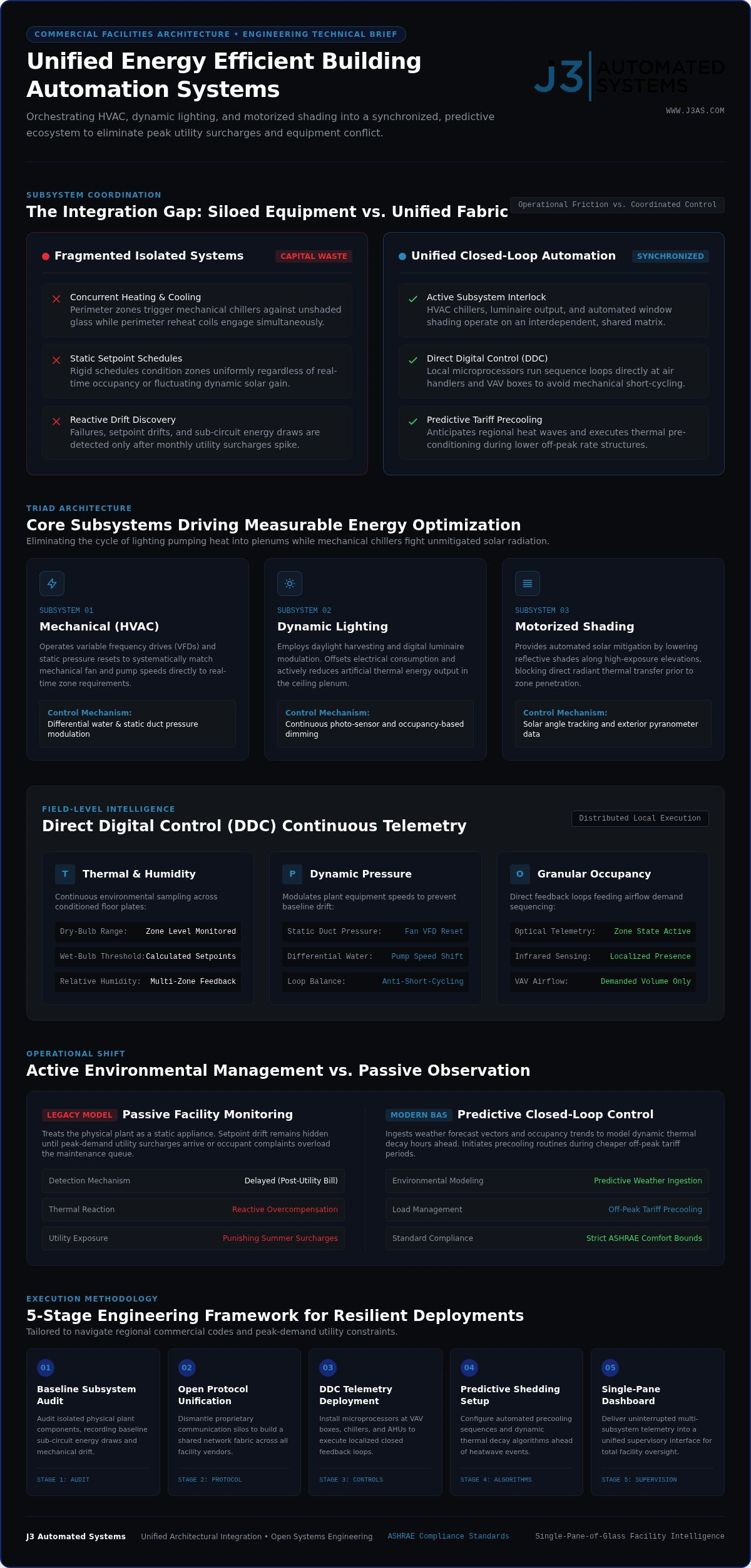
Upgrading to highest-tier mechanical chillers or premium LED fixtures won't protect your operating margins if those assets function in isolated departmental silos. True architectural performance demands unified subsystem orchestration rather than piecemeal equipment replacements. Modern energy efficient building automation systems resolve this operational friction by bridging commercial HVAC, dynamic lighting, and motorized shading into a synchronized, self-regulating ecosystem that actively anticipates environmental load.
Commercial facility directors across Texas know the operational strain all too well. Relentless summer heatwaves trigger punishing peak-demand utility surcharges, while fragmented, proprietary control systems force maintenance teams to spend critical hours manually adjusting wall thermostats without real-time sub-circuit visibility. How do modern facilities curtail this consumption without sacrificing occupant comfort or operational control? Discover how unified building automation transforms energy performance, lowers commercial operating costs, and orchestrates long-term facility resilience. Below, we examine the open protocols, predictive load-shedding strategies, and single-pane-of-glass dashboards engineered for demanding commercial environments in 2026.
Key Takeaways
- Explore how modern energy efficient building automation systems replace rigid, static setpoints with responsive closed-loop environmental controls.
- Discover the compounding operational savings created when commercial HVAC, automated lighting, and motorized shading operate on a shared communication fabric.
- Uncover the hidden capital waste caused by isolated smart devices, multi-vendor communication silos, and competing equipment control loops.
- Learn a structured, five-stage engineering framework tailored to navigate peak-demand utility constraints and evolving regional commercial codes.
- See how single-source architectural integration eliminates operational friction and delivers a unified, single-pane-of-glass facility management platform.
What Defines Modern Energy Efficient Building Automation Systems?
A building is not merely an assembly of steel, glass, and concrete. Viewed through an engineering lens, it is an integrated thermal and mechanical ecosystem. High-performance building automation systems (BAS) serve as the central digital nervous system of this ecosystem, interlinking isolated machinery into a responsive, unified whole. Where traditional facilities rely on static setpoint schedules that push conditioned air regardless of actual occupancy, contemporary installations deploy closed-loop feedback mechanisms that actively read environmental variables and modulate physical plant outputs in real time.
Without this synchronization, facilities hemorrhage capital through concurrent heating and cooling cycles. An uncoordinated mechanical plant frequently conditions an entire floor plate to offset solar gain while simultaneously engaging reheat coils in adjacent perimeter zones. Centralized supervisory software eliminates this friction. By streaming uninterrupted subsystem telemetry to a single interface, operators establish verified operational baselines, track sub-circuit energy draws, and identify mechanical drift long before equipment failure cascades across the utility bill.
Direct Digital Control (DDC) and Environmental Telemetry
Microprocessor-based field controllers form the foundational intelligence of the physical plant. Rather than relying on central processing units to manage granular actions, modern DDC hardware executes localized control sequences directly at air handling units, variable air volume (VAV) boxes, and chillers. These controllers gather continuous telemetry across multiple operational data streams:
- Thermal and humidity metrics: Tracking dry-bulb temperature, wet-bulb thresholds, and relative humidity across multiple zones.
- Dynamic pressure signals: Monitoring static duct pressure and differential water pressures to adjust pump speeds.
- Granular occupancy telemetry: Reading optical and infrared zone states to regulate airflow volume on demand.
These closed feedback loops protect delicate equipment from excessive short-cycling. By maintaining tight control bands, the system optimizes mechanical life spans while systematically reducing thermal baseline loads.
Active Environmental Management vs. Passive Monitoring
Legacy facilities operate passively, treating the physical plant as a fixed appliance. In this outdated model, building managers discover system drift only when peak-demand utility charges spike or when uncomfortable occupants log service tickets. This reactive approach consistently burns excess wattage by overcompensating for localized temperature swings.
Engineering modern energy efficient building automation systems requires shifting from passive observation to active environmental management. Predictive algorithms ingest internal occupancy profiles and external weather forecasts, calculating dynamic thermal decay hours ahead of external heat waves. The supervisory system then initiates automated precooling sequences during lower off-peak tariff periods. Physical environments maintain strict ASHRAE comfort metrics, yet operational waste stays precisely managed and contained.
Core Subsystems Driving Measurable Energy Optimization
Energy conservation in commercial facilities cannot rely on mechanical efficiency alone. Peak performance emerges when mechanical plants, interior illumination, and passive solar mitigation function as an interdependent unit. When these three layers operate in isolation, they constantly counteract one another. A central chiller strains to pull thermal energy out of a perimeter suite while interior luminaires pump continuous heat into the ceiling plenum and unshaded glass floods the floor plate with direct solar radiation. High-performance energy efficient building automation systems unite these assets through a shared operational matrix.
| Subsystem | Primary Control Mechanism | Operational Energy Impact |
|---|---|---|
| Mechanical (HVAC) | Variable frequency drives and static pressure resets | Matches fan and pump kilowatt draw to dynamic thermal loads |
| Architectural Lighting | Continuous daylight harvesting and PIR sensing | Curbs wattage draw and eliminates parasitic internal heat gains |
| Motorized Shading | Astronomic solar tracking and fabric thermal barriers | Rejects peak exterior infrared heat before it penetrates the building envelope |
Dynamic HVAC and Variable Air Volume (VAV) Optimization
Modulating chilled-water valves, variable frequency drives (VFDs), and fan velocities slashes central plant power consumption. Instead of operating supply fans at fixed pressure thresholds, static pressure reset routines continuously poll VAV terminal boxes. If zone dampers remain wide open, the system increases fan speed; as zones reach satisfied states, the automation sequence lowers duct static pressure. Integrating carbon dioxide telemetry alongside thermal sensors establishes demand-controlled ventilation, conditioning outside air strictly when occupant density requires it rather than running broad cycles through vacant spaces.
Architectural Lighting Control and Daylight Harvesting
Commercial fixtures generate significant internal heat alongside visible illumination. Calibrated photosensors measure natural luminance along perimeter zones, progressively dimming LED fixtures from 100 percent down to low-output thresholds as morning sunlight increases. Astronomic time clocks synchronize exterior façade and landscape architectural arrays with shifting celestial schedules, eliminating daytime burn hours. Occupancy sensors turn off lighting in unpopulated corridors, break rooms, and conference rooms, trimming base utility loads.
Motorized Shading and Dynamic Solar Heat Rejection
Preventing heat from entering the building envelope is far more efficient than pumping it out through mechanical compression. Automated solar tracking window shades descend in lockstep with the sun's trajectory, deflecting severe infrared radiation during peak afternoon exposures. Selecting high-performance fabrics with precise openness factors preserves exterior view corridors while establishing an effective thermal reflection barrier. Exploring a commercial building automation strategy that harmonizes motorized shading with chilled-water sequences systematically insulates central cooling plants from extreme heat spikes.
The Integration Gap: Why Fragmented Smart Devices Drain Capital
Deploying commercial facilities with standalone smart gadgets creates an illusion of modern control while actively draining operating budgets. Off-the-shelf digital thermostats, standalone lighting panels, and third-party shade timers function in behavioral isolation. Without a unified supervisory architecture, these devices run contradictory routines. An uncoordinated interior zone triggers terminal reheat cycles to satisfy localized airflow while perimeter units run full-stage mechanical cooling against afternoon sun. This internal conflict forces facilities to pay twice for the same thermal cubic foot, driving utility meters into severe peak-demand tiers.
This integration gap stems directly from multi-vendor protocol silos. Operating half a dozen disparate mobile applications and proprietary software portals leaves facility engineers blind to facility-wide metrics. Capital drains away through the administrative friction of managing incompatible platforms. Bridging these disparate operational assets into true energy efficient building automation systems requires a single accountable engineering partner who aligns every controller with whole-building efficiency goals.
Proprietary Protocols vs. Open Standards (BACnet and Modbus)
Proprietary legacy vendors historically locked building owners into walled gardens, making equipment upgrades punitive and cross-brand interoperability impossible. Modern engineering breaks this captive dynamic through open, non-proprietary communication frameworks such as BACnet IP and Modbus. Standardized protocols allow central plants, electrical switchgear, and terminal dampers to exchange operational values on a shared low-latency IP bus. This unified data layer allows complex energy-saving logic to execute instantly across equipment lines without custom middleware.
Eliminating Operational Friction and Sensor Blindspots
Disjointed field sensors inevitably generate conflicting data streams that paralyze supervisory control routines. When uncalibrated wall sensors report conflicting metrics, mechanical systems oscillate wildly between competing operational states. High-performance field networks eliminate these blindspots by organizing physical sensors into a coherent network topology. As detailed in our guide to commercial building management systems in Texas, routing clean, verified telemetry to a single supervisory interface eliminates diagnostic guesswork and grounds every sequence in empirical building physics.
A Strategic Engineering Framework for Texas Commercial Deployments
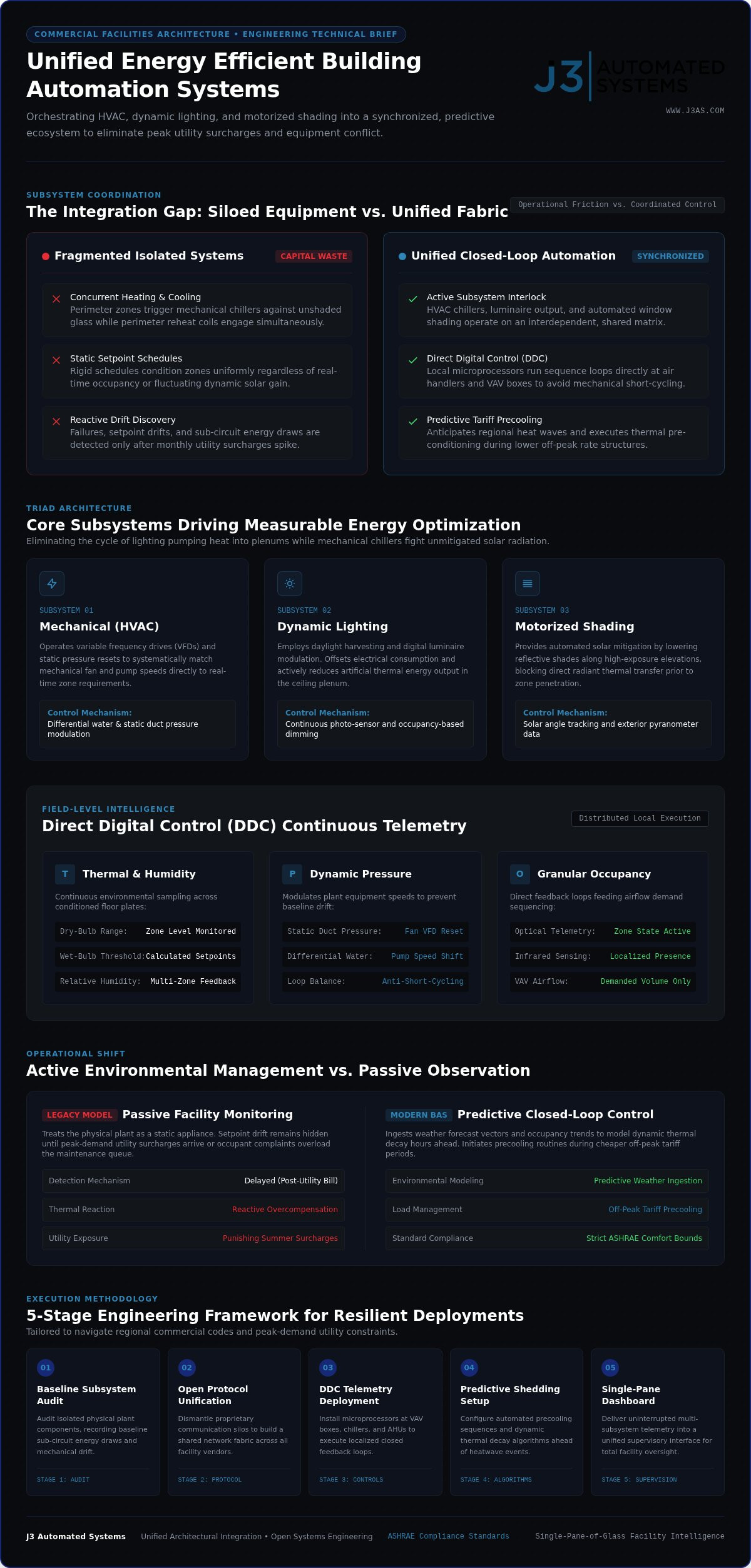
Executing an enterprise automation project requires methodological rigor. Because commercial facilities face intense summer heatwaves and volatile grid constraints across Texas, deploying energy efficient building automation systems cannot rely on generic pre-sets. Mitigating these extreme conditions demands a structured, five-stage engineering framework:
- Audit and Empirical Profiling: Logging sub-circuit power draws to uncover invisible thermal leakage and baseline waste.
- Hardware Engineering: Designing resilient field-controller architectures and specifying precise sensor arrays.
- Network Deployment: Laying robust physical low-voltage buses and dedicated operational VLAN topologies.
- Supervisory Programming: Authoring custom logic loops, predictive reset algorithms, and multi-subsystem triggers.
- Precision Commissioning: Point-to-point field validation and seasonal stress-testing under peak operational loads.
This disciplined roadmap ensures that low-voltage infrastructure performs predictably when outdoor ambient temperatures climb into triple digits.
Baseline Energy Audits and Load Profiling
Engineering begins with verifiable physics rather than assumptions. Non-intrusive current transformers (CTs) installed across main distribution switchgear map consumption profiles across individual mechanical circuits. This empirical baseline reveals unmetered parasitic phantom loads running during scheduled dark hours. Profiling mechanical behavior against solar azimuth angles and ambient humidity indices exposes building envelope deficiencies, establishing exact data points for control sequences.
Grid-Interactive Automation and ERCOT Demand Response
Texas facilities must negotiate severe transmission charges tied to ERCOT four-coincident peak (4CP) windows. Intelligent automation transforms this liability into an operational advantage. Modern supervisory software monitors real-time grid conditions, launching aggressive pre-cooling routines during early morning hours when wholesale electricity prices remain low. As regional peak alerts trigger, the building executes automated, low-impact load shedding. The system systematically cycles fan static pressures, ramps down non-critical circulation pumps, and trims back decorative accent illumination without sacrificing tenant comfort.
Precision Commissioning and Sequence Tuning
A control program is only as reliable as its physical feedback loops. Precision commissioning requires field technicians to stroke every damper actuator from zero to 100 percent, verify temperature sensor thermistor calibrations against laboratory instruments, and audit BACnet packet transmission rates. Network failover logic undergoes live simulation to confirm that mechanical chillers and air handling units maintain safe local equilibrium even if supervisory communication drops. Ready to insulate your facility against grid volatility? Speak with our commercial building automation team to engineer your deployment framework.
Unified Systems Architecture: Partnering with J3 Automated Systems
Projected operational savings often evaporate across fragmented contractor handoffs. When mechanical installers, lighting specialists, and IT teams work in technical silos, the resulting friction leads to conflicting control loops, communication dropouts, and widespread finger-pointing when utility reduction targets fall short. J3 Automated Systems operates as a master systems integrator rather than a detached equipment reseller. By unifying commercial BMS, automated lighting, motorized shades, and enterprise-grade networking under a single engineering discipline, we bridge the divide between physical architectural infrastructure and intelligent digital controls.
Single-Source Accountability from Design to Commissioning
Deploying truly energy efficient building automation systems requires unbroken accountability across every phase of the project lifecycle. J3 eliminates coordination failure points by directly overseeing low-voltage systems architecture, equipment procurement, physical network deployment, and supervisory software programming. Our engineers construct dedicated operational network backbones, ensuring edge controllers exchange critical telemetry without data packet loss. Meticulous post-installation commissioning validates every control sequence, actuator stroke, and sensor calibration, safeguarding asset life spans while lifting administrative burdens from facility staff.
Tailored Solutions for San Antonio, Austin, and Hill Country Estates
Central Texas facilities face distinct operational pressures. Relentless summer heatwaves, acute solar gain, and regional utility grid dynamics demand automation logic engineered specifically for local climate realities. We tailor every deployment to the property's envelope dynamics, synchronizing mechanical cooling plants with dynamic exterior shading and interior daylight harvesting. Beyond fundamental field controls, our engineering team bridges physical BMS hardware with custom internal web applications and AI process integration to deliver unified, single-pane-of-glass facility management. You don't have to wrestle with disparate software portals or competing equipment loops. Explore tailored architectural possibilities by consulting with J3 Automated Systems.
Orchestrating Long-Term Commercial Facility Resilience
Achieving deep energy conservation requires looking beyond isolated mechanical equipment upgrades. Lasting efficiency demands an orchestrated architectural ecosystem where commercial BMS, dynamic solar shading, and daylight-harvesting fixtures communicate across an open, unified backbone. By replacing rigid static schedules with continuous closed-loop telemetry, commercial properties protect operating margins against peak electrical tariffs while extending physical asset longevity.
Realizing this level of precision depends on single-source accountability. J3 Automated Systems bridges low-voltage engineering, physical hardware commissioning, and custom digital workflows under one disciplined roof. Serving premier facilities across San Antonio and Austin, our specialists design, install, and fine-tune energy efficient building automation systems that transform complex environmental variables into effortless operational harmony. When your physical infrastructure operates in concert, bottom-line performance follows naturally. Schedule a consultation with J3 Automated Systems to elevate your commercial facility's operational capabilities.
Frequently Asked Questions
What is the primary difference between a smart thermostat and a building automation system?
A smart thermostat is a localized, standalone device that regulates temperature in a single zone without awareness of broader building systems. Modern energy efficient building automation systems act as supervisory platforms. They orchestrate complex mechanical plants, multi-zone variable air volume boxes, motorized shading, and ventilation simultaneously. While a thermostat merely turns heating or cooling on and off, an enterprise automation architecture continuously modulates airflow, water valves, and static duct pressures based on facility-wide environmental telemetry.
How much energy can an integrated building automation system save annually in a commercial facility?
Annual energy savings vary based on existing infrastructure, building envelope quality, and operational schedules. Commercial facilities that integrate variable frequency drives, daylight harvesting, and occupancy-driven setback routines routinely trim total mechanical and lighting consumption by 15 to 30 percent. Unifying disparate controls eliminates simultaneous heating and cooling while clipping expensive peak electrical demand spikes, producing immediate compounding operational savings across hot Texas summer cooling seasons.
Can existing legacy commercial mechanical equipment be retrofitted with modern building automation controls?
Yes. Most central plants, air handling units, and boilers don't require full mechanical replacement to gain advanced digital intelligence. Systems engineers install open-protocol Direct Digital Control (DDC) field controllers and standardized BACnet or Modbus gateways directly onto legacy equipment. Replacing pneumatic lines and static thermostats with modern electronic actuators and precision sensors brings legacy mechanical hardware into a synchronized, high-performance supervisory architecture without the capital cost of wholesale equipment renewal.
How does automated shading integrate with commercial HVAC systems to improve energy efficiency?
Automated shades deploy dynamic solar tracking algorithms that descend fabric barriers based on real-time solar positioning and exterior lux levels. By rejecting intensive infrared radiation before it penetrates the building envelope, shading prevents localized perimeter hotspots. This proactive thermal barrier reduces cooling loads on variable air volume units and central chillers, allowing commercial HVAC systems across Austin and San Antonio facilities to run at lower stages during peak afternoon heatwaves.
What communication protocols are standard for energy-efficient commercial automation systems?
Open, vendor-neutral protocols serve as the industry standard for high-performance commercial deployments. BACnet IP and BACnet MS/TP dominate commercial mechanical automation, providing seamless communication between central chillers, air handlers, and field sensors. Modbus is standard for electrical power meters and variable frequency drives, while modern supervisory platforms often incorporate MQTT or REST APIs. These non-proprietary standards prevent restrictive vendor lock-in and enable smooth low-latency data exchange across diverse hardware.
How does a building automation system participate in automated electrical grid demand response?
Energy efficient building automation systems connect directly to utility communication channels, receiving real-time pricing signals or demand-response alerts from grid operators like ERCOT. When peak grid stress or high 4CP intervals approach, supervisory software initiates pre-programmed sequences. The system pre-cools spaces ahead of time, temporarily relaxes temperature bands in non-critical zones, dims architectural illumination, and slows secondary circulation pumps, slashing peak electrical consumption without compromising critical day-to-day business operations.
Why is professional systems commissioning critical to achieving projected building energy savings?
Even sophisticated software cannot compensate for uncalibrated hardware or misconfigured wiring. Professional commissioning requires a dedicated engineering team to verify every physical control point in the field. Technicians stroke valve and damper actuators from end to end, test network communication integrity, and calibrate thermistors against laboratory standards. This hands-on verification bridges the gap between digital design theory and physical reality, ensuring the automation infrastructure achieves its targeted operational savings.