High-Performance Residential Networking: Engineering the Invisible Backbone of Modern Estates
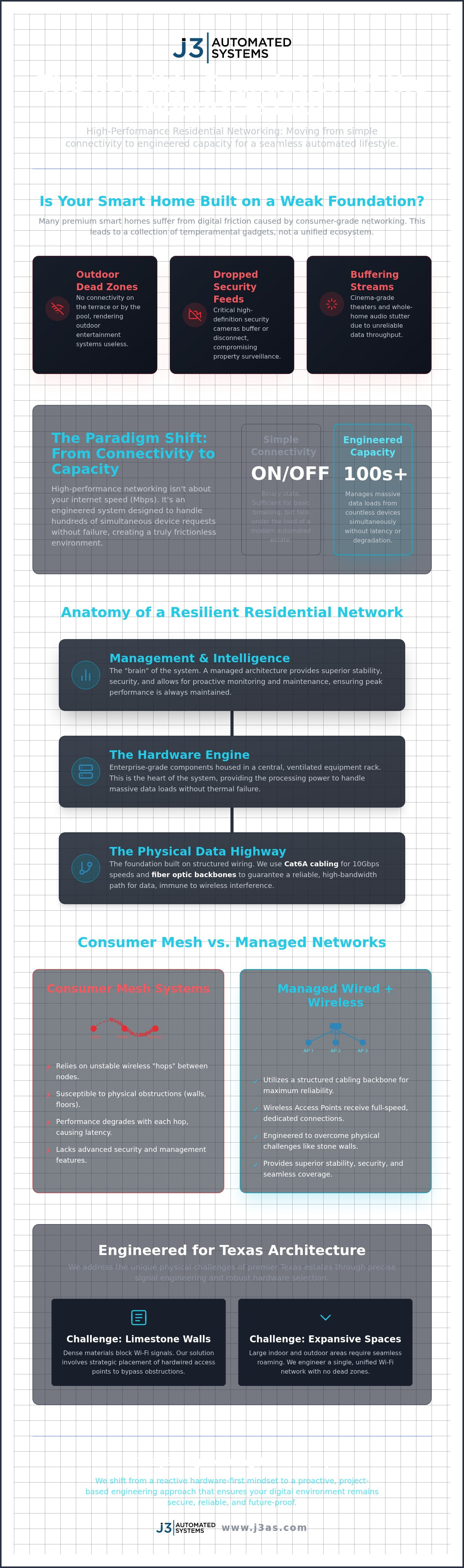
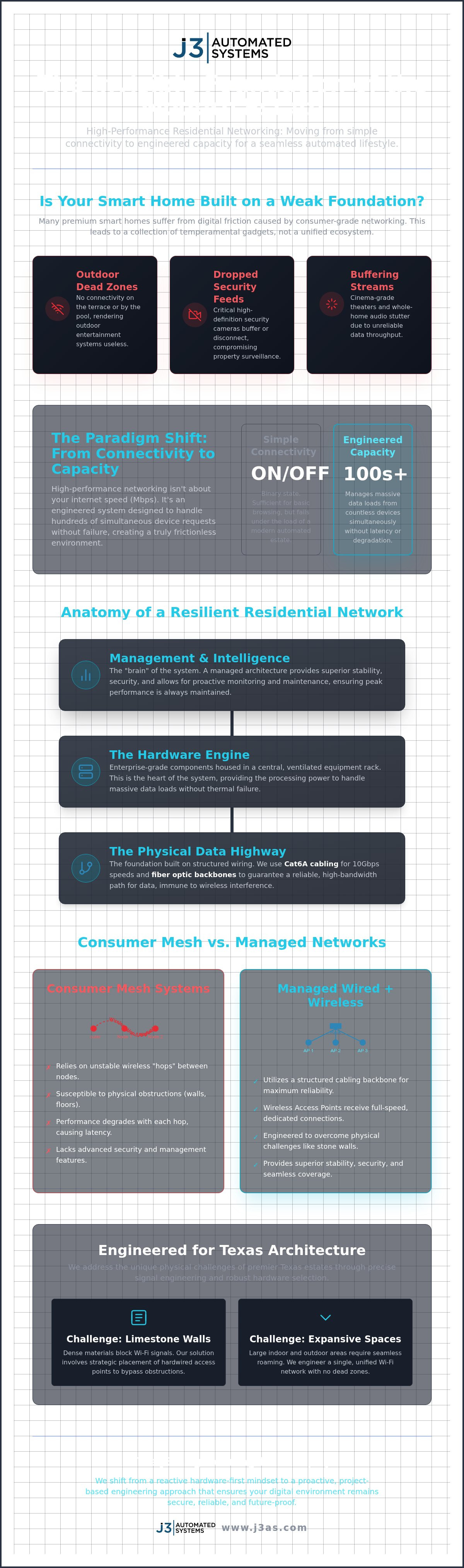
If your home automation feels like a collection of temperamental gadgets rather than a unified ecosystem, the problem isn't the devices; it's the foundation they stand on. Many estate owners invest in premium smart technologies only to be met with the frustration of buffering streams, dropped security feeds, or dead zones in the outdoor terrace. You shouldn't have to tolerate a system that requires manual resets or constant troubleshooting to remain functional. High performance residential networking is no longer a luxury for the tech-obsessed; it's the essential utility that supports the modern lifestyle.
We understand that you expect your property's digital infrastructure to be as reliable and invisible as the plumbing. This guide reveals how enterprise-grade network architecture eliminates digital friction and powers the sophisticated automation systems found in premier Texas homes. You'll discover the engineering principles behind seamless whole-property connectivity, the security requirements for a robust remote work environment, and the specific hardware standards, such as Wi-Fi 7 and Cat6a cabling, that ensure your estate remains future-proof for years to come.
Key Takeaways
- Distinguish between simple internet connectivity and an engineered capacity designed to support hundreds of devices without latency.
- Recognize the essential role of high performance residential networking as the invisible backbone that enables complex automation and cinema-grade theaters.
- Identify why managed network architectures provide superior stability over consumer mesh systems by utilizing structured cabling rather than wireless hops.
- Address the specific physical challenges of Texas estate architecture, including limestone walls and expansive outdoor living spaces, through precise signal engineering.
- Shift from a reactive hardware-first mindset to a proactive, project-based engineering approach that ensures your digital environment remains secure and reliable.
What is High-Performance Residential Networking?
High performance residential networking is far more than a collection of high-speed routers; it is a meticulously engineered, enterprise-grade infrastructure designed to support the intense digital demands of a modern estate. While a standard home area network (HAN) might suffice for basic web browsing or checking emails, it often buckles under the weight of high-definition security feeds, whole-home audio, and remote professional requirements. We view this networking as the invisible backbone of the property, a silent utility that ensures every digital interaction feels instantaneous and effortless.
The distinction lies in moving from simple connectivity to engineered capacity. Connectivity is binary; you are either online or offline. Capacity, however, is about the network's ability to manage hundreds of simultaneous requests without performance degradation. In a premier residence, this translates to a frictionless environment where technology serves the inhabitant, rather than demanding their attention through constant troubleshooting or manual resets. It creates a feeling of calm reliability, where the complexity of the system is hidden behind a veil of seamless operation.
The Nervous System of the Smart Home
Think of the network as the central nervous system of your home. It provides the essential pathways that allow your lighting, climate control, and security systems to communicate with one another. When you adjust a shade or dim a light from a touch panel, that command travels through this invisible architecture. If the network is fragmented, you experience latency, the frustrating delay between a touch and an action. By engineering stability from the core outward, we ensure that local device communication remains robust even when external internet traffic fluctuates, moving from global connectivity down to the precise stability of a single smart switch.
Beyond Mbps: Understanding Throughput and Latency
A common misconception is that a high-speed plan from an Internet Service Provider (ISP) guarantees a fast home experience. Raw speed is merely the potential of the pipe entering the house. True performance depends on reliable throughput, which is the actual amount of data successfully delivered to a device over time. This is critical for 4K streaming and high-fidelity audio, where a single dropped packet can cause a stutter. Latency is the specific measurement of delay in data transfer that disrupts real-time communication and ruins the immersion of an automated environment. A high-performance system prioritizes these metrics to maintain a state of intelligent operation across the entire property.
The Anatomy of a Resilient Residential Network
A truly high-performance system is defined by its ability to remain invisible while performing at peak capacity. High performance residential networking relies on a structured, three-tiered hierarchy: the physical layer, the hardware engine, and the management intelligence. Unlike off-the-shelf gadgets that require frequent replacement, this infrastructure is a permanent architectural asset. It's built to endure, providing a stable foundation for every digital interaction within the estate.
The heart of this system is the central equipment rack. This isn't merely a storage space; it's a controlled environment where craftsmanship meets engineering. A professional installation prioritizes clean cable management and active ventilation to prevent thermal failure. Heat is the primary enemy of electronics, and a well-organized rack ensures that components operate within their ideal temperature range. This modular approach allows for seamless future-proofing, as individual components can be upgraded without disturbing the underlying structure of the home.
Structured Wiring: The Physical Data Highway
Reliability begins with low voltage wiring for smart homes. While wireless technology provides convenience, it remains a shared medium susceptible to physical obstructions and signal interference. Hardwired connections provide dedicated, symmetrical bandwidth for stationary high-demand devices such as media servers and cinema systems. We utilize Cat6A cabling as a standard to support 10Gbps speeds over full distances, often pairing these runs with fiber optic backbones for links between detached structures or main distribution frames. This ensures the physical highway is ready for the data requirements of the next decade.
Enterprise-Grade Hardware vs. Consumer Routers
Consumer routers are all-in-one devices that often buckle under the massive data loads of a modern estate. They lack the processing power to handle simultaneous 4K streams, video conferencing, and security data without requiring frequent reboots. High-performance systems separate these duties among dedicated components: high-security gateways, managed switches, and discrete wireless access points. These professional-grade units utilize Power over Ethernet (PoE) to deliver both data and power through a single cable. This simplifies the installation of security cameras and touch panels while providing a cleaner, more aesthetic result throughout the residence. By investing in high performance residential networking, homeowners move from a state of fragmentation to one of intelligent, effortless operation. Engineering such a complex system requires an accountable partner who values long-term functionality over quick fixes.
Consumer Mesh vs. Managed Residential Networks
Retail mesh systems offer an alluring promise of simplicity. They appeal to a "plug-and-play" mindset, suggesting that a few wireless nodes scattered throughout a home can solve complex coverage issues. However, high performance residential networking requires a level of architectural precision that off-the-shelf kits cannot provide. A common fallacy suggests that adding more nodes or satellite units will solve persistent connectivity issues; in reality, saturating a property with uncoordinated hardware often creates more signal interference than it resolves.
A managed network functions as a single, intelligent entity. This distinction is most apparent during the "handoff" experience. As you move from a home office to an outdoor living area during a high-stakes video call, a managed system actively steers your device to the optimal access point. Consumer mesh systems often "cling" to a weak signal from a distant node, resulting in the jitter and dropped connections that disrupt professional productivity and digital harmony.
The Limitations of Mesh Systems in Large Estates
Large properties expose the structural flaws of mesh technology, specifically "wireless backhaul." In these systems, nodes communicate with each other over the same wireless frequencies used by your devices. This process can effectively cut your available bandwidth in half with every "hop" the data takes. Managed systems eliminate this bottleneck by utilizing a wired backhaul, where every access point connects directly to the central switch via the structured cabling discussed in previous sections. This ensures that a device in a detached guest house receives the same throughput as one in the main residence.
- Bandwidth Contention: Mesh nodes compete for the same airwaves as your streaming devices and laptops.
- Latency Accumulation: Every wireless hop adds a layer of delay that degrades real-time communication.
- Lack of Visibility: Retail systems rarely offer the professional monitoring tools required to diagnose issues before they cause a system-wide failure.
The Security Advantage of Managed Systems
Security is often an afterthought in consumer-grade hardware. Managed residential networks allow for the implementation of Virtual Local Area Networks (VLANs). This technique isolates vulnerable IoT devices, such as smart appliances or legacy cameras, from the private data residing on your personal servers and workstations. For the modern executive, this infrastructure supports secure networking for remote work through hardware-level VPN integration and proactive threat detection. Instead of waiting for a breach, a managed gateway monitors traffic patterns to identify and neutralize anomalies, providing a secure environment that "just works" without constant manual intervention.
Engineering for Connectivity in Texas Estates
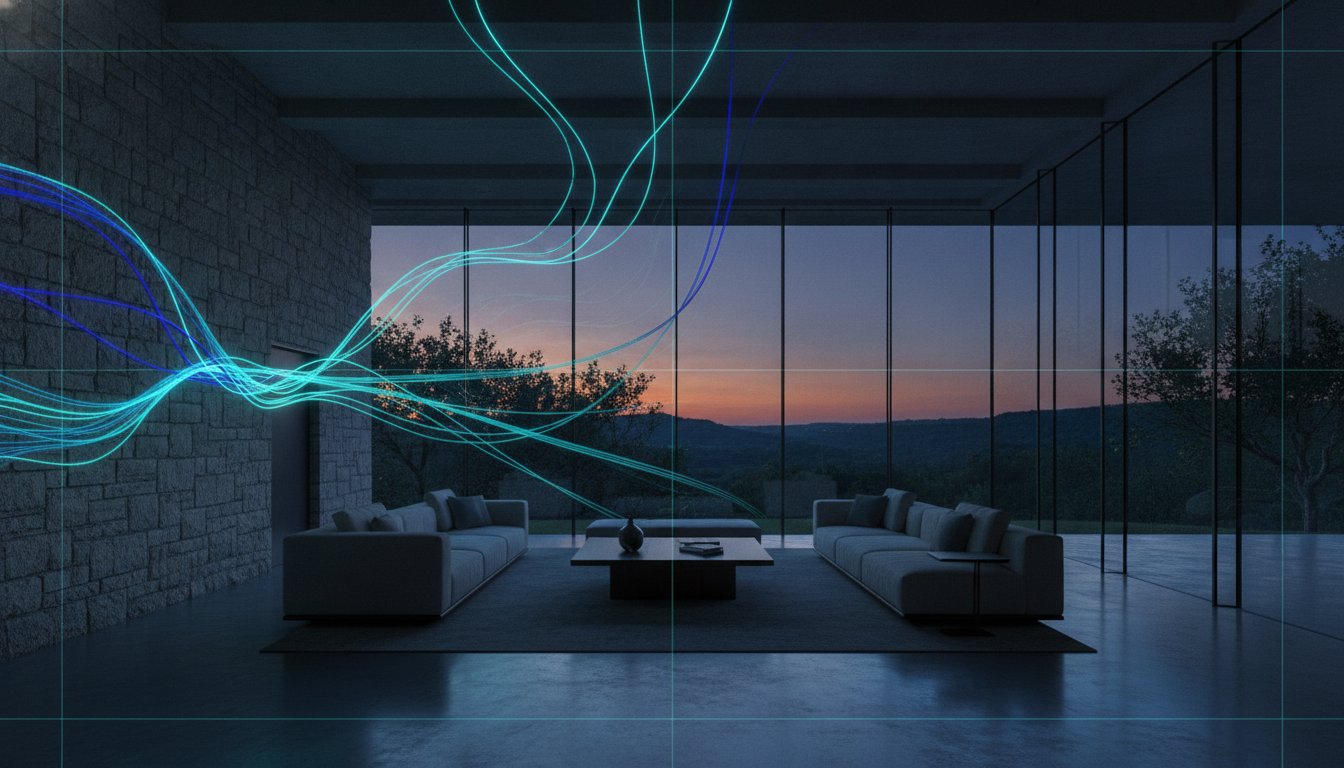
Designing a digital infrastructure for a Texas estate requires a deep understanding of local architectural nuances and environmental extremes. In the San Antonio to Austin corridor, the very materials that provide beauty and structural integrity often serve as the greatest obstacles to signal propagation. High performance residential networking in these environments is not a matter of simply increasing power; it is an exercise in strategic engineering. We treat the network as a vital utility, as fundamental to the property's operation as water or electricity, particularly in more remote Hill Country locations where cellular reliability is often compromised.
Thermal management is another critical consideration often overlooked in standard installations. Texas heat can easily overwhelm sensitive electronics housed in poorly ventilated spaces. Our approach involves active cooling and climate-monitored equipment enclosures to ensure that the hardware maintaining your estate's intelligence never reaches critical temperatures. This commitment to resilience ensures that your connectivity remains as steady in July as it is in January.
Overcoming Architectural Interference
Materials common in premier Texas homes, such as thick limestone, steel framing, and radiant barrier roof decking, are notoriously effective at blocking radio frequencies. These elements can turn a beautiful residence into a series of disconnected digital silos. To counter this, we implement a dense grid of Wireless Access Points (WAPs) that are strategically placed for maximum coverage while remaining aesthetically invisible. For detached structures like guest houses, equestrian barns, or remote workshops, we bypass wireless limitations entirely by deploying fiber optic links. This creates a high-speed, interference-free connection that maintains the integrity of the primary network across the entire acreage.
Seamless Outdoor Connectivity
The modern Texas lifestyle extends far beyond the interior walls, encompassing expansive pool decks, outdoor kitchens, and vast acreage. Providing a consistent experience in these areas requires weather-rated hardware designed to withstand humidity and extreme temperature swings. A robust outdoor network does more than support high-definition streaming by the pool; it provides the essential foundation for commercial security system design Texas. This allows for intelligent perimeter protection and real-time surveillance across the property line. To ensure your estate's digital foundation is engineered for these unique challenges, consult with the experts at J3 Automated Systems for a tailored roadmap.
The J3 Engineering Philosophy: Integration as a Roadmap
At J3 Automated Systems, we view high performance residential networking as a project-based engineering discipline rather than a simple hardware installation. Our philosophy centers on a methodical roadmap that begins with comprehensive signal mapping and culminates in a fully commissioned, resilient environment. This engineered foundation is what enables the most demanding luxury amenities to function without compromise. For instance, a truly immersive cinema grade home theater design depends entirely on the network's ability to deliver massive, uncompressed data streams with zero latency. Without a robust backbone, even the finest silver screen experience is susceptible to the friction of buffering and synchronization errors.
Beyond entertainment, the modern estate is becoming a hub for sophisticated data processing. As homeowners increasingly integrate ai business process automation into their personal and professional lives, the requirement for a secure, high-capacity backbone becomes non-negotiable. These systems require constant, high-speed access to both local and cloud-based resources to manage everything from predictive climate control to complex financial workflows. We handle this underlying complexity so the client doesn't have to, providing a single point of accountability for the entire digital ecosystem.
A Single Accountable Team
The traditional approach to home technology often involves a fragmented collection of vendors, which inevitably leads to a state of digital friction where no one takes full responsibility for the final result. J3 eliminates this burden by serving as a single, accountable engineering partner. Our white-glove commissioning process ensures that every device, from a simple smart switch to a bespoke cinema server, is verified for peak performance before we consider a project complete. This relationship continues long after the initial implementation through proactive remote management and dedicated support. We monitor the health of your systems in real time, often identifying and resolving potential issues before they disrupt your day, ensuring your environment remains as polished as the day it was installed.
Ready for the Future of AI and Automation
Technology never stands still, and a high performance residential networking solution must be designed for what comes next. By engineering scalability into the physical and hardware layers, we prepare your estate for the arrival of next-generation AI tools and evolving wireless standards like Wi-Fi 7 and beyond. An intelligent system should grow with your needs, adapting to new demands without requiring a total overhaul of the property's infrastructure. This forward-thinking approach ensures that your investment remains relevant as the digital landscape shifts. We invite you to move beyond the frustration of fragmented gadgets and embrace a state of effortless, intelligent operation. Contact J3 Automated Systems today to begin engineering your custom automation roadmap and secure the invisible backbone of your estate.
Securing Your Digital Legacy
Transitioning from a collection of fragmented devices to a unified, intelligent environment requires more than just premium hardware; it demands a shift in perspective. We've explored how structured cabling, enterprise-grade hardware, and precise Texas-specific engineering create the invisible backbone necessary for modern luxury. By prioritizing capacity over simple connectivity, you ensure that your estate remains a sanctuary of calm reliability rather than a source of digital friction. This architectural foundation serves as the silent steward of your home's long-term intelligence.
A resilient network is the essential utility that enables your property to evolve alongside the rapid advancements in AI and bespoke automation. As a single accountable team, J3 Automated Systems provides the deep-thinking partnership required to manage this complexity across the San Antonio to Austin corridor. We combine intellectual rigor with a high-touch service model to deliver high performance residential networking that "just works" without manual intervention. Begin your automation roadmap with J3 Automated Systems to transform your property into a masterwork of intelligent operation. Your vision for a seamless, secure, and sophisticated lifestyle is within reach.
Frequently Asked Questions
What is the difference between a standard router and a high-performance residential network?
Standard routers are consumer-grade, all-in-one devices that often fail under massive data loads. A high performance residential networking system utilizes discrete, enterprise-grade components like dedicated gateways and managed switches to handle hundreds of simultaneous requests without performance degradation. This architecture shifts the focus from simple internet access to engineered capacity, ensuring your digital environment remains stable regardless of the device count.
Do I need special wiring for a high-performance home network?
Resilient infrastructure requires a foundation of high-category structured cabling, specifically Cat6A or fiber optics. While wireless technology is convenient for mobile devices, a high performance residential networking solution uses hardwired connections for stationary amenities like cinema systems and security servers to ensure dedicated bandwidth. This physical layer acts as the permanent data highway for your estate, supporting speeds up to 10Gbps and providing a future-proof environment for emerging technologies.
Can a managed network improve my remote work security in San Antonio?
A managed network significantly enhances security by implementing Virtual Local Area Networks (VLANs) to isolate private data from vulnerable smart devices. For executives in San Antonio, this means your remote work traffic remains on a dedicated, encrypted segment of the network, protected by enterprise-grade firewalls and proactive threat detection. This approach eliminates the vulnerabilities found in standard consumer hardware, providing a secure, professional-grade environment for sensitive communications.
How many wireless access points do I need for a 5,000 square foot home?
A 5,000 square foot home typically requires between four and six wireless access points, though the final count depends on your specific architectural materials. Thick limestone walls and steel framing, common in premier Texas estates, act as signal barriers that require precise engineering to overcome. We conduct a thorough signal mapping process to determine the optimal placement for each unit, ensuring a seamless handoff as you move through the property without losing connectivity.
Will a high-performance network stop my Netflix buffering?
Buffering is usually the result of inconsistent throughput or high latency, issues that an engineered network is specifically designed to solve. By prioritizing traffic and ensuring that high-bandwidth activities like 4K streaming have a clear path, we eliminate the bottlenecks that cause digital friction. This results in an effortless experience where media starts instantly and remains stable, even when other systems in the home are active.
Is it possible to have seamless Wi-Fi in my outdoor kitchen and pool area?
Outdoor connectivity is entirely possible through the use of weather-rated access points and strategic fiber optic links. These components are designed to withstand the humidity and extreme temperature swings of the Texas climate while providing the same signal strength as your interior spaces. Whether you are in the outdoor kitchen or at the far end of the pool, the network maintains a fluid, high-speed connection for both entertainment and perimeter security.
Why is a professional equipment rack necessary for home networking?
A professional equipment rack is the command center of a resilient home, providing the necessary thermal management and organization for your hardware. Heat is the primary cause of electronic failure; a ventilated rack ensures that components operate within their ideal temperature range to extend their lifespan. This organized approach also simplifies future upgrades and maintenance, allowing for a white-glove service experience where the technology remains out of sight but perfectly functional.
How does J3 Automated Systems handle network security and privacy?
J3 Automated Systems approaches security through a philosophy of proactive monitoring and single-team accountability. We implement hardware-level encryption and segmented VLANs to ensure your private data is never exposed to the internet-of-things devices on your network. Our team manages the entire digital ecosystem, providing a secure environment that is both intellectually rigorous and easy to use, so you don't have to worry about the complexities of cyber defense.