Integrated Building Management Systems: Engineering Guide

Commercial buildings waste an average of 30% of the energy they consume, a figure that often translates into thousands of dollars evaporated into the Texas heat every month. You likely recognize the friction caused by siloed systems where HVAC, lighting, and security operate as isolated islands, forcing your team to juggle multiple interfaces while maintenance gaps widen. This guide illustrates how to bridge those gaps using integrated building management systems for commercial properties, transforming fragmented hardware into a unified, intelligent ecosystem that slashes operational overhead and refines the tenant experience.
Achieving this level of harmony requires more than just new hardware; it demands an architecture-first engineering mindset. We'll explore the strategic roadmap for consolidating your physical infrastructure into a single, accountable interface that eliminates digital friction. From leveraging open-protocol frameworks to implementing AI-driven predictive maintenance, you'll discover how to transition from reactive repairs to a state of proactive, effortless operation. This is the path to a future-proofed technology stack that treats your building not as a collection of parts, but as a high-performance asset.
Key Takeaways
- Understand how a centralized nervous system replaces fragmented silos to create a harmonious, responsive building environment.
- Discover how intelligent HVAC and automated shading mitigate solar heat gain, a critical factor for maintaining efficiency in the Central Texas climate.
- Learn why open-protocol standards are essential for maintaining long-term flexibility and avoiding the constraints of proprietary vendor lock-in.
- Explore the strategic engineering roadmap required to successfully deploy integrated building management systems for commercial properties from discovery through commissioning.
- Identify the specific operational metrics that drive ROI, including reduced energy waste and elevated tenant satisfaction through seamless control interfaces.
The Architecture of Integrated Building Management Systems (IBMS)
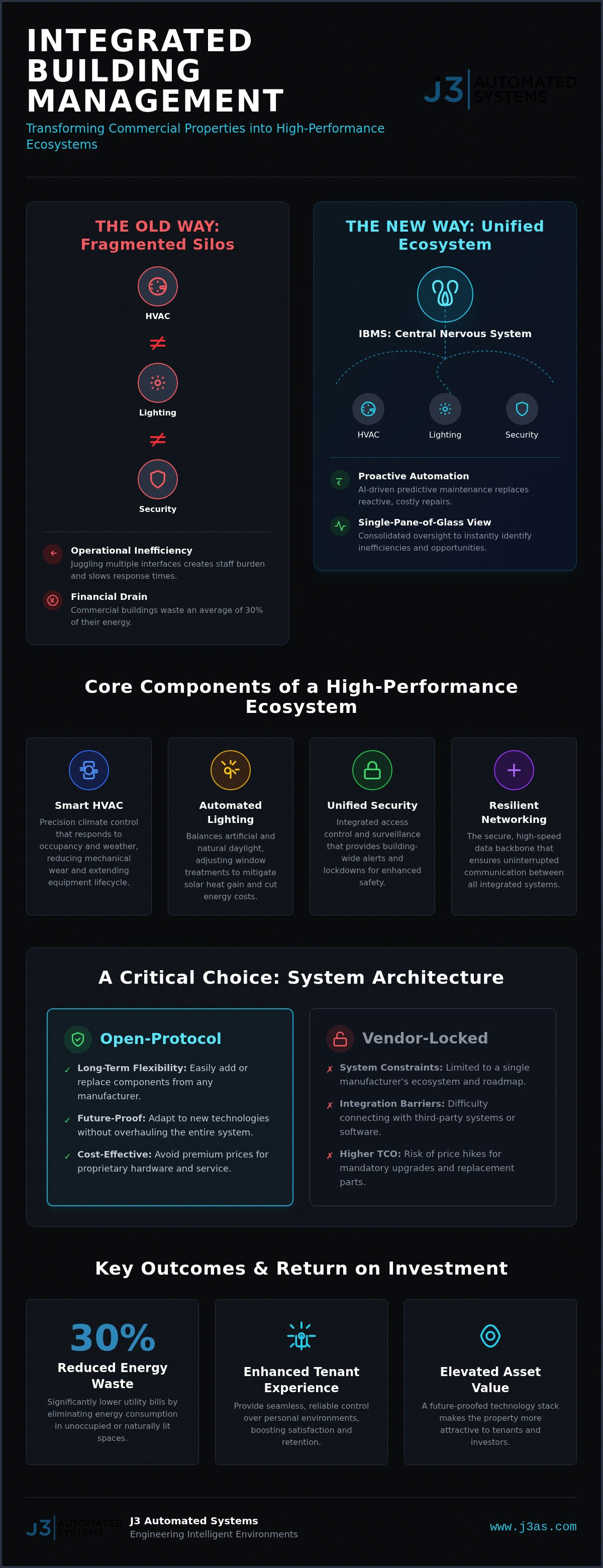
An Integrated Building Management System (IBMS) functions as the centralized nervous system of a modern facility. It's the intelligence layer that bridges the gap between disparate mechanical systems and digital oversight. Traditionally, commercial properties operated with disconnected silos; the HVAC system didn't speak to the lighting, and security remained a separate entity. Transitioning to integrated building management systems for commercial properties replaces this fragmentation with a unified ecosystem. This shift allows for a level of coordination where every component works in concert to achieve a single goal: optimal performance.
A master systems integrator acts as the architect of this harmony. By designing a cohesive communication layer, they reduce the operational friction that typically plagues facility managers. This professional oversight ensures that data moves fluidly between devices, regardless of the manufacturer. The core architecture rests on four critical pillars:
- HVAC: Precision climate control that responds to occupancy levels and external weather conditions.
- Lighting: Automated systems that balance artificial light with natural daylighting to reduce consumption.
- Security: Unified access control and surveillance that integrate with building-wide alerts and lockdowns.
- Networking: The resilient backbone that ensures data flows securely and without interruption across the property.
Breaking Down the Silo Mentality
Fragmented systems are more than just an inconvenience; they're a financial drain. When HVAC and lighting don't share data, you're likely paying for redundant labor and wasting energy in unoccupied spaces. Managing multiple proprietary interfaces creates a burden on staff, leading to maintenance gaps and slower response times. The engineering goal is to achieve a "single pane of glass" oversight. This consolidated view allows stakeholders to identify inefficiencies instantly, removing the weight of manual cross-referencing between different software platforms.
The Role of Custom Software and AI
True intelligence moves beyond simple on-off schedules. Modern engineering incorporates custom web apps that visualize building health in real-time, providing stakeholders with actionable insights rather than raw data. By integrating AI into the IBMS, we shift from reactive maintenance to data-driven predictive automation. These tools analyze usage patterns to automate repetitive administrative tasks or adjust environmental settings before a human notices a shift in demand. This creates a state of effortless operation where the technology stack evolves alongside the property's needs.
Core Components of a High-Performance Commercial Ecosystem
High-performance buildings operate through a series of interconnected technologies that respond dynamically to their environment. These integrated building management systems for commercial properties rely on a robust foundation where hardware and software converge. This synergy ensures that every kilowatt spent and every access event recorded contributes to a broader strategy of efficiency and safety. When these components are engineered as a single ecosystem, the building stops being a passive structure and becomes an active participant in your business operations.
Smart HVAC and Climate Engineering
Precision in climate control requires more than just a standard thermostat. We implement variable frequency drives (VFDs) and high-density, zone-based sensors to ensure air delivery matches actual demand in real-time. This intelligent load balancing reduces mechanical wear and tear, significantly extending the lifecycle of expensive rooftop units. For owners managing assets in the unique climate of the San Antonio and Austin corridors, commercial building management systems Texas provides the necessary resilience against extreme temperature fluctuations and humidity.
Lighting and shade automation represents another significant opportunity for passive energy savings. By leveraging natural daylighting, sensors adjust artificial light levels and window treatments based on the sun's position. This reduces the solar heat gain coefficient (SHGC) during peak hours, lowering the burden on the cooling system while maintaining a premium aesthetic for occupants. These systems don't just save money; they enhance the comfort and productivity of the people inside.
Integrated Security and Access Control
Modern protection requires a departure from standalone cameras and manual logs. A unified approach combines high-definition surveillance with biometric entry points, creating a frictionless experience for authorized personnel while hardening the perimeter. Real-time threat detection, powered by AI-enhanced video analytics, identifies anomalies before they escalate into security breaches. Consulting on commercial security system design Texas ensures these layers are engineered to meet the specific risk profiles of premier facilities.
Networking serves as the invisible backbone, facilitating the high-speed data exchange required for these systems to function. When designing integrated building management systems for commercial properties, we prioritize resilience to ensure no single point of failure can disrupt building operations. We bridge the gap by integrating custom AI into your existing business processes, allowing for automated reporting and administrative workflows that traditional systems overlook. If you're looking to eliminate operational friction, partnering with a systems architect can reveal hidden efficiencies in your current floor plan.
Optimizing ROI: Efficiency in the Central Texas Climate
The Texas heat is a relentless variable in the commercial property equation. In the Austin and San Antonio corridors, cooling isn't a luxury; it's the primary driver of operational expense. Implementing integrated building management systems for commercial properties allows owners to shift from a defensive posture to a strategic one. By analyzing the interplay between capital expenditure (CAPEX) and long-term operating expenses (OPEX), high-end engineering reveals that the initial investment in sophisticated automation pays dividends through reduced energy waste and extended equipment life. This isn't merely about hardware; it's about the precision of the integration.
Managing Energy Spikes During Texas Summers
Peak demand charges can account for a significant portion of a commercial utility bill. We employ peak demand shaving strategies that utilize thermal storage and automated setback schedules to shift the cooling load away from the most expensive hours of the day. This requires a level of precision that traditional thermostats cannot provide. Resilient networking ensures that even during extreme weather events, your sensor array remains online, providing the data necessary to adjust the solar heat gain coefficient (SHGC) through intelligent shading. This proactive adjustment prevents the building from over-absorbing solar heat, maintaining a stable internal environment without taxing the mechanical systems during the hottest hours of the afternoon.
Extending Equipment Lifecycles through Predictive Maintenance
Reactive repairs are the enemy of a healthy bottom line. By integrating vibration and temperature sensors into the IBMS, we move toward an engineered maintenance roadmap. These sensors detect the subtle precursors to catastrophic HVAC failure, such as bearing wear or refrigerant leaks, long before they trigger a system-wide shutdown. For facility teams in Boerne and San Marcos, this removes the burden of constant manual inspections and emergency call-outs. It transforms maintenance from a frantic response into a methodical, planned process.
Leveraging this granular data does more than just lower monthly bills; it provides the documentation required to secure energy efficiency rebates and green building certifications. These certifications often increase the market valuation of the property, further solidifying the ROI of a well-integrated system. When your building operates with this level of intelligence, it ceases to be a liability and becomes a high-performance asset that protects your capital and enhances your reputation as a premier property owner.
Vendor-Locked vs. Open-Protocol Systems: Making the Choice
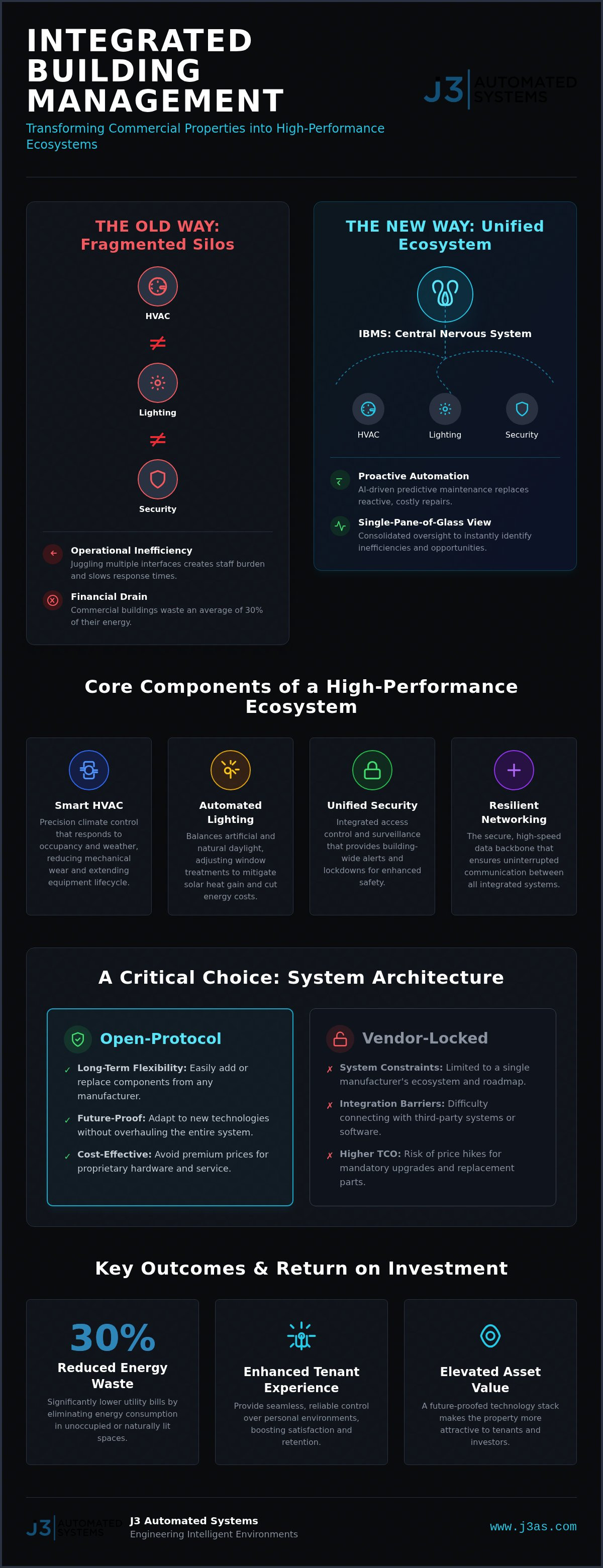
Selecting the foundation for your facility's intelligence is a decision that echoes for decades. When evaluating integrated building management systems for commercial properties, owners often face a choice between proprietary, closed systems and open-protocol standards like BACnet or LonWorks. Proprietary systems may offer a simplified initial setup, but they often come with a hidden cost: vendor lock-in. A truly engineered solution prioritizes interoperability, ensuring that your building remains a flexible asset rather than a hostage to a single manufacturer's product lifecycle.
The Danger of Proprietary Dead-Ends
Proprietary systems create a closed loop that limits your ability to evolve. If a manufacturer discontinues a critical controller or shifts their software subscription model, your facility team is left with few options. These systems frequently resist integration with third-party AI or custom web applications, making it nearly impossible to implement the bespoke digital workflows that drive modern efficiency. Choosing an open-protocol framework ensures that you own the building's data and the underlying software logic. This ownership is vital for property owners who value long-term stability over the convenience of off-the-shelf hardware.
Engineering for Seamless Interoperability
True integration requires a single accountable partner who sees the hidden connections between physical infrastructure and digital processes. We bridge the gap between disparate hardware through custom software development, ensuring that your HVAC, lighting, and security systems speak a common language. This level of harmony is supported by enterprise-grade networking, which maintains system uptime even during the heavy demand cycles typical of the Texas climate. By focusing on the architecture of the system rather than the sale of the hardware, we ensure that your technology stack remains future-proofed for expansion or upgrades.
A white-glove integrator focuses on the longevity of the ecosystem. We don't just install equipment; we engineer a resilient environment that reduces operational burden and empowers your team with clear, actionable data. If you're ready to move beyond the limitations of closed systems, consult with our engineering team to design a truly open architecture for your facility.
The J3 Engineering Roadmap: From Discovery to Commissioning
The successful deployment of integrated building management systems for commercial properties is a journey from fragmentation to fluidity. It requires a methodical, five-step engineering roadmap designed to ensure the final ecosystem is as resilient as it is intelligent. Unlike off-the-shelf solutions that prioritize rapid onboarding, an engineered approach respects the physical complexity of the property. This process ensures that every component, from the smallest sensor to the primary chiller, operates within a unified logic that serves your broader business goals.
- Step 1: Discovery. We begin with a deep-dive discovery and business process mapping. We study how your team interacts with the space and where manual effort creates friction.
- Step 2: Design. Our engineers develop custom documentation and an automation roadmap. This phase defines the communication protocols and hardware requirements tailored to your budget.
- Step 3: Build. A local team handles the professional installation and low-voltage wiring. This ensures that the physical infrastructure is robust enough to support high-speed data exchange.
- Step 4: Commissioning. We perform precision tuning and verification. This isn't an automated process; it's a hands-on calibration to ensure every system achieves maximum efficiency.
- Step 5: Support. We provide ongoing AI-driven optimization. As your property usage evolves, the system is tuned to maintain its high-performance state.
A Single Accountable Team for Central Texas
San Antonio businesses benefit from a high-touch, local engineering partner. When you have one team responsible for AV, security, and the BMS, you eliminate the finger-pointing that often occurs between disconnected vendors. This "Single Accountable Team" narrative is central to our philosophy. We bridge the gap between physical environments and digital tools, often incorporating custom web app development San Antonio to provide a bespoke interface for your facility's nervous system. This ensures that your management team has a clear, intuitive view of building health at all times.
Mapping Physical Spaces to Digital Workflows
We believe that true building intelligence requires mapping physical spaces to digital workflows. This involves integrating AI business process automation directly into the building's infrastructure. Imagine a facility that automatically prepares meeting rooms based on your internal calendar or adjusts security protocols during high-traffic events. We create custom dashboards that offer real-time portfolio visibility, allowing stakeholders to make data-driven decisions from a single pane of glass. If you're ready to transform your facility into a responsive, intelligent asset, schedule a consultation for your commercial property today.
Engineering a Unified Future for Your Facility
The transition from fragmented building operations to a unified ecosystem is a strategic evolution that secures both your capital and your operational peace of mind. By prioritizing open-protocol architecture and precision engineering, you eliminate the friction of vendor lock-in and the inherent waste of siloed data. Implementing integrated building management systems for commercial properties ensures that your HVAC, lighting, and security systems operate as a single, intelligent asset capable of responding to the unique demands of the Texas climate. Your facility is ready to evolve.
Success in this transformation requires a partner who provides end-to-end design and commissioning with a focus on long-term functionality. J3 Automated Systems offers deep local expertise across San Antonio and Austin, delivering the accountability of a single-source integrator. We bridge the gap between physical infrastructure and bespoke digital workflows to create environments that are both high-performing and effortless to manage. Partner with J3 for your next intelligent building project to begin mapping your property's roadmap toward harmony and efficiency. It's time to transform your building into a responsive, high-performance asset.
Frequently Asked Questions
What is the primary difference between a BMS and an Integrated BMS?
A standard BMS typically manages a single system, like HVAC, in isolation. An Integrated BMS unifies HVAC, lighting, security, and AV into a single, intelligent ecosystem. This architectural approach removes the friction of managing multiple proprietary interfaces. For premier properties in Austin and San Antonio, this means a more harmonious environment where systems share data to optimize performance and reduce operational burden across the entire facility.
How much can a commercial building management system save on energy costs?
While individual results vary based on building age and usage, commercial buildings waste an average of 30% of the energy they consume according to industry data. Implementing intelligent automation can significantly mitigate this waste. By utilizing demand-based climate management and automated shading to reduce solar heat gain, property owners in the Central Texas corridor can reclaim a substantial portion of these lost operational costs.
Can an existing commercial building in San Antonio be retrofitted with smart technology?
Retrofitting existing commercial buildings in San Antonio and Boerne is entirely possible and often highly beneficial. Our engineering roadmap starts with a deep-dive discovery to map your physical space and current infrastructure. We then design custom software and hardware bridges to integrate modern automation into your existing building. This process transforms older properties into high-performance assets without the need for a complete reconstruction of the facility's core.
Do I need to upgrade my networking infrastructure to support building automation?
Resilient networking serves as the invisible backbone of any high-performance building. Modern automation requires a robust infrastructure to support high-speed data exchange between sensors, controllers, and cloud-based AI. If your current network lacks the capacity for enterprise-grade traffic, an upgrade is essential to ensure system uptime. We engineer these networks to be both secure and redundant, preventing any single point of failure from disrupting your building's operations.
How does AI improve the performance of a building management system?
AI transitions building management from reactive schedules to proactive, data-driven intelligence. It enables predictive maintenance by analyzing vibration and temperature data to identify potential equipment failures before they occur. Additionally, AI integrates with business processes to automate repetitive administrative tasks. This level of automation ensures your building responds dynamically to occupancy patterns, maximizing both tenant comfort and energy efficiency throughout the day.
What is the role of a master systems integrator (MSI) in commercial construction?
A master systems integrator (MSI) acts as the visionary architect for your property's technology stack. Instead of dealing with separate vendors for HVAC, security, and AV, you work with a single accountable partner. The MSI ensures that every system speaks a common language, reducing technical friction and ensuring long-term functionality. This holistic oversight is critical for successful project delivery in complex commercial construction environments across Texas.
Is it possible to integrate security and HVAC into one interface?
Yes, unifying security and HVAC into a single interface is a core benefit of integrated building management systems for commercial properties. This "single pane of glass" oversight allows facility managers to monitor surveillance feeds and adjust climate zones from one intuitive dashboard. By bridging these disparate systems, you create a more responsive environment where security events, like after-hours access, can automatically trigger lighting and HVAC adjustments in specific zones.
How long does a typical commercial building automation installation take?
The timeline for a commercial building automation installation depends on the project's complexity and the building's scale. A typical project follows a methodical five-step roadmap: discovery, design, build, commissioning, and support. While the physical installation of low-voltage wiring and hardware takes several weeks, the precision commissioning phase is equally vital. This ensures every component is fine-tuned for maximum efficiency before the system is fully handed over to your team.