Integrated Business Automation Strategy for Texas Firms

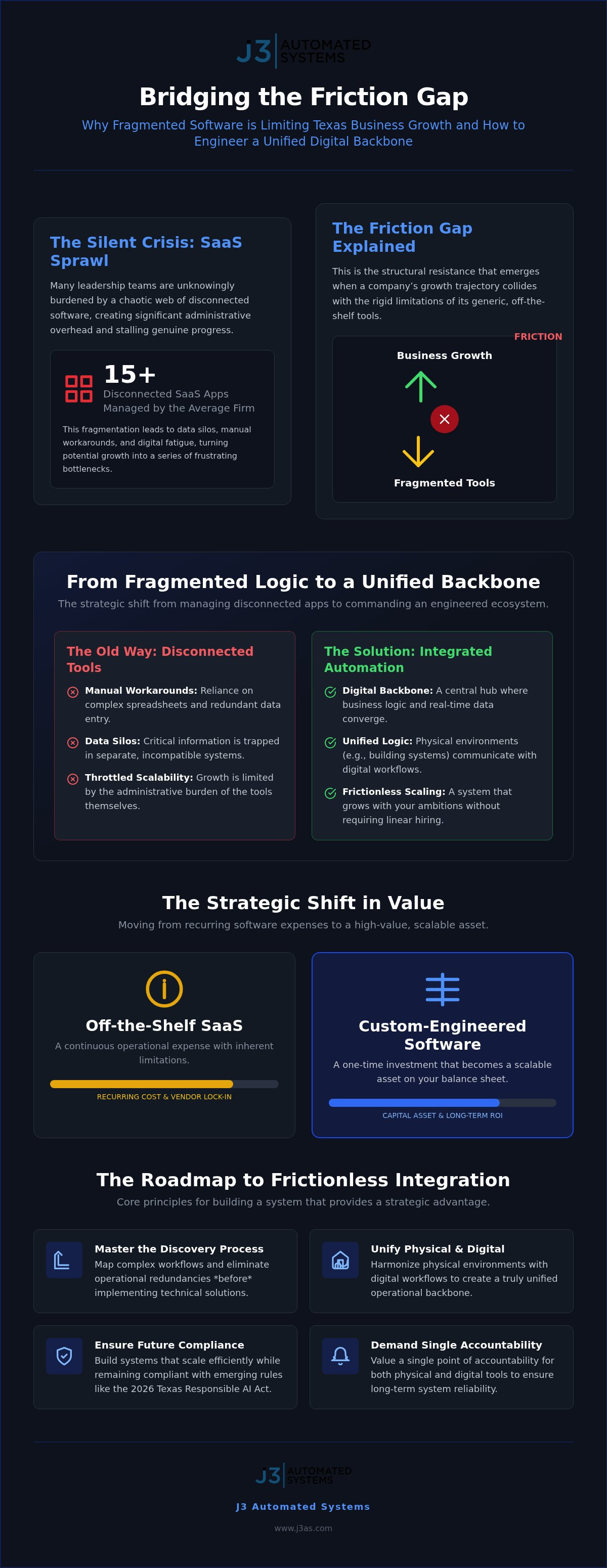
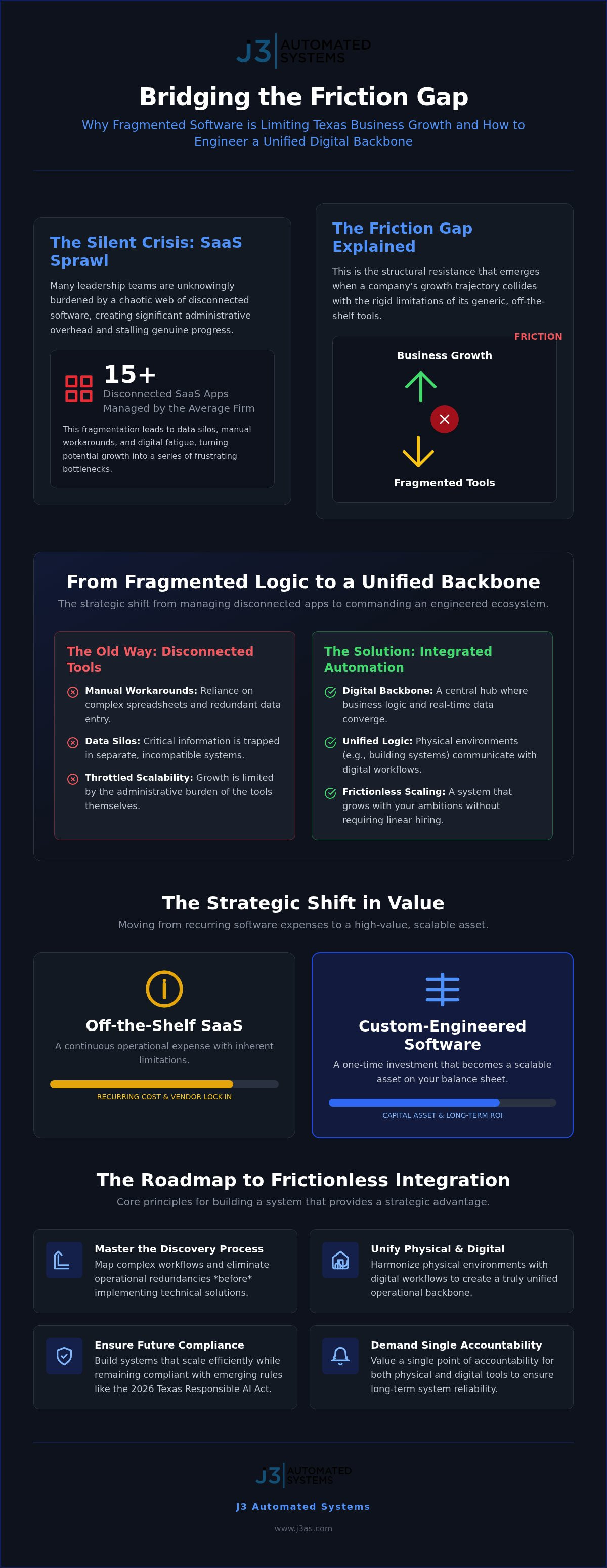
While 59% of Texas firms have now integrated AI into their operations, a silent crisis of complexity remains. Many leadership teams find themselves managing over 15 disconnected SaaS applications; this fragmentation creates significant administrative overhead and stalls genuine progress. Implementing an integrated business automation strategy is the only way to resolve the friction that occurs when your physical environment and digital logic fail to communicate. It's a burden that turns potential growth into a series of manual workarounds rather than a streamlined evolution.
This unified approach offers a more sophisticated path forward, replacing chaos with architectural precision. You'll discover how to bridge the gap between your building’s physical systems and your digital workflows to create a frictionless digital backbone. We'll examine the transition from disconnected tools to actionable intelligence via custom dashboards, ensuring your firm scales efficiently while remaining compliant with the 2026 Texas Responsible AI Governance Act. By the end of this guide, you'll understand how to build a system that grows with your ambitions without requiring linear hiring.
Key Takeaways
- Identify the hidden costs of SaaS sprawl and learn how to bridge the "friction gap" that occurs when generic software fails to keep pace with your firm's growth.
- Discover how an integrated business automation strategy harmonizes physical environments with digital workflows, creating a unified backbone for your entire operation.
- Evaluate the strategic shift from recurring SaaS expenses to custom-engineered software that acts as a scalable, high-value asset on your balance sheet.
- Master the discovery process to map complex workflows and eliminate operational redundancies before implementing any technical solutions.
- Recognize the value of a single point of accountability for both physical automation and digital tools to ensure long-term system reliability and performance.
The Friction Gap: Why Fragmented Tools Limit Texas Business Growth
Texas firms often reach a stage where their internal momentum outpaces the capabilities of their software. This misalignment creates what we define as the Friction Gap. It's the structural resistance that emerges when a company’s growth trajectory collides with the rigid limitations of generic, off-the-shelf tools. While these applications serve a purpose during the early stages of a business, they eventually become a ceiling that prevents true scalability. Transitioning to an integrated business automation strategy allows a firm to move beyond being a mere user of tools to becoming the owner of a precisely engineered ecosystem, a specialty of J3 Automated Systems.
The hidden cost of SaaS sprawl is particularly damaging in high-growth environments across Central Texas, from bustling metropolitan hubs like Austin to rapidly expanding communities such as New Braunfels, Seguin, Boerne, and Bandera. Many firms unknowingly accumulate 20 or more disconnected subscriptions, each housing a separate silo of data. This fragmentation leads to digital fatigue, where employees spend more time navigating various interfaces than performing high-value work. Business process automation (BPA) aims to resolve these inefficiencies, yet many standard solutions fail to bridge the gap between digital logic and physical operations. When your software doesn't speak to your building or your field equipment, you aren't automated; you're just digitally busy.
The Legacy Debt Dilemma
High-performance teams often find themselves hitting a productivity ceiling due to legacy debt. This occurs when outdated internal tools and manual workarounds, such as complex spreadsheets, become the primary way to manage workflows. Identifying the tipping point is crucial. It's the moment when the administrative hours spent on these workarounds cost more than the investment in a custom build. For companies undergoing rapid regional expansion across Central Texas, including those serving clients in New Braunfels, Seguin, Boerne, and Bandera, this digital fragmentation poses a significant risk to operational consistency and long-term profitability.
Fragmented Logic in the Texas Triangle
Firms operating across the San Antonio and Austin corridor face unique challenges when managing multi-site operations with disconnected tools. Operational friction is the structural resistance created by incompatible digital processes. When data must be manually entered into multiple systems to keep a project moving, scalability is throttled. For engineering and service firms throughout this region, this reliance on manual entry doesn't just slow down production. It introduces errors that compromise the white-glove service level their clients expect. An integrated business automation strategy replaces this fragmented logic with a unified flow, ensuring that information moves as quickly as the business demands.
Engineering the Holistic Digital Backbone: Unifying Physical and Digital Logic
A true integrated business automation strategy requires more than just connecting software; it demands the creation of a digital backbone. This backbone acts as a central hub where business logic, real-time data, and physical automation converge into a single, fluid system. Most automation efforts stop at the browser window, yet the most significant gains often lie in the intersection of your digital tools and your physical space. By integrating custom software for business efficiency with building management systems (BMS), firms ensure their environment responds as intelligently as their operations. It's the difference between managing a collection of apps and commanding an engineered ecosystem.
The benefits of automation extend far beyond simple time-savings. It's about removing the cognitive burden from your team so they can focus on high-level strategy. This level of seamlessness transforms the internal user experience into a service of its own, where technology feels like a quiet, capable partner rather than a source of frustration. When the digital and physical worlds are unified, the operational friction discussed previously begins to dissolve, replaced by a state of calm reliability.
AI-Driven Workflow Integration
Modern automation has moved past simple chatbots. We now engineer custom-built AI agents that execute specific tasks within your unique project lifecycle. By weaving AI business process automation into your existing rhythms, your systems transition from being reactive to proactive. These agents anticipate operational needs, such as flagging supply chain delays before they impact a site or automatically adjusting HVAC schedules based on meeting room bookings. This integration happens without friction, ensuring your team remains in their flow state without manual intervention.
Visualizing Intelligence via Custom Dashboards
Precision requires visibility. A "single pane of glass" allows leadership to oversee every facet of the business, from project milestones to energy consumption. Utilizing a custom dashboard for business data transforms raw information into actionable intelligence. This isn't just about digital metrics. By connecting physical assets, such as commercial security system design Texas, to your reporting hub, you gain a holistic view of your facility’s health and security in real-time.
When these systems are unified, the result is a state of effortless operation that scales naturally. If you're ready to move beyond fragmented tools, consider how engineering a custom digital backbone could redefine your firm's scalability.
Bespoke vs. Off-the-Shelf: Evaluating ROI and Long-Term Scalability
Choosing between a subscription-based model and a bespoke build is a fundamental decision that dictates a firm's financial and operational ceiling. While the low entry price of generic software is enticing, it often masks a false economy. An integrated business automation strategy based on custom architecture transforms software from a recurring liability into a balance-sheet asset. You move from renting someone else's logic to owning your own intellectual property, creating a permanent foundation for growth that doesn't disappear when a vendor changes their pricing structure.
Ownership offers a level of control that off-the-shelf products can't match. When you own the code, you aren't just a user; you're the architect of your own efficiency. This shift in perspective is what separates industry leaders from those who are perpetually playing catch-up with their competitors' tech stacks. By investing in a system designed specifically for your workflows, you eliminate the friction of forced workarounds and create a digital environment that fits your business like a tailored suit.
Total Cost of Ownership (TCO) Analysis
A rigorous Total Cost of Ownership (TCO) analysis reveals the true price of convenience. When you compare the 3-year cost of a custom build against the escalating per-user fees of enterprise-grade SaaS, the financial advantage shifts toward proprietary ownership. Beyond the subscription cost, firms must account for the "Integration Tax," which represents the hidden labor and specialized consulting required to force fragmented tools to communicate. The global custom software market is projected to reach $146 billion by 2030, a figure that reflects the industry's pivot toward specialized, high-performance systems. This growth underscores the reality that generic platforms often fail to deliver the long-term ROI that high-growth companies require.
The Competitive Advantage of Proprietary Tools
Proprietary tools allow you to digitize your "Secret Sauce" rather than forcing your team to adapt to the constraints of a third-party app. For local Texas firms, this distinction is vital to out-compete national chains that rely on the same generic software as everyone else. By implementing custom automation solutions for small business, you create a unique operational barrier to entry. Your processes become faster, more precise, and impossible for competitors to replicate without the same engineered backbone. This tailored approach ensures your integrated business automation strategy remains a unique asset rather than a commodity.
Resilient networking and data protection are non-negotiable for sensitive Texas industries, from energy to healthcare. Engineering a custom environment allows for deeper control over security protocols that generic SaaS providers often overlook. This bespoke approach ensures your firm remains compliant with local regulations while maintaining the high-tier performance required for modern facilities. It's about building a fortress around your data, ensuring your operations remain secure as you scale.
The Discovery Roadmap: Mapping Workflows for Frictionless Integration
Successful automation fails when it's treated as a product purchase rather than an engineering challenge. A robust integrated business automation strategy begins at the whiteboard, long before a single line of code is written. This discovery process is where we dissect your current project lifecycle to find the structural weaknesses that generic tools ignore. By treating discovery as a phase of engineering, we ensure the final system isn't just a collection of features, but a solution to specific operational resistance.
The roadmap follows a logical, three-step progression to move from manual effort to intelligent flow. First, we identify the specific bottlenecks and redundancies in your current lifecycle, such as the moments where data is trapped in a spreadsheet or a single person's inbox. Second, we map the data flow between your digital tools and your physical building assets, ensuring your software understands what's happening on the facility floor. Finally, we engineer the user journey for your employees. If the system doesn't feel like a natural extension of their work, adoption will stall. We design for zero friction from day one.
From Chaos to Clarity: The Logic Mapping Phase
J3 maps your existing workflows to identify precisely where automation will yield the highest ROI. We look at the "End-to-End" lifecycle, ensuring that your software supports a project from the initial bid through to final site commissioning. This architectural approach allows us to avoid "feature bloat," which is the tendency to build unnecessary functions that complicate the user experience. We build exactly what's required for efficiency, creating a lean, powerful system that does exactly what your business needs and nothing more. It's about precision over volume.
Designing for Human Adoption
White-glove software design focuses on the people who interact with the tools every day. A system can be technically perfect, but it's a failure if it feels like a burden to your team. We bridge the gap between office staff and field technicians by creating unified, mobile-first tools that keep everyone in sync. This approach ensures the system feels like a capable assistant rather than a rigid requirement. When your field team can update a project status with a single tap, and your office dashboard reflects that change instantly, the friction discussed in previous sections finally disappears.
If you're ready to see how your current workflows could be transformed into a streamlined digital backbone, schedule a discovery session with J3 Automated Systems to begin your mapping process.
Partnering with a Visionary Integrator: The Texas Strategic Advantage
The complexity of modern operations requires more than a software vendor; it demands a single point of accountability. When you distribute your integrated business automation strategy across multiple contractors-one for networking, another for building systems, and a third for custom code-you invite the very friction you're trying to eliminate. J3 Automated Systems acts as a visionary integrator, providing a unified team that handles engineering, installation, and ongoing software development. This consolidated approach ensures that every component of your digital backbone is designed to work in harmony, removing the burden of managing conflicting vendors and incompatible systems.
Our role is to serve as a master of complexity, simplifying your world through intellectual rigor and technical precision. We don't just deliver equipment; we provide a high-level consultancy that bridges the gap between your physical environment and your digital workflows. This partnership moves beyond "support tickets" into a proactive stewardship, where we anticipate your growth needs and adjust your systems before bottlenecks occur. It's a premium service orientation designed for firms that value long-term functionality over quick, fragmented fixes.
A Holistic Approach to Property and Process
Our expertise spans the entire spectrum of automation, from the invisible infrastructure of high performance residential networking to sophisticated custom web applications for commercial firms. We understand that the logic behind cinema grade home theater design, where precision and user experience are paramount, can be integrated into commercial environments to create premium client experiences. This high-touch service model is especially valuable for firms in San Antonio, Austin, Boerne, and the surrounding Hill Country. Whether you're managing a corporate headquarters or a high-end estate, our local presence provides a strategic advantage through responsive, face-to-face partnership that offshore outsourcing cannot replicate.
Securing Your Operational Future
Engineering a digital backbone isn't a one-time event; it's an evolving commitment to efficiency. As market dynamics shift within the Texas Triangle, your custom software must adapt to maintain your competitive edge. We provide white-glove support that ensures your integrated business automation strategy evolves alongside your firm. This proactive maintenance keeps your systems resilient and scalable, allowing you to focus on high-level leadership while we manage the underlying technical complexity.
The first step toward operational harmony is a comprehensive systems audit. This assessment isn't a superficial checklist; it's a rigorous engineering evaluation of your data flows and physical infrastructure. We identify the specific friction points where your current tools are failing to support your ambitions and map a path toward a unified flow. Contact J3 Automated Systems to engineer your integrated automation strategy.
Reclaiming Operational Harmony
The transition from a collection of fragmented tools to a unified digital backbone is more than a technical upgrade; it's a strategic evolution. By bridging the gap between your physical environment and digital logic, you eliminate the friction that stalls growth and creates administrative burden. This integrated business automation strategy ensures your systems work as a single, intelligent entity rather than a series of disconnected silos. You move from managing complexity to commanding a scalable, proprietary asset that grows with your firm.
True operational excellence requires a partner who provides a single point of accountability for both hardware and software. J3 Automated Systems offers visionary integration backed by Texas-based engineering and support, ensuring your systems are as resilient as they are intelligent. It's time to stop fighting your tools and start leveraging a system designed specifically for your unique workflows. Your journey toward effortless operation is a deliberate path from fragmentation to architectural precision.
Schedule a Custom Systems Audit with J3 Automated Systems to identify your friction points and begin engineering your digital future. We look forward to helping you build a legacy of efficiency and growth.
Frequently Asked Questions
What is the difference between an automation strategy and just buying software?
An automation strategy is a comprehensive architectural blueprint, whereas buying software is simply acquiring a disconnected tool. The strategy ensures that every digital and physical component works in harmony to eliminate operational friction. Without this high-level mapping, firms often suffer from SaaS sprawl and fragmented data silos that limit long-term scalability and increase administrative burden.
Is an integrated automation strategy worth the investment for a local Texas SMB?
Investing in an integrated business automation strategy is highly beneficial for Texas SMBs aiming to scale without proportionally increasing their administrative headcount. It transforms your operations from a series of manual workarounds into a streamlined digital backbone. This shift allows local firms to out-compete larger national chains by leveraging proprietary efficiency and superior data intelligence across their regional sites.
How long does it typically take to engineer a custom digital backbone?
Engineering a custom digital backbone typically follows a methodical timeline that moves from discovery to deployment over several months. We prioritize a deliberate pace to ensure the mapping phases are exhaustive and the logic is sound. This precision prevents future rework and ensures the final system integrates seamlessly with both your physical facility and digital workflows from the moment of activation.
Can custom software integrate with my existing tools like QuickBooks or Salesforce?
Custom-engineered tools are specifically designed to communicate with existing platforms such as QuickBooks, Salesforce, or specialized industry ERPs. We eliminate data silos by building secure, reliable bridges between your legacy software and your new digital backbone. This integration ensures that information flows effortlessly across your entire enterprise without the need for manual data entry or redundant administrative tasks.
Do I own the source code for the custom tools J3 develops?
You maintain full ownership of the intellectual property and source code for the custom tools J3 develops for your firm. Unlike SaaS models where you essentially rent logic, our custom builds are balance-sheet assets that belong entirely to your business. This ownership provides a significant strategic advantage, ensuring your operational "secret sauce" remains protected, proprietary, and free from recurring subscription fees.
How does physical building automation tie into a business strategy?
Physical building automation, including lighting, HVAC, and security, provides real-time environmental data that informs your broader business logic. Occupancy sensors or energy monitors can automatically trigger project status updates or adjust facility usage based on actual demand. Integrating these physical assets into your digital reporting hub creates a holistic view of your operations that standalone software simply cannot provide.
What is the 'Discovery Phase' and why is it necessary?
The Discovery Phase is a critical engineering audit where we map your existing workflows to identify bottlenecks and high-ROI opportunities. It's necessary because it prevents feature bloat and ensures we build a system that solves your specific friction points. This phase transforms operational chaos into a clear architectural roadmap for your integrated business automation strategy, ensuring every line of code serves a purpose.
Does J3 provide ongoing support for custom-engineered systems?
J3 provides proactive, long-term support and maintenance to ensure your custom-engineered systems evolve alongside your business growth. We move beyond the traditional support ticket model to act as a dedicated steward of your technology stack. Our Texas-based engineering team remains available to scale your digital backbone as market dynamics shift or your operational requirements expand into new territories.