Integrated Smart Home Technology in Texas: The 2026 Estate Engineering Guide
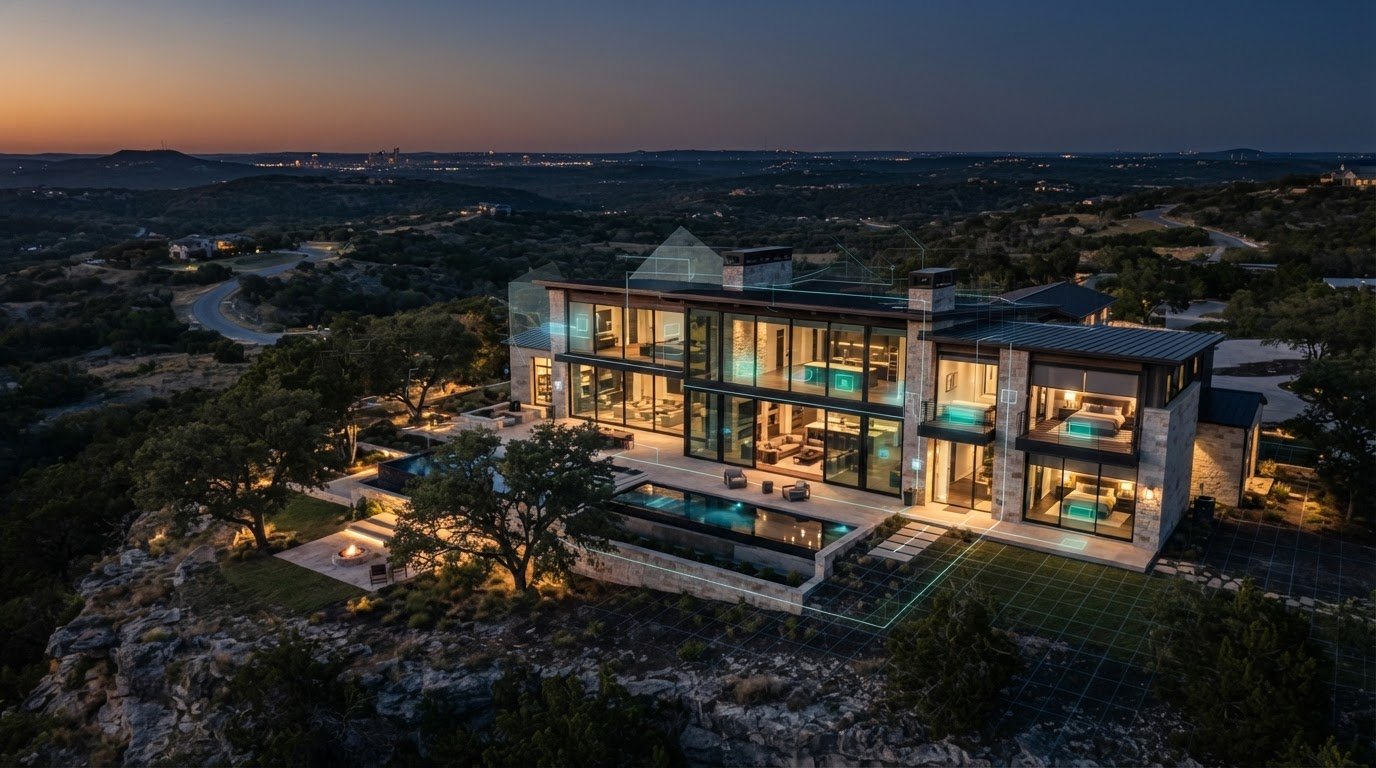
A collection of high-end connected devices doesn't make an intelligent estate; it simply creates an expensive web of daily friction. If you're constantly toggling between separate apps just to adjust multi-zone HVAC, lower motorized shades against the brutal afternoon sun, and manage audio across outdoor pavilions, your home is working against you. Sprawling Hill Country layouts and multi-acre properties require a far higher standard. Deploying engineered integrated smart home technology Texas estates demand means unifying environmental controls, security, and power into a single, beautifully concealed ecosystem.
You already understand that true luxury lies in simplicity and quiet reliability, not in troubleshooting a patchwork of fragile consumer gadgets. In this 2026 estate engineering guide, you'll discover how holistic low-voltage design eliminates subcontractor finger-pointing, preserves pure interior aesthetics, and ensures uninterrupted operation during extreme Texas weather events. We break down the architectural integration, fiber network infrastructure, and single-touch control architecture necessary to deliver effortless living across your entire property.
Key Takeaways
- Explore how engineered integrated smart home technology Texas estates utilize connects lighting, climate, entertainment, and access into a single responsive system.
- Discover how automated shading coordinates dynamically with multi-zone climate controls to mitigate extreme solar heat loads and reduce daily mechanical strain.
- Learn the critical operational differences between specialized low-voltage engineering firms and basic electrical contractor add-ons.
- Review the essential multi-step architectural design methodology required to embed resilient networking and concealed hardware into expansive estate floor plans.
- Identify the core qualification standards for selecting an integration partner capable of delivering single-source accountability across design, commissioning, and ongoing support.
The Evolution of Integrated Smart Home Technology in Texas Estates
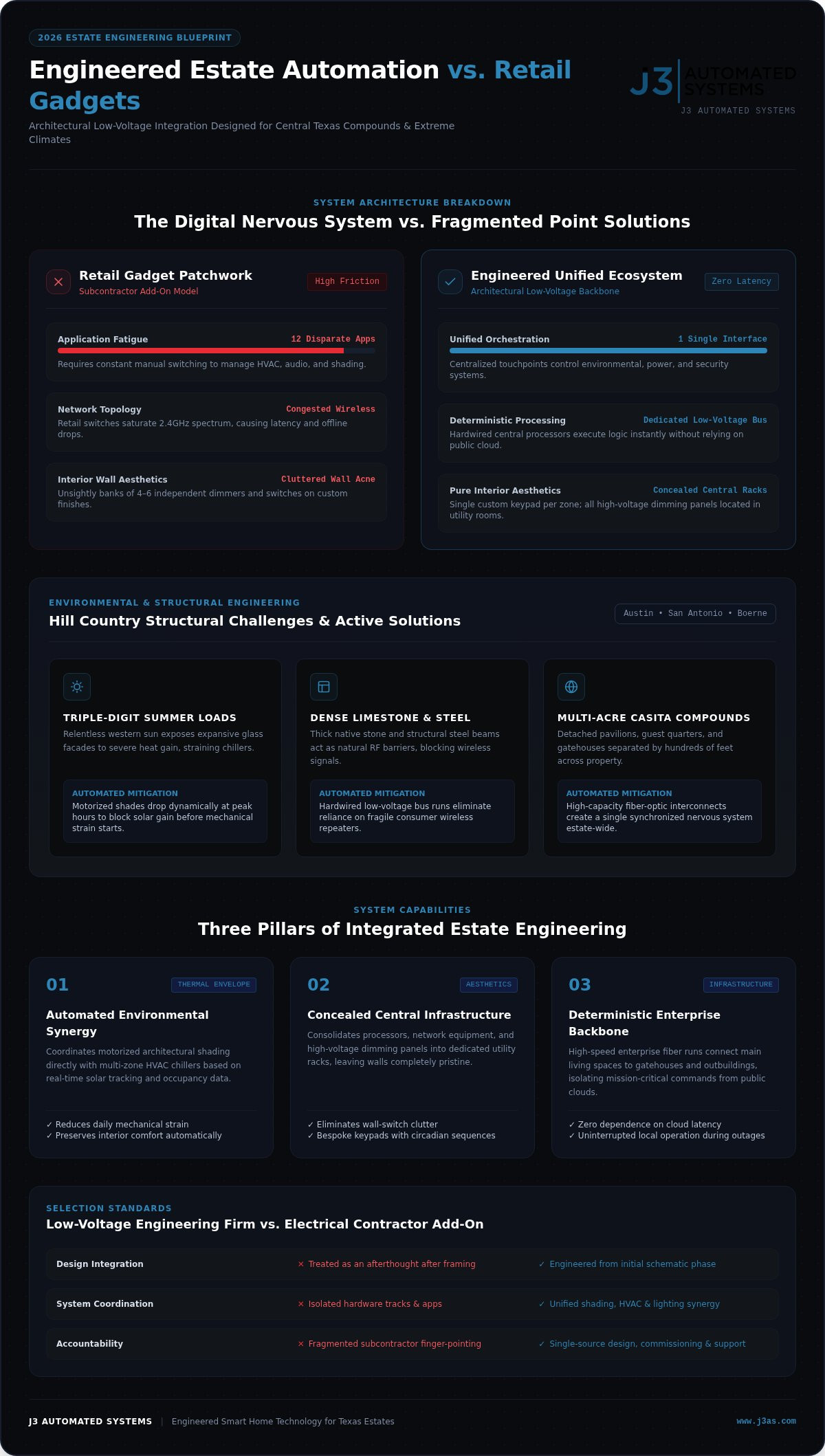
True luxury automation is not achieved by accumulating connected devices. It requires a singular digital nervous system. While consumer gadgets operate in isolated silos, engineered centralized home automation systems weave lighting, access control, multi-zone HVAC, and architectural acoustics into an intelligent whole. As modern engineering demonstrates, an integrated smart home coordinates lighting, climate, and access through automated predictive logic. Rather than demanding constant human direction, the estate anticipates occupancy, solar trajectory, and security postures quietly in the background.
Basic electrical subcontractors often treat smart technology as an afterthought, wiring independent wall dimmers or installing retail smart switches that saturate local Wi-Fi frequencies. In contrast, implementing integrated smart home technology texas architects and builders rely on demands enterprise-grade low-voltage infrastructure designed from initial schematics. Centralized hardware racks conceal complex processing off-site or within dedicated utility rooms, eliminating wall clutter and protecting refined interior design.
Moving Beyond Fragmented Point Solutions and Consumer Gadgets
Relying on disparate consumer gadgets introduces friction and structural vulnerability across sprawling residential compounds. Off-the-shelf smart products depend on public cloud servers, creating latency and leaving essential features exposed when internet connectivity drops. A unified ecosystem eliminates this failure point:
- Deterministic communication: Dedicated low-voltage buses and hardwired processors execute commands instantly, bypassing congested wireless channels.
- Unified software orchestration: A single interface replaces twelve disparate mobile apps, presenting synchronized controls for audio distribution, climate, and security.
- Predictive subsystem logic: Subsystems share telemetry, allowing high-draw systems to modulate output without manual intervention.
Responding to Central Texas Architectural and Environmental Demands
Hill Country estates present unique physical challenges that standard retail hardware cannot survive. Dense Texas limestone walls, sprawling multi-structure compounds, and heavy steel framing act as natural radio barriers, causing consumer Wi-Fi devices to drop offline repeatedly. Reliable deployment requires an engineered enterprise backbone featuring fiber-optic interconnects between outbuildings, guest casitas, and main living quarters.
Central Texas environmental extremes demand active mechanical coordination. In regions like Austin, San Antonio, and Boerne, triple-digit summer heat loads place immense pressure on regional electrical infrastructure. Sophisticated integrated smart home technology in Texas combines motorized architectural shading with environmental sensors to deflect severe solar heat gain before it penetrates the building envelope. By automating the relationship between passive thermal barriers and interior chillers, an engineered estate maintains stable interior temperatures while significantly curbing mechanical strain.
Core Pillars of an Engineered Luxury Automation Ecosystem
A unified estate environment functions as an orchestrated ecosystem where individual subsystems reinforce one another. Rather than isolating climate, lighting, and entertainment into disconnected hardware tracks, an engineered installation blends these disciplines into a responsive architectural framework. When deploying integrated smart home technology texas residences require balance, ensuring that high-performance mechanical systems and delicate architectural finishes work in tandem without friction.
Architectural Lighting, Motorized Shades, and Environmental Harmony
Expansive glass facades define premier Hill Country architecture, but they also expose interiors to severe thermal gain. Motorized exterior and interior shades drop automatically during peak afternoon hours, shielding living spaces from relentless western sun exposure. This dynamic shading barrier coordinates directly with multi-zone climate equipment, relieving cooling strain across large floor plans. Centrally located low-voltage dimming panels eliminate cluttered banks of wall switches, replacing them with bespoke keypads programmed for dynamic circadian sequences that mirror the sun's natural color temperature from dawn to dusk.
Cinema-Grade Private Screening and Whole-Property Audio Integration
Acoustic precision within luxury residences demands deliberate isolation and high-output performance. Designing dedicated spaces requires specialized low-frequency management, structural dampening, and calibrated multi-channel processing, as detailed in our guide to cinema grade home theater design. Outside the screening room, entertainment flows smoothly into outdoor loggias, pool pavilions, and open galleries. To discover how continuous soundscapes are engineered to defeat ambient wind and open-air acoustic loss across multi-acre grounds, explore our complete analysis of luxury home audio solutions.
Resilient Low-Voltage Infrastructure and Enterprise Networking
An intelligent property is only as dependable as the network carrying its data traffic. Deploying high performance residential networking establishes the necessary digital foundation through hardwired 10GbE fiber backbones, commercial routing, and dual-WAN failover that switches seamlessly between redundant internet providers during regional grid fluctuations. Protecting estate subsystems from digital intrusions requires rigorous security protocols, including dedicated IoT network segmentation to isolate sensitive controls, surveillance, and entertainment traffic from guest and mobile networks.
Every critical component, from central processors to environmental sensors, relies on uninterrupted battery backups that shield sensitive circuit boards from line transients and temporary brownouts. Discerning homeowners seeking a fully unified property can collaborate with J3 Automated Systems to design a customized low-voltage architecture tailored to their estate's exact demands.
Integrated Engineering vs. Electrical Subcontractor Add-Ons
High-voltage line wiring and low-voltage systems engineering require entirely distinct disciplines. Electrical subcontractors excel at code compliance, service entrance panels, and high-voltage power distribution. However, treating intelligent automation as an electrical add-on routinely produces uncoordinated hardware, aesthetic discord, and finger-pointing between trades when devices fail to communicate. A certified technology integrator takes holistic accountability for system performance across every connected subsystem, translating architectural intent into an integrated digital fabric.
Executing modern integrated smart home technology texas estates demand means designing data topologies before walls are framed. Rather than mounting disparate consumer hubs across mechanical closets, a dedicated technology architect develops detailed signal schematics, thermal dissipation plans for hardware enclosures, and specialized bus cabling. This ensures lighting, climate, shades, and whole-property entertainment operate as one synchronized environment.
Comparing Traditional Electrical Approaches with Systems Integration
The differences between standard trade work and holistic engineering emerge across four critical operational dimensions:
- System Architecture: Electricians route line-voltage wiring directly to local switches. Integrators design centralized panelized enclosures using programmable microprocessors, eliminating switch banks and providing discreet digital control.
- Pre-Construction Coordination: Systems integrators interface directly with interior architects and lighting designers, aligning keypad finishes, shade pocket dimensions, and flush-mount fixtures to protect interior aesthetics.
- Network Infrastructure: High-voltage crews rarely engineer enterprise backbones. Integrators deploy managed switches, clean fiber pathways, and dedicated subnets engineered to handle sustained local traffic without congestion.
- Long-Term Support: Electrical contractors typically conclude their involvement at the final trim inspection. Technology partners provide ongoing software maintenance, remote diagnostics, and tailored logic adjustments long after move-in.
Mitigating System Latency, Protocol Conflicts, and Firmware Drift
Consumer devices often rely on conflicting wireless protocols such as Zigbee, Z-Wave, and standard Wi-Fi. In sprawling residences, these uncoordinated radios compete for bandwidth, introducing severe control latency and dropped commands. Centralized automation processors bypass these conflicts by establishing hardwired communication pipelines with deterministic response times.
Independent smart devices frequently suffer from firmware drift, where unsynchronized cloud updates break third-party integrations overnight. A unified engineering model isolates primary property operations from volatile consumer clouds. The estate's core routines remain responsive locally, mirroring the fail-safe stability seen in commercial building management systems Texas developers rely on for mission-critical facility controls. When hardware firmware requires modernization, it is vetted and deployed uniformly through proactive management, protecting perimeter access, climate scheduling, and illumination routines from sudden interruption.
Designing an Estate Automation Architecture for Central Texas Properties
Executing a successful deployment requires a phase-gated engineering methodology. Designing the integrated smart home technology texas luxury builds demand cannot happen after drywall goes up. Instead, it follows a structured five-stage progression:
- Discovery: Defining operational requirements, lifestyle rhythms, and property interactions.
- Schematic Design: Drafting low-voltage pathways, wiring schedules, and MEP coordination plans.
- Infrastructure Rough-In: Pulling structured wiring, high-speed fiber backbones, and rough-in enclosures.
- Rack Integration: Terminating, dressing, and rack-mounting enterprise processors and amplification.
- Commissioning & Handover: Programming custom logic, fine-tuning sensors, and completing client onboarding.
Pre-Construction Collaboration with Architects and Builders
In Austin, San Antonio, and across the Hill Country, luxury estates frequently utilize monolithic slab foundations. Embedding below-slab conduit and exterior ground pathways requires detailed technology schematics before concrete pours. Direct collaboration with mechanical and interior design teams allows integrators to hide temperature probes within custom millwork, eliminating protruding wall thermostats and preserving smooth architectural surfaces.
Centralized Equipment Rack Specification and Thermal Management
Enterprise automation processors, multichannel audio amplifiers, and network core switches generate substantial thermal energy. In warm Texas environments, an unventilated mechanical closet will degrade sensitive circuit boards within months. Professional installations consolidate hardware into heavy-gauge equipment racks outfitted with dedicated, thermostatically controlled exhaust venting. Precision cable management and isolated power conditioning safeguard delicate silicon from lightning-induced voltage spikes and fluctuating rural utility lines.
Refining the User Interface for Intuitive, Effortless Living
The ultimate measure of engineering rigor is simplicity on the surface. Custom-engraved architectural keypads eliminate switch clutter by consolidating pathway illumination, motorized shades, and continuous audio onto one unified wall station. In high-traffic zones like the kitchen or primary suite, flush-mounted touch screens provide single-touch access to macro routines:
- Morning: Slowly raises east-facing shades, illuminates master bath lighting to a warm color temperature, and brings audio zones online.
- Entertain: Activates outdoor loggia soundscapes, sets architectural accent lighting, and locks pool access gates.
- Away: Lowers western shades against intense afternoon solar gain, sets HVAC systems into conservation modes, and arms perimeter security latches.
To establish a cohesive low-voltage infrastructure tailored to your build, schedule an engineering consultation with J3 Automated Systems.
Selecting an Integration Partner for Modern Texas Residences
The success of an estate automation project depends entirely on who holds the engineering responsibility. While high-volume electrical contractors treat smart hardware as an auxiliary line item, complex properties require a dedicated systems architect. Partnering with a specialized firm guarantees single-source accountability from initial conduit design through software commissioning and life-cycle management. When selecting a team to deliver the integrated smart home technology texas residences rely on, regional presence is vital. Establishing local operational coverage across San Antonio, Austin, Boerne, New Braunfels, Seguin, Bandera, and San Marcos ensures prompt on-site responsiveness and deep familiarity with regional building methods.
The Advantage of a Single Accountable Engineering Team
Fragmenting low-voltage infrastructure across multiple trades introduces operational confusion. When an outdoor audio zone drops or a motorized shade fails to trigger alongside the HVAC schedule, electricians point to the audio vendor, who in turn blames the network installer. A single engineering team eliminates this friction completely. By unifying environmental controls, cinema-grade private screening spaces, and enterprise networking under one master specification, you maintain a singular point of accountability. Custom software capabilities also allow the engineering team to bridge bespoke architectural features, creating specialized drivers for unique water elements, automated entry gates, or custom wine room environments without compromise.
White-Glove Commissioning, System Tuning, and Proactive Support
System deployment does not conclude when the construction punch list is signed. True luxury integration demands careful post-occupancy calibration:
- Acoustic and Environmental Calibration: Technicians conduct on-site sound profile tuning and adjust dynamic lighting levels across day and night cycles after furnishings are placed.
- Proactive Remote Diagnostics: Enterprise monitoring platforms quietly track device health, thermal metrics, and network bandwidth, resolving anomalous processor behavior or re-establishing communication pathways before residents notice a disruption.
- Tailored Client Onboarding: Integration specialists lead an in-person orientation, verifying that every family member and property manager can control the residence intuitively from wall keypads or primary mobile interfaces.
Protecting the long-term integrity of your estate requires deliberate design and enduring support. Consult with J3 Automated Systems to engineer your custom estate technology and bring absolute cohesion to your living environment.
Realizing the Full Potential of Your Texas Estate
True architectural living demands complete harmony between expansive physical spaces and the digital systems supporting them. Implementing dependable integrated smart home technology texas estates require replaces fragmented consumer apps and conflicting hardware with a singular, responsive ecosystem. When motorized shading, circadian lighting, multi-room audio, and enterprise networking are engineered into the property's early schematics, complex technology operates silently in service of your daily comfort.
Achieving this level of continuous reliability requires single-source accountability. J3 Automated Systems provides comprehensive low-voltage engineering, precision hardware procurement, professional installation, and ongoing white-glove tuning. Serving discerning homeowners and custom builders across San Antonio, Austin, Boerne, and surrounding Hill Country communities, we coordinate AV, environmental controls, robust networking, and custom software under one standard of excellence. Schedule an architectural consultation with J3 Automated Systems to bring lasting balance, resilience, and effortless control to your property.
Frequently Asked Questions
What is the difference between an integrated smart home and smart home devices?
Smart devices function as independent gadgets managed through isolated mobile apps. An integrated smart home unifies lighting, shading, multi-room audio, and climate into a centralized, hardwired processor. When deploying integrated smart home technology texas properties require, devices communicate locally through synchronized predictive logic rather than competing for bandwidth across fragmented third-party clouds.
Can integrated smart home systems help manage high Texas energy bills?
Yes, unified systems significantly reduce utility strain by coordinating dynamic building envelope controls with mechanical HVAC equipment. Automated motorized shading lowers during peak afternoon hours along south- and west-facing elevations to block severe solar heat gain. By keeping thermal loads out of living spaces, multi-stage cooling systems cycle less frequently during intense summer heatwaves.
When should an integrator be involved during a custom home build or renovation?
An integrator should join the project team during the architectural schematic phase before structural engineering is finalized. Early involvement ensures low-voltage conduits, centralized equipment closet ventilation, recessed shade pockets, and in-ceiling acoustic enclosures are designed directly into the architectural blueprints before slab pours begin across Austin or San Antonio properties.
How do stone walls and large estate layouts in Texas affect smart home connectivity?
Thick Texas limestone walls and expansive steel framing absorb radio frequencies, creating severe wireless dead zones for consumer equipment. Solving this requires hardwired enterprise infrastructure. Integrators run structured cabling and multi-gigabit fiber-optic lines between the main residence, guest casitas, and outdoor pavilions, pairing them with commercial access points to ensure continuous roaming coverage.
What happens to my integrated smart home if the internet connection goes down?
All core living functions continue operating normally because the system relies on a local centralized processor rather than remote cloud servers. Wall keypads, scheduled lighting sequences, motorized shades, and internal security pathways execute instantaneously without internet access. Only off-property remote notifications and external streaming services pause until connectivity is restored.
Can smart home controls be integrated into historical homes in San Antonio and Boerne?
Yes, heritage properties in areas like the King William Historic District or downtown Boerne can be upgraded without compromising historic plaster or timber. Integrators deploy specialized low-voltage keypads, architecturally concealed architectural speakers, and localized wireless controllers that preserve historical integrity while delivering modern integrated smart home technology texas homeowners expect.
Why is a commercial-grade network required for whole-home automation systems?
Modern luxury residences support hundreds of IP-connected endpoints across surveillance cameras, streaming amplifiers, environmental sensors, and touch screens. Standard residential routers suffer from processor bottlenecks under this volume. Commercial-grade routing, enterprise managed switches, and isolated VLAN configurations prevent traffic congestion and protect property controls from external network vulnerabilities.