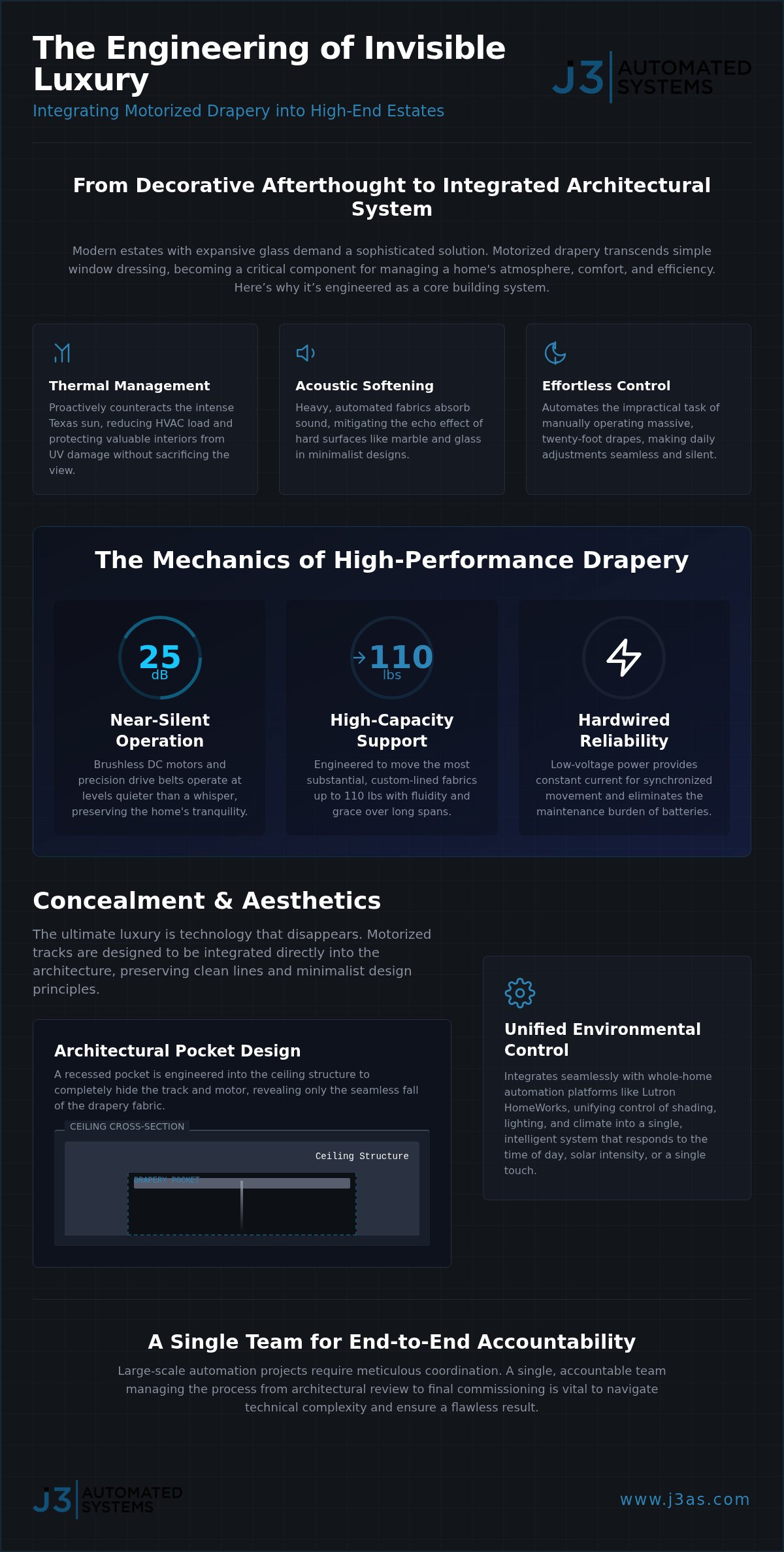
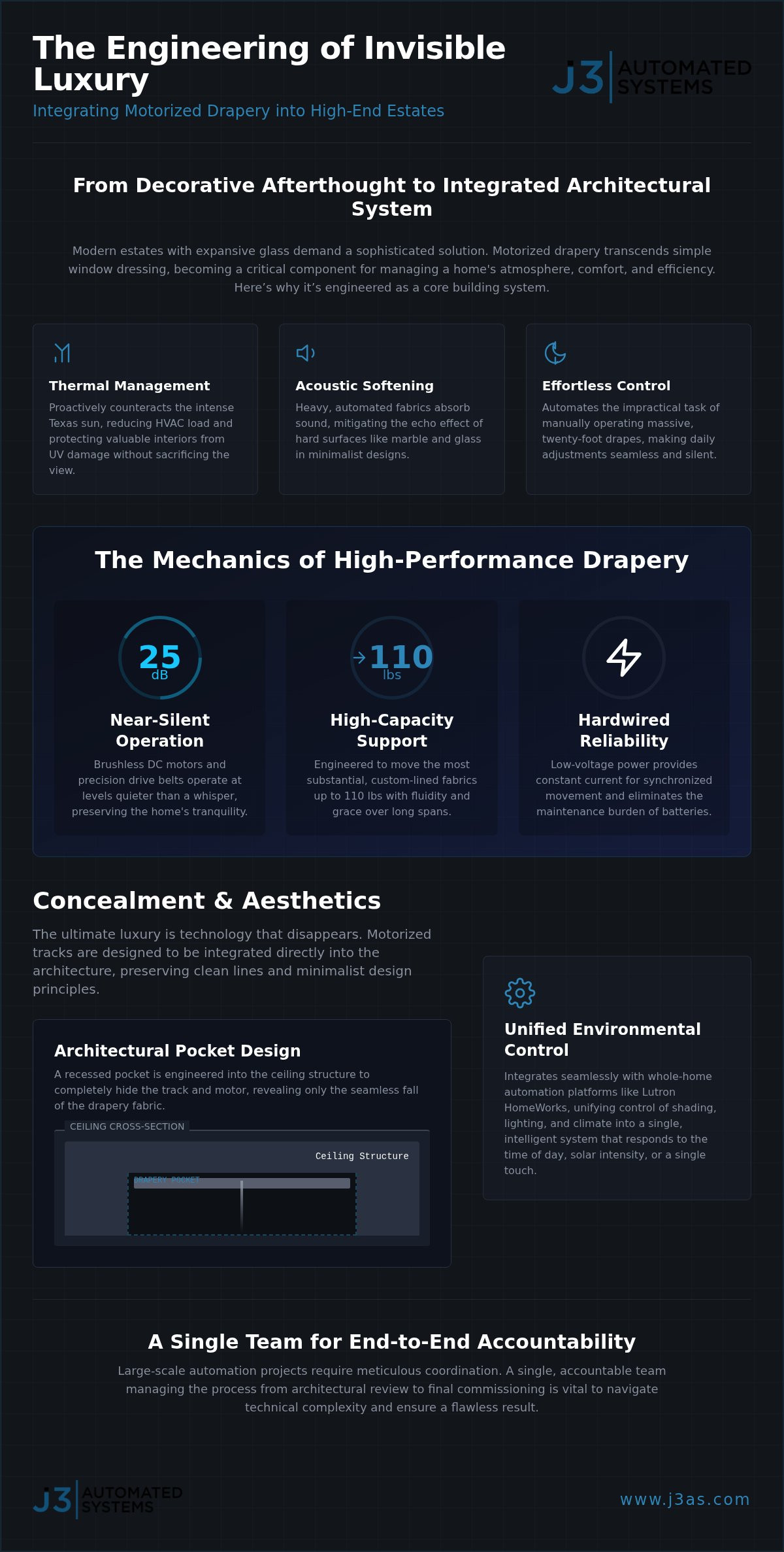
Motorized Drapery Tracks: 2026 Luxury Engineering Guide
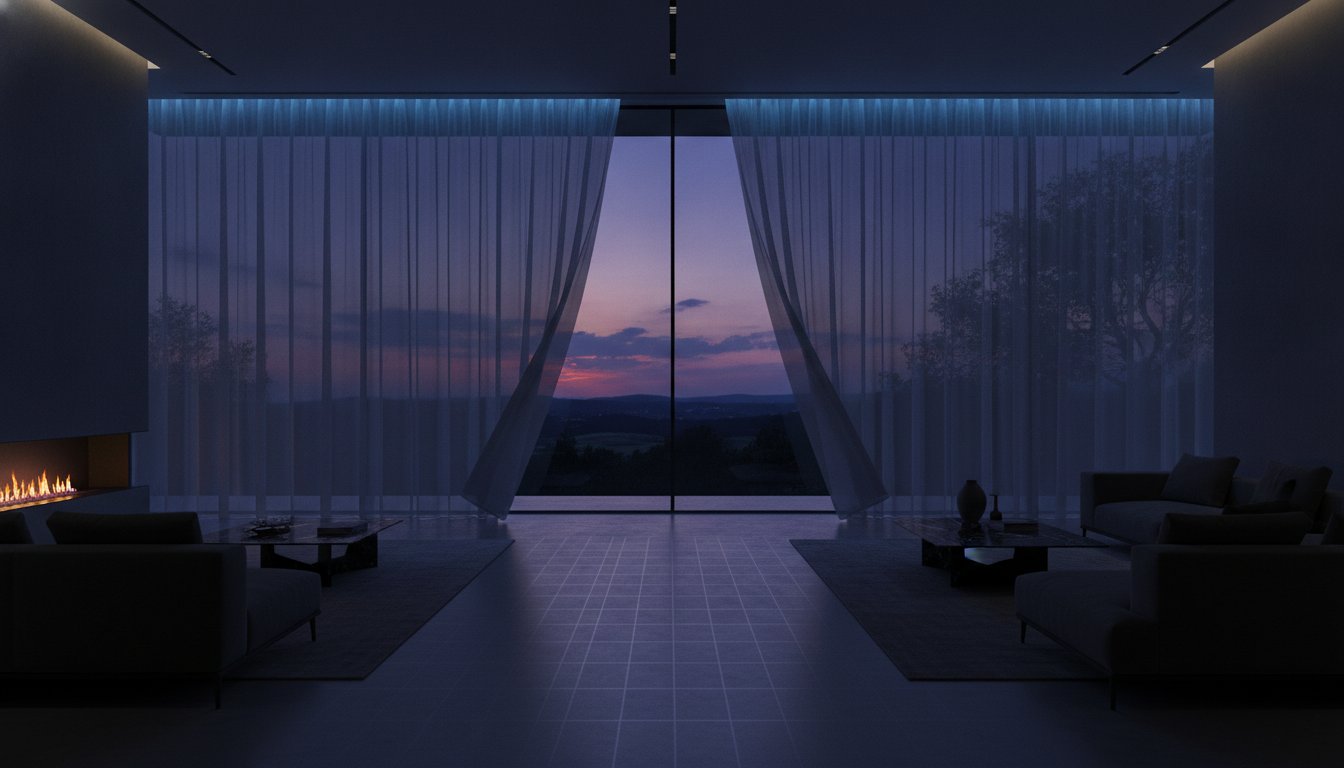
A window treatment in a high-end estate is far more than a decorative layer; it is a critical piece of architectural engineering that dictates the home's atmosphere and thermal performance. You understand the friction of managing expansive, floor-to-ceiling drapes that feel heavy to the touch or seeing beautiful minimalist lines disrupted by visible, clunky hardware. It's frustrating when a noisy motor breaks the silence of a well-appointed room, or when the Texas sun forces a choice between a view and a comfortable temperature.
This guide demonstrates how to integrate motorized drapery tracks for luxury homes that balance high-capacity power with near-total silence. You will discover the technical requirements for concealing mechanical components within the ceiling and how to leverage 25dB motor technology for effortless movement. We'll explore how these systems provide a single point of control for automated thermal management, ensuring your home remains an oasis of intelligent, silent operation. By shifting the perspective from simple hardware to integrated systems, you can achieve a result that is as functional as it is invisible.
Key Takeaways
- Understand why motorized drapery tracks for luxury homes are engineered as integrated building systems rather than standalone window treatments.
- Discover how brushless motors and precision drive belts achieve near-silent operation at 25dB to preserve your home's quiet ambiance.
- Learn to unify environmental control by integrating motorized shading with lighting via sophisticated platforms like Lutron HomeWorks.
- Identify the specific pocket dimensions and architectural requirements needed to achieve total concealment of high-capacity tracks.
- See why a single accountable team is vital for managing the technical complexity of large-scale automation projects in Texas estates.
The Architectural Role of Motorized Drapery in Modern Estates
Modern estate design often prioritizes expansive glass to erase the boundary between indoors and out. In Austin and San Antonio, these floor-to-ceiling vistas are breathtaking, but they present a significant engineering challenge. Manual operation of heavy, high-capacity fabrics is simply impractical; the sheer weight of a twenty-foot custom drape makes daily adjustment a burden rather than a choice. We view automated window coverings as a core component of a holistic building management system, not a decorative afterthought. When you treat shading as an architectural layer, it moves from a static element to a dynamic tool for controlling the home's environment.
Thermal Control for the San Antonio Climate
The intensity of the Texas sun can quickly turn a glass-walled living space into a thermal liability. High-performance motorized drapery tracks for luxury homes provide the first line of defense against radiant heat gain. By integrating solar sensors, these tracks respond dynamically to UV intensity, closing automatically during peak hours to prevent heat from saturating the interior. This proactive approach significantly reduces the load on HVAC systems by managing the building's thermal envelope before the thermostat even triggers. This level of precision is achieved through the synergy between shading and commercial building management systems Texas developers use to maintain climate stability. Beyond energy efficiency, this automation protects expensive art collections and fine wood finishes from the degrading effects of direct sunlight.
Acoustic Softening in Minimalist Design
Minimalist luxury often relies on hard surfaces like polished marble, vast glass panels, and exposed concrete. While visually striking, these materials create acoustic "echo chambers" that can feel cold or hollow. Motorized drapery tracks facilitate the use of heavy, sound-absorbing fabrics that would be impossible to manage by hand. These textiles act as massive acoustic dampers, softening the environment and improving speech intelligibility. This is particularly vital in open-plan layouts where sound travels freely. For specialized spaces, these tracks are central to cinema grade home theater design, where they provide the necessary light blockage and sound control to create a truly immersive private screening experience. By balancing hard architectural lines with soft, automated treatments, we create a residence that feels as refined as it looks.
Engineering Silence: Mechanics of High-Performance Tracks
The hallmark of a luxury installation is not the movement itself, but the absolute absence of sound. High-performance motorized drapery tracks for luxury homes achieve this through brushless DC motors and high-precision, steel-reinforced drive belts. Traditional motors often produce a mechanical whine or a jarring start-stop motion that disrupts the room's tranquility. In contrast, premium engineering focuses on a soft-start and soft-stop feature that eases the fabric into motion. Current industry standards for elite systems now target noise levels as low as 25dB, which is quieter than a whisper. This ensures the ambiance of a master suite or a private library remains undisturbed while the environment shifts.
Supporting the weight of heavy, custom-lined drapes requires significant torque without sacrificing this silence. High-quality tracks are engineered to support loads of up to 110 lbs over long spans, ensuring that even the most substantial velvet or silk drapes move with fluidity. Managing this weight necessitates a robust power solution. While battery-powered options exist for simple retrofits, luxury estates almost exclusively utilize hardwired low-voltage power. This removes the maintenance burden of recharging and provides the constant current needed for synchronized movement across multiple window banks. If you are planning a project with these technical requirements, J3 Automated Systems provides the engineering oversight needed to ensure long-term reliability.
Curved Track Engineering for Custom Architecture
Austin’s architectural landscape often features radius walls and expansive bay windows that demand more than a standard straight run. Engineering a curved track involves more than just bending metal; it requires maintaining a consistent internal friction profile so the motor doesn't strain at the turn. We can achieve 90-degree bends or gradual curves that follow the exact perimeter of a room without compromising speed. This process begins with precise laser site measurements, as even a minor deviation can cause the drive belt to bind or increase operating noise.
Pinch Pleat vs. Ripplefold Mechanics
The choice between Ripplefold and Pinch Pleat determines how the fabric moves and how much of your view is preserved when the drapes are open. Ripplefold is the preferred choice for modern aesthetics, creating a consistent, wave-like fold that glides smoothly along the track. It offers a smaller "stack," which means the fabric bunches more tightly at the ends to maximize glass exposure. Pinch Pleat remains the standard for traditional elegance, but it requires careful spacing of the track carriers to ensure the pleats don't interfere with the motor's operation. Both styles benefit from the intelligence of a high-performance track that understands the exact limit of the fabric's travel.
Seamless Integration: Connecting Shading to Whole-Home Automation
True luxury is found in the removal of fragmentation. While consumer-grade motors often rely on standalone remotes or finicky Wi-Fi bridges, motorized drapery tracks for luxury homes function as a primary layer within a centralized architectural control system. Professional-grade tracks utilize digital encoders to ensure every drape in a bank moves in perfect, synchronized harmony. This precision prevents the "drift" common in cheaper alternatives, where hemlines eventually fall out of alignment over time. By consolidating these movements into a single automation platform, we replace a drawer full of remotes with a streamlined interface that responds to your lifestyle.
The Lutron HomeWorks advantage lies in its ability to unify lighting and shading under a single processor. This creates a more resilient network than systems that attempt to bridge disparate brands. We program scenario-based automation to handle the complex variables of daily life. A 'Morning' scene can be timed to gradually open drapes to 30% at sunrise, waking you with soft natural light, while an 'Entertainment' scene instantly secures the perimeter and dims the lights for a private screening. This level of control extends to multi-property management, allowing you to monitor and adjust the environment of your Austin estate or San Antonio residence from a single mobile application.
The Synergy of Ketra Lighting and Motorized Shades
The relationship between artificial and natural light is delicate. Ketra lighting is designed to mimic the sun's shifting color temperature throughout the day, but that effect is easily compromised by uncontrolled glare. We link your motorized shades directly to the Ketra processor to create a unified 'Natural Light' experience. As the drapes close to mitigate the Texas afternoon sun, the interior lighting automatically shifts its warmth and intensity to compensate. This ensures the room's ambiance remains consistent, regardless of the external conditions. The position of your drapes becomes a variable that the lighting system understands and reacts to in real time.
Integration with Home Security and Privacy
Automated window treatments provide a critical layer of defense for your property. An 'Away' mode can be programmed to mimic occupancy by opening and closing drapes at irregular intervals, making the home appear active even when it's vacant. This logic integrates deeply with the commercial security system design Texas homeowners trust for intelligent protection. Privacy is managed via astronomical clocks that track the exact sunset time in San Antonio or Austin. This ensures your drapes close the moment the sun dips below the horizon, securing your home's interior without you ever needing to intervene manually.
Concealment and Aesthetics: Designing for Invisible Technology
The hallmark of a truly sophisticated interior is the "invisible mandate." In the highest tier of residential design, technology should be felt through its performance rather than seen through its hardware. While traditional luxury often relied on ornate rods and finials, modern estates prioritize a minimalist aesthetic where the mechanics are entirely recessed into the architecture. Achieving this requires moving beyond standard retail solutions to engineered motorized drapery tracks for luxury homes that are integrated directly into the ceiling structure. This approach preserves the clean lines of a room and ensures that the focus remains on the view and the fabric, not the motor.
Choosing between flush-mount and recessed profiles depends on the stage of construction and the desired visual impact. Flush-mount tracks sit level with the ceiling surface, providing a sleek look with minimal protrusion. Recessed tracks, however, are built into a dedicated architectural pocket, allowing the fabric to appear as if it is emerging directly from the ceiling. This level of finish requires meticulous planning during the framing phase to ensure the structural headers and electrical pathways are correctly positioned. If you are ready to begin this integration process, consult with J3 Automated Systems to coordinate these technical details with your design team.
Architectural Pocket Specifications
Designing an effective drapery pocket is a precise exercise in spatial coordination. For a standard Ripplefold system, the pocket must be wide enough to accommodate the "stack back"—the thickness of the fabric when fully open—without causing friction against the pocket walls. A dual-track system, which often combines a sheer layer with a blackout drape, typically requires a pocket width of at least 10 to 12 inches and a depth of 6 inches. We work closely with architects and trim carpenters to ensure these dimensions are respected. We also prioritize the inclusion of discreet motor access panels. These panels allow for future maintenance or firmware updates without the need to cut into finished plaster or custom millwork.
Wiring and Infrastructure Planning
The reliability of an automated shading system is only as strong as the network supporting it. We view high performance residential networking as the invisible backbone of the entire home. For large-scale drapery runs in Boerne or New Braunfels estates, we often recommend centralized power supplies located in a dedicated equipment room. This reduces the number of localized outlets needed at the window and simplifies troubleshooting. Pre-wiring during the early stages of new construction is essential; it allows us to run low-voltage shielded cabling that prevents interference and ensures the motors receive a consistent, ripple-free current for synchronized movement across the entire property.
Bespoke Drapery Solutions for Texas Luxury Homes
Implementing motorized drapery tracks for luxury homes requires more than just high-end hardware; it demands a single accountable team capable of bridging the gap between architectural intent and technical execution. In the expansive estates of San Antonio, Austin, and the Hill Country, fragmented responsibilities often lead to project delays or compromised aesthetics. We eliminate this friction by serving as a dedicated engineering partner. Our role is to ensure that the sophisticated shading systems discussed in previous chapters operate with the same reliability as the home's structural foundations. By taking full ownership of the engineering, installation, and commissioning, we provide a white-glove experience that removes the burden from the homeowner.
The J3 Engineering Process
Our methodology begins with environmental mapping, where we analyze the unique solar exposure and acoustic requirements of your property. This data-driven approach ensures that the hardware selected is perfectly matched to the load and speed requirements of your custom fabrics. The process follows a deliberate lifecycle:
- Discovery and Mapping: Aligning technological capabilities with your specific daily routines and architectural constraints.
- Custom Fabrication: Securing architectural-grade tracks that are precisely curved or sized for your window banks.
- System Commissioning: Integrating shading with luxury home audio solutions to ensure a unified sensory environment.
This ensures that the sound of the environment is never compromised by mechanical operation. We don't just install equipment; we engineer a long-term solution that adapts to your lifestyle. Each system is calibrated to move with a deliberate, steady pace that mirrors the natural rhythm of your home.
Consulting with San Antonio and Austin Architects
We provide builders and designers with a technical roadmap that simplifies the integration of complex technology. By collaborating during the early design phases, we help avoid the costly retrofitting that often occurs when automation is treated as an afterthought. Our team provides the structural requirements for motorized drapery tracks for luxury homes, delivering the exact pocket dimensions needed for an invisible finish. We serve as a steward of the client’s experience, managing the complexity so the design team can focus on the aesthetic vision.
If you are developing a property in Boerne, New Braunfels, or the surrounding areas, contact J3 for a bespoke automation roadmap to ensure your next project achieves a state of intelligent, effortless operation. This partnership ensures that every component, from the drive belts to the control platform, works in harmony to preserve the home's ambiance and long-term functionality.
Achieving Architectural Harmony through Intelligent Automation
Engineering a residence that balances expansive glass with absolute privacy requires a systems-thinking approach. You have seen how high-performance motorized drapery tracks for luxury homes provide more than just movement; they offer vital thermal defense, acoustic softening, and a seamless aesthetic that hides the complexity of the motor. By prioritizing near-silent mechanics and precise architectural pockets, you ensure the technology enhances the environment without ever intruding on it. This transformation from manual effort to intelligent operation is the hallmark of modern luxury.
Achieving this level of precision depends on a single accountable engineering team that understands the hidden connections between your home's structure and its digital backbone. As an expert Lutron HomeWorks integrator serving Austin and San Antonio estates, J3 Automated Systems provides the meticulous planning and white-glove commissioning needed for long-term reliability. Request Your Bespoke Automation Roadmap from J3 Automated Systems to begin transforming your architectural vision into a functional masterpiece. Your estate deserves a solution that moves with effortless intelligence.
Frequently Asked Questions
How much do motorized drapery tracks cost for a luxury home?
Cost varies significantly based on the project's architectural complexity and the total linear footage required. Factors such as motor torque for heavy fabrics, the necessity for curved tracks, and the depth of automation integration dictate the investment. While entry-level retail options exist, motorized drapery tracks for luxury homes involve bespoke engineering and professional commissioning to ensure long-term reliability. We recommend a consultation to map out the specific technical requirements of your estate.
Can motorized drapery tracks be curved to fit bay windows?
Yes, motorized tracks can be custom-fabricated to follow the exact radius of a bay window or a curved architectural wall. This process requires precise laser site measurements to ensure the track's internal friction remains consistent through every turn. High-performance systems maintain a smooth, synchronized sweep even through 90-degree bends. This level of customization is a hallmark of luxury Texas estates where unique glass geometries are a primary design feature.
What is the difference between Ripplefold and Pinch Pleat motorized drapes?
The primary difference lies in the aesthetic fold and the resulting stack width when the drapes are open. Ripplefold creates a consistent, wave-like appearance that glides smoothly and bunches tightly to maximize your view. Pinch Pleat offers a more traditional, structured elegance with gathered fabric at the top. While both are compatible with high-performance tracks, Ripplefold is often preferred for modern minimalist designs due to its architectural symmetry and fluid movement.
Do motorized drapes require a professional installer?
Professional installation is essential for high-capacity systems to ensure structural integrity and seamless automation. Luxury installations involve complex low-voltage wiring, precise pocket concealment, and synchronization with whole-home platforms like Lutron HomeWorks. A professional team manages the load calculations for heavy custom fabrics and ensures the motors are perfectly calibrated. This prevents mechanical strain and ensures the invisible finish that defines high-end residential design in San Antonio and Austin.
Can I control my motorized drapes with my smartphone or voice?
Yes, elite systems integrate directly with luxury automation platforms for effortless control via smartphone, voice, or dedicated keypads. You can trigger specific scenes, such as Privacy or Movie Night, which adjust multiple window banks simultaneously. This integration also allows for astronomical clock scheduling, ensuring your drapes respond to the local sunset. For homeowners with multiple properties, these mobile interfaces provide a single point of control for environmental management from anywhere.
What happens to motorized drapes if the power goes out?
Most professional-grade motorized tracks include a manual override feature that allows you to move the fabric by hand without damaging the motor. In the event of a power failure, the system remains stationary until power is restored, unless a battery backup is integrated into the low-voltage supply. High-end integrators prioritize hardwired reliability, but the mechanical design ensures you aren't left without privacy or light control during an unexpected outage.
Are motorized drapery tracks loud?
No, premium motorized drapery tracks for luxury homes are engineered for near-silent operation, typically producing noise levels as low as 25dB. This is achieved through the use of brushless DC motors and precision-engineered drive belts that eliminate the mechanical whine found in consumer-grade products. Soft-start and soft-stop technology further ensures that the transition into motion is completely fluid, preserving the quiet ambiance of your bedroom or private library.
Can I use my own fabric with motorized drapery tracks?
Yes, these tracks are specifically designed to support heavy, high-end custom fabrics including velvet, silk, and specialized blackout linings. Because custom drapes often carry significant weight, we utilize high-torque motors and reinforced tracks capable of supporting runs up to 110 lbs. Working with an integrator during the design phase allows us to verify that the chosen fabric's weight and stack dimensions align perfectly with the track's mechanical capacity.