Retrofitting Commercial HVAC Automation Systems: An Engineering Guide to Intelligent Building Transformation
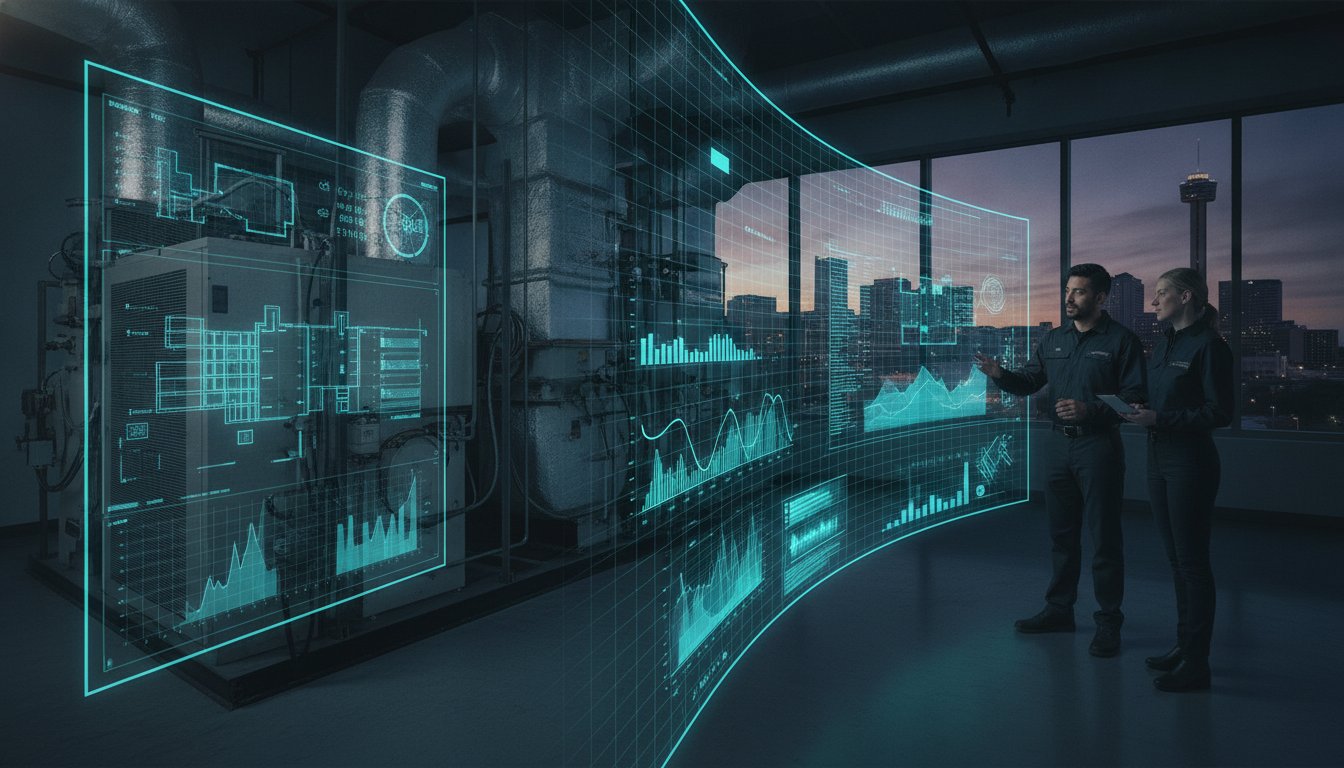
What if the most significant barrier to your building's efficiency isn't the age of your chillers, but the silence of the controllers that run them? Most facility managers feel the mounting pressure of rising operational costs and the friction of managing fragmented hardware that refuses to communicate. You likely believe that achieving modern efficiency requires a total, disruptive equipment overhaul. However, retrofitting commercial hvac automation systems offers a more sophisticated path. It allows you to bridge the gap between legacy mechanical assets and the digital future without the capital intensity of a full replacement.
We understand that your goal is harmony, not just hardware. This guide demonstrates how to transform your existing infrastructure into a unified, intelligent control interface that extends the lifespan of your current assets. We'll explore how AI integration and the shift toward low-GWP refrigerants, mandated by the 2026 AIM Act, serve as catalysts for a return on investment that often ranges between 25% and 50%. You'll discover a methodical engineering approach to eliminating energy waste and gaining remote visibility. We'll show you how to turn your mechanical room into a high-performance digital ecosystem that's both resilient and effortless to manage.
Key Takeaways
- Modernize your building's performance by retrofitting commercial hvac automation systems to replace fragmented legacy controls with a unified digital nervous system.
- Transition from proprietary, siloed hardware to open-protocol architecture to ensure your infrastructure remains resilient and adaptable to future technological shifts.
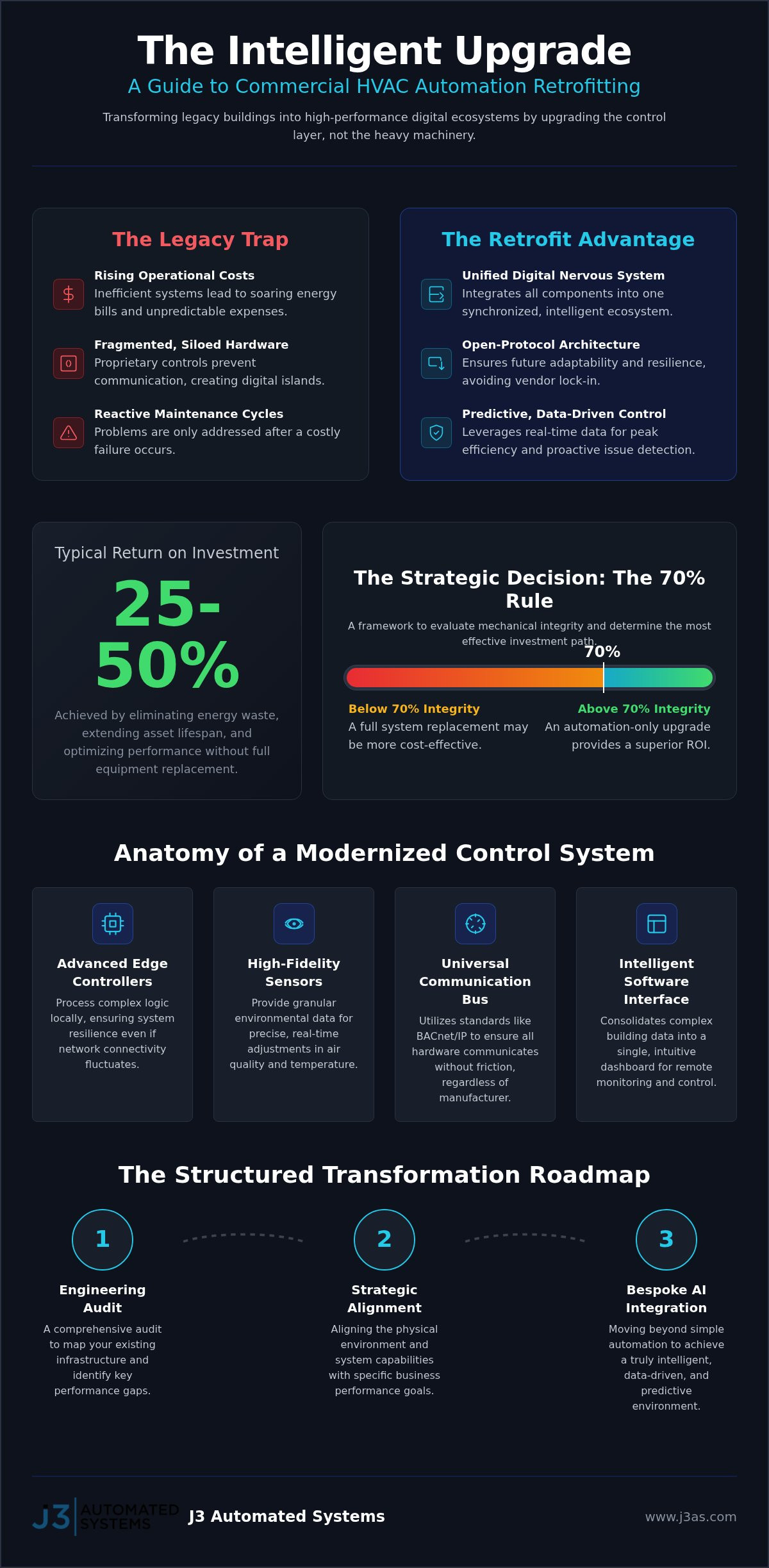
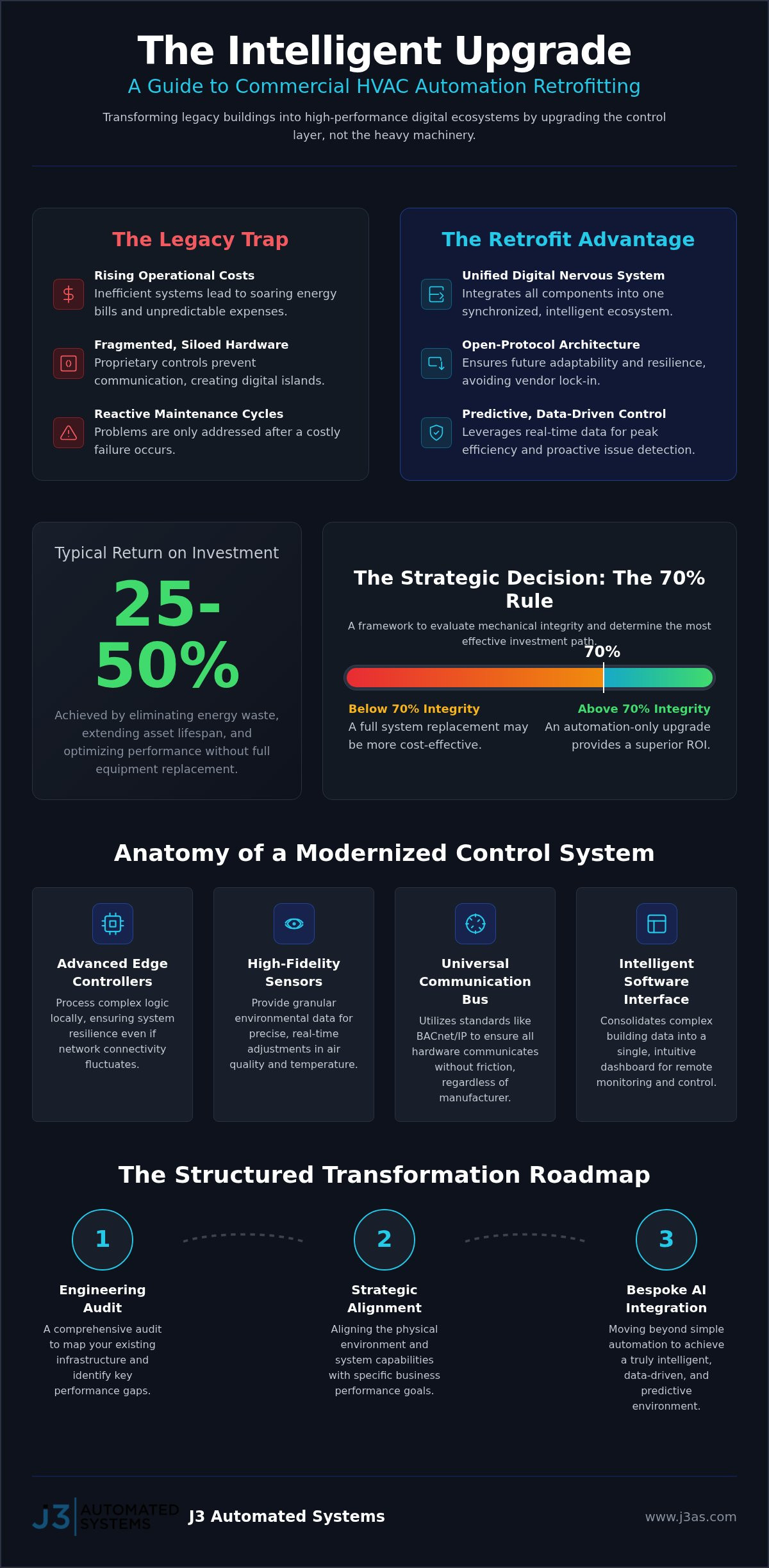
- Apply the "70% Rule" to evaluate mechanical integrity, determining when an automation-only upgrade provides a superior return on investment compared to a full system replacement.
- Execute a structured transformation through a comprehensive engineering audit that aligns your physical environment with specific business performance goals.
- Leverage bespoke AI business process integration to move beyond simple temperature control and achieve a truly intelligent, data-driven building environment.
What is Commercial HVAC Automation Retrofitting?
At its core, an automation retrofit is the strategic modernization of the intelligence governing your mechanical infrastructure. Rather than replacing heavy steel and copper, we focus on the control layer. This process integrates modern Building Automation Systems (BAS) into existing frameworks, transforming a collection of isolated machines into a synchronized ecosystem. It's the difference between a building that merely functions and one that thinks.
Many older commercial properties suffer from proprietary protocols that act as digital silos. These closed systems prevent data from flowing freely, leaving facility managers with zero visibility into real-time performance. This friction forces teams into a cycle of reactive maintenance where you only address problems after a failure occurs. Retrofitting commercial hvac automation systems shifts this paradigm toward predictive, intelligent thermoregulation. By unlocking the data trapped within your hardware, we enable a state of calm reliability and operational harmony.
A modernized system relies on several critical pillars to ensure seamless performance:
- Advanced Edge Controllers: These process complex logic locally, ensuring the system remains resilient even if network connectivity fluctuates.
- High-Fidelity Sensors: These provide the granular environmental data necessary for precise adjustments in air quality and temperature.
- Universal Communication Bus: We typically utilize BACnet/IP as a standard language to ensure that hardware from different eras and manufacturers can communicate without friction.
- Intelligent Software Interface: This simplifies the complexity of your building's data into a single, intuitive dashboard for remote monitoring.
The Anatomy of a Modernized Control System
The transition often begins by moving from antiquated pneumatic systems to Direct Digital Control (DDC). While pneumatic tubes rely on physical air pressure and manual calibration, DDC uses electronic signals for precise, instantaneous adjustments. We install high-fidelity sensors to achieve environmental harmony, ensuring that every zone responds to real-time occupancy and ambient conditions. This digital backbone is essential for meeting 2026 building standards and ensuring your mechanical assets operate at their peak design efficiency.
Why Texas Businesses are Prioritizing Retrofits
In San Antonio and Austin, the environment presents unique engineering challenges. Extreme heat loads place immense pressure on mechanical assets, often leading to premature failure and soaring energy bills. By retrofitting commercial hvac automation systems, Texas enterprises can participate in sophisticated demand response programs. This reduces the strain on the ERCOT grid during peak summer months. Beyond simple cost savings, these upgrades are a primary vehicle for achieving LEED certification and meeting modern sustainability benchmarks without the waste of a total equipment teardown.
Engineering the Digital Nervous System: Hardware vs. Software
A building's mechanical components are only as effective as the logic that drives them. True intelligent building transformation requires more than just replacing outdated controllers with newer, off-the-shelf versions. It demands a bespoke engineering approach that treats the facility as a single, cohesive entity. When retrofitting commercial hvac automation systems, the goal is to create a digital nervous system where hardware procurement and physical installation align perfectly with sophisticated software logic. This synergy ensures that every component, from the smallest sensor to the largest chiller, contributes to a state of operational harmony.
Resilience in modern infrastructure depends heavily on open-protocol architecture. By avoiding proprietary silos, we ensure that your commercial building management systems Texas remain adaptable as technology evolves. This approach removes the burden of vendor lock-in and allows for a more fluid integration of diverse mechanical assets. It transforms your facility from a collection of machines into a responsive, data-driven environment.
The Hardware Layer: VSDs and Intelligent Actuators
Physical upgrades provide the necessary "muscles" for your building's intelligence. Variable Speed Drives (VSDs) serve as the primary engine of energy efficiency by allowing motors to run at precise speeds rather than a wasteful binary on-off state. We pair these with intelligent actuators on dampers and valves to achieve meticulous control over fluid and airflow. Success when retrofitting commercial hvac automation systems also relies on strategic sensor placement. By capturing high-fidelity data at the zone level, the system can make granular adjustments that eliminate cold spots and reduce unnecessary cooling cycles.
The Software Layer: Custom Dashboards and AI
The software layer acts as the brain of the operation, translating raw data into actionable insights. We prioritize custom web app development San Antonio to provide facility managers with intuitive, high-performance interfaces. These bespoke tools replace fragmented legacy dashboards with a unified view of the entire property. By integrating AI, the system analyzes occupancy patterns in real time to automate setpoint adjustments before a room even feels warm. This predictive capability removes the friction of manual overrides and ensures a seamless experience for building occupants. If you're ready to modernize your facility's logic, our team can help you engineer a more intelligent digital backbone.
Retrofit vs. Replacement: A Strategic ROI Framework
Decision-makers often face a binary choice when legacy systems falter: repair a failing component or replace the entire mechanical plant. This perspective overlooks the strategic middle ground of retrofitting commercial hvac automation systems. Before committing to a full mechanical replacement, we perform a rigorous audit of your chillers, boilers, and air handling units (AHUs). If the physical infrastructure retains its structural integrity, a total teardown is often an unnecessary burden. True engineering leadership involves identifying which assets are worth saving and which are truly obsolete. For systems that require a complete refresh, you can explore Air Conditioning Installation to find solutions that are designed to integrate seamlessly with modern building controls.
We utilize the '70% Rule' as a primary engineering benchmark during our assessment. If a mechanical asset still possesses at least 70% of its projected service life or operational reliability, the most logical path is an automation-only upgrade. Replacing a healthy mechanical chassis simply to acquire better controls is an inefficient use of capital. By focusing on the intelligence layer, you avoid the massive hidden costs associated with full replacement, such as structural modifications to roof curbs or the logistical complexity of crane rentals in dense urban corridors. This approach transforms your existing hardware into a high-performance asset without the friction of a construction site.
Assessing Capital Expenditure (CapEx) vs. Operating Expense (OpEx)
Retrofitting often shifts the financial burden from a massive Capital Expenditure (CapEx) to a more manageable Operating Expense (OpEx). This distinction is critical for maintaining healthy balance sheets while still achieving modernization. Beyond the initial outlay, you realize long-term value by reducing commercial operating costs via automation. Predictive AI maintenance schedules identify anomalies before they become catastrophic failures. This digital stewardship extends the physical life of your hardware by ensuring it never runs outside of its optimal design parameters.
Operational Continuity: The Cost of Disruption
Operational Continuity: The Cost of Disruption
For a San Antonio medical facility or a downtown Austin office tower, downtime isn't an option. Full HVAC replacements often require 'blackout' periods that disrupt business for days or weeks. We mitigate this risk through phased retrofitting. To further ensure uptime, integrating specialized alert systems from inTouch R&B allows for remote monitoring of critical HVAC units and pumps. By modernizing one zone at a time, we maintain a 'white-glove' environment for your tenants. Our isolation strategies ensure that the installation of new sensors and controllers happens seamlessly behind the scenes. Your facility remains fully operational while its digital nervous system evolves, moving from a state of manual effort to one of intelligent, effortless operation.
Executing a successful transformation requires a methodical, engineering-led approach that respects the unique demands of the Texas environment. Planning for retrofitting commercial hvac automation systems begins with a comprehensive audit of both the physical and digital landscapes. This isn't a mere inventory of equipment. It's a deep analysis of how your current infrastructure handles the intense heat loads of San Antonio and Austin. We move through a structured five-step process to ensure operational harmony:
- Step 1: Engineering Audit. We assess the mechanical health and digital potential of every asset.
- Step 2: Process Mapping. We align your building's performance goals with your specific business workflows.
- Step 3: Bespoke Roadmap. We design a system specifically engineered for 100 degree Texas summers and high humidity.
- Step 4: Phased Execution. Our single accountable team manages the installation to prevent operational disruption.
- Step 5: Ongoing Tuning. We utilize AI-driven optimization to refine setpoints as occupancy patterns evolve.
This steady, deliberate pace ensures that every adjustment contributes to a more resilient and efficient facility. By taking the time to define the problem before presenting a multi-layered solution, we remove the burden of guesswork from building management.
Site Surveys and Load Calculations
Modernizing a facility requires precise data. We inspect ductwork integrity and zoning efficiency to ensure that air is delivered exactly where it's needed. We perform updated load calculations based on current occupancy data, which often differs significantly from original building plans. This phase frequently involves evaluating commercial security system design Texas to integrate occupancy sensors with HVAC logic. When your security system identifies an empty floor, the automation system responds instantly, eliminating energy waste without manual intervention.
Navigating Texas Compliance and Codes
Adherence to local regulations is a non-negotiable aspect of any engineering project. Every retrofit must comply with San Antonio and Austin mechanical codes while meeting ASHRAE 90.1 standards for energy efficiency. We maintain a strict focus on safety protocols for live-facility retrofits, ensuring that work proceeds in high-traffic environments without compromising occupant safety. This professional, polished approach guarantees that your modernization project meets all 2026 regulatory benchmarks. If you're ready to modernize your facility, our team can develop your bespoke engineering roadmap today.
The J3 Advantage: Bespoke Integration and Accountable Engineering
Success in retrofitting commercial hvac automation systems isn't just about the hardware; it's about the accountability behind the installation. Many facilities suffer from the friction of fragmented vendors, where software developers and mechanical contractors operate in isolation. This often leads to a system that technically functions but lacks true harmony. We eliminate this burden by serving as a single, accountable team for both engineering and implementation. As a visionary integrator, we don't just see individual machines; we see the hidden connections that allow a facility to operate as a singular, intelligent entity.
Our mastery of complexity extends into ai business process automation, where we bridge the gap between physical HVAC controls and your broader organizational intelligence. We ensure that your building's environment doesn't just react to temperature changes but proactively supports your specific business goals. Our white-glove commissioning process guarantees that every sensor and actuator works in perfect harmony from the moment the system goes live. This meticulous approach provides a polished result that commands respect and ensures long-term functionality.
Beyond HVAC: A Holistic Automation Philosophy
These principles of integrated intelligence are gaining traction globally. To see how specialized robotic and industrial systems are being deployed in other major commercial hubs, you can visit EdNex Automation to learn more about their work in the UAE.
True environmental control requires a unified philosophy that encompasses more than just air. We synchronize your retrofitting commercial hvac automation systems with automated lighting and shades to manage heat gain and occupant comfort through a single interface. This level of integration relies on building the same caliber of high performance residential networking found in elite estates, adapted for the rigorous reliability demands of modern commercial facilities. By acting as a dedicated steward of your experience, we simplify the complex world of smart building technology into a state of intelligent, effortless operation.
Next Steps: Engineering Your Building's Future
Modernizing your infrastructure is a journey that begins with a deep-thinking partner who values precision over quick fixes. We invite you to initiate a discovery session where our engineers will evaluate the specific needs of your facility and its existing mechanical assets. From this session, you'll receive a tailored automation roadmap that details exactly how we will transform your legacy hardware into a high-performance asset. This methodical planning ensures that every digital and physical process is aligned for maximum efficiency. You can Contact J3 Automated Systems to begin your commercial transformation.
Mastering Your Building's Digital Evolution
Transitioning from fragmented, manual operations to a state of intelligent, effortless control is no longer a luxury for premier Texas facilities; it's a strategic necessity. By retrofitting commercial hvac automation systems, you unlock the latent potential of your existing mechanical assets while bypassing the excessive costs of a total equipment replacement. You've learned how a bespoke digital backbone, guided by the "70% Rule" and integrated with custom AI, creates a resilient environment that anticipates needs rather than just reacting to them. This evolution turns legacy hardware into a high-performance asset that commands respect and ensures long-term functionality.
We specialize in custom AI and software integration, providing a single point of accountability for even the most complex building transformations. Our expert engineering and installation teams ensure that your modernization project adheres to the highest ASHRAE standards and local Texas codes. Don't let legacy friction limit your building's performance or inflate your operational costs. Partner with J3 for your commercial HVAC automation roadmap and take the first step toward a more harmonious, data-driven future. Your facility’s transformation into a high-performance, intelligent environment is ready to begin.
Frequently Asked Questions
What is the typical ROI for a commercial HVAC automation retrofit?
Most commercial projects show a return on investment between 25% and 50% according to industry research. Smart controls and building automation typically offer a rapid payback period of one to two years. These gains result from eliminating energy waste and extending the lifespan of your mechanical assets through precise, data-driven operation. In the Texas climate, these savings are often realized more quickly due to high cooling demands.
Can retrofitting be done without shutting down my building's cooling?
Retrofitting commercial hvac automation systems can be executed without a total building shutdown. We utilize a phased implementation strategy that modernizes one zone at a time, ensuring your cooling remains operational in high-traffic areas. This isolation strategy is essential for San Antonio medical facilities and Austin office towers that require constant climate control. We maintain a white-glove environment throughout the transformation process to prevent operational friction.
How does AI improve the efficiency of an HVAC automation system?
AI analyzes real-time occupancy patterns and historical weather data to automate setpoint adjustments before a space becomes uncomfortable. Instead of relying on rigid schedules, the system uses predictive logic to prepare your facility for peak thermal loads. This proactive approach removes the burden of manual overrides and ensures your mechanical hardware operates only when necessary, significantly reducing unnecessary wear and energy consumption while maintaining environmental harmony.
Is it possible to integrate my security and lighting with a new HVAC retrofit?
Yes, integrating security and lighting with your HVAC system is a core component of a holistic automation roadmap. By syncing these systems, your building can automatically adjust temperatures and lighting levels based on real-time occupancy data from your security sensors. This level of integration creates a unified digital nervous system that simplifies management and maximizes efficiency across your entire Texas property, moving your facility toward effortless operation.
What are the most common protocols used in building automation retrofits?
The most common protocols include BACnet/IP, Modbus, and LonWorks. We prioritize open-protocol architecture like BACnet/IP to ensure your system remains resilient and adaptable to future technological shifts. This approach avoids the limitations of proprietary hardware silos and allows diverse mechanical assets to communicate seamlessly. It provides a flexible foundation for long-term building intelligence without the burden of vendor lock-in or fragmented data visibility.
How long does a commercial building automation installation typically take?
The duration of an installation varies based on the facility's scale and the complexity of the existing infrastructure. A phased retrofit for a mid-sized office in Austin might take several weeks, though we schedule work to prevent operational disruption. We provide a tailored roadmap during the discovery session that outlines specific milestones and ensures a methodical, steady progression toward full system commissioning without compromising your building's functionality.
Will a retrofit help my building meet Texas energy efficiency standards?
A properly engineered retrofit is a primary vehicle for meeting current ASHRAE 90.1 standards and local mechanical codes in San Antonio and Austin. These updates ensure your facility complies with 2026 energy efficiency benchmarks and qualifies for various commercial incentive programs. By modernizing your control layer, you reduce the overall strain on the ERCOT grid during extreme Texas heat peaks while demonstrating a commitment to sustainable stewardship.
Do I need to replace my air handlers to get smart automation?
You don't need to replace your air handlers if they possess sufficient mechanical integrity. We apply the "70% Rule" to evaluate your existing assets; if the physical chassis is sound, retrofitting commercial hvac automation systems allows you to gain smart controls and remote monitoring. This path provides a high-performance result without the capital intensity or disruption of a full mechanical replacement, extending the life of your expensive hardware.