Secure Networking for Remote Work: 2026 Framework

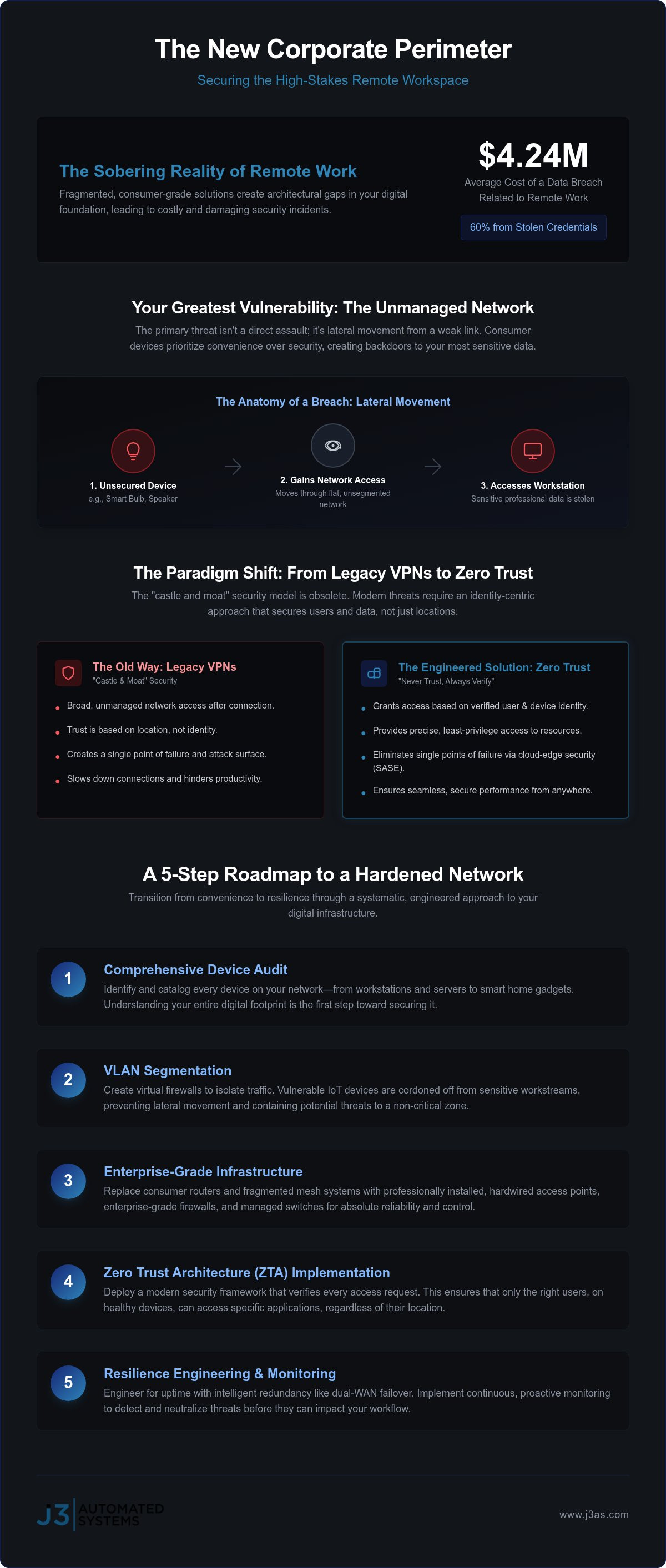
Did you know that the average cost of a data breach related to remote work has reached $4.24 million, with 60% of those incidents stemming from stolen credentials? This figure represents a sobering reality for professionals who still rely on consumer-grade hardware to guard their most sensitive data. You likely understand the frustration of a VPN dropping during a critical call or the nagging concern that a smart device on your guest network might provide a backdoor for intruders. These aren't merely technical glitches; they're symptoms of an architectural gap in your digital foundation.
Achieving truly secure networking for remote work requires a shift from fragmented tools to a unified, engineered roadmap. The modern leader shouldn't be forced to choose between the convenience of home automation and the rigorous security of the corporate office. You'll discover how to transition from basic Wi-Fi to an enterprise-grade, zero-trust network environment designed for absolute resilience. This framework explores the move toward WPA3 standards and NIST CSF 2.0 compliance, ensuring your property supports both high-end automation and seamless professional workflows without friction.
Key Takeaways
- Understand why the modern residential environment is the new corporate perimeter and why consumer-grade routers no longer suffice for high-stakes professional security.
- Discover how to implement secure networking for remote work by moving beyond legacy VPNs toward a sophisticated Zero Trust architecture that eliminates single points of failure.
- Learn the architectural importance of resilient physical infrastructure, prioritizing hardwired access points and professional low-voltage wiring over fragmented mesh systems.
- Master a systematic five-step roadmap to harden your network, including comprehensive device audits and the use of VLAN segmentation to isolate vulnerable IoT traffic.
- Explore how a bespoke, engineered approach transforms your network into a seamless, invisible backbone that supports both high-end automation and absolute professional privacy.
The Evolution of Secure Networking: Why Residential Connections are the New Corporate Perimeter
The traditional office wall has dissolved, replaced by a digital landscape where the residence serves as the primary hub for high-stakes professional activity. In this environment, secure networking for remote work is no longer a secondary consideration; it's a foundational architectural requirement. We must define it not as a collection of software patches or standalone apps, but as a holistic system where enterprise-grade hardware and sophisticated protocols intersect to create a resilient environment. This approach ensures that the digital boundaries of your estate are as formidable as the physical ones.
Consumer-grade routers, while convenient for basic web browsing, are fundamentally ill-equipped for the 2026 threat landscape. These devices prioritize ease of use over robust network security, often lacking the processing power required for continuous threat monitoring or the granular control needed to isolate sensitive work data. As we move into an era where the home office acts as a direct gateway to corporate assets, the "good enough" approach of off-the-shelf hardware becomes a liability. True security begins with high performance residential networking that treats the estate with the same technical rigor as a commercial headquarters.
The Security Vulnerability of the Unmanaged Home Office
The primary threat in a typical home environment isn't always a direct attack on a laptop. Instead, it's the lateral movement through unmanaged weak links. Unpatched IoT devices, such as smart appliances or automated shades, often lack the security updates common in professional hardware. If a single smart bulb is compromised, an attacker can move through the network to access the workstation where your most sensitive professional data resides. This vulnerability creates a state of constant friction, where the very tools meant to simplify your life become the primary drivers of digital risk.
From Convenience to Resilience
Transitioning to a professional-grade environment requires a fundamental mindset shift from simple connectivity to absolute resilience. It's not just about getting online; it's about maintaining uptime through intelligent redundancy and meticulous planning. This is the concept of the "Invisible Backbone" in estate engineering. By integrating dual-WAN failover and enterprise-grade access points, we remove the burden of connectivity issues. The result is a network that operates with a quiet brilliance, providing a seamless experience that balances the demands of high-end automation with the non-negotiable requirements of secure networking for remote work.
Core Technologies: Moving Beyond Legacy VPNs to Zero Trust Architecture
The "castle and moat" strategy of yesterday's cybersecurity has become an architectural relic. In an era where work happens from a home office as often as a corporate suite, relying on a traditional Virtual Private Network (VPN) introduces more risk than it mitigates. To achieve truly secure networking for remote work, we must shift our focus from securing a physical location to securing the individual user and their specific interactions with data. This is the essence of Zero Trust: a philosophy built on the uncompromising principle of "Never Trust, Always Verify."
Zero Trust isn't a single product but a comprehensive framework that unifies security and networking through Secure Access Service Edge (SASE). By moving security to the cloud edge, SASE ensures that protection follows the user regardless of their physical coordinates. This transition replaces location-based trust with identity-based access, ensuring that a connection is granted only after the system verifies the user's identity, the device's health, and the context of the request. It's a precise, intelligent approach that eliminates the broad, unmanaged access points common in older systems.
The Limitations of Legacy VPNs in 2026
Traditional VPNs often create significant performance bottlenecks known as the "trombone effect." This occurs when data is routed from your home, through a distant corporate data center, and then back out to a cloud application, causing unnecessary latency and friction. Beyond performance, legacy VPNs typically create "flat networks." Once a user authenticates, they often have lateral visibility across the entire corporate infrastructure. If that single login is compromised, the attacker gains a skeleton key to every asset. Zero Trust Network Access (ZTNA) serves as the modern, identity-centric successor to the traditional VPN, providing granular access to specific applications without ever exposing the broader network.
Implementing Zero Trust at the Residential Level
Bringing enterprise-grade security to a private estate requires a methodical application of these principles. Multi-Factor Authentication (MFA) is the non-negotiable baseline, acting as the first layer of verification. However, the true sophistication lies in micro-segmentation. This process involves creating secure "islands" within your home network, ensuring that your professional workstation, guest Wi-Fi, and automated systems remain entirely isolated from one another. Even if a guest's device or a smart appliance is compromised, the threat remains contained, unable to reach your professional data.
Continuous monitoring and automated threat response operate in the background, providing a level of quiet brilliance that maintains security without requiring manual intervention. For those managing high-stakes professional workflows alongside complex home automation, consulting with an expert integrator can bridge the gap between these sophisticated technologies and a seamless user experience. This holistic integration ensures that your network is not just connected, but intelligently fortified against the evolving threats of 2026.
Physical Infrastructure: The Role of Enterprise-Grade Hardware in Remote Security
While Zero Trust protocols provide the logic for secure networking for remote work, the physical infrastructure provides the muscle. A network's resilience is fundamentally limited by the quality of its physical layer. For many high-stakes professionals, the transition from consumer mesh Wi-Fi to hardwired Access Points (APs) represents the difference between intermittent frustration and uninterrupted productivity. Reliance on wireless backhauls often introduces latency and instability, issues that enterprise-grade hardware is specifically engineered to eliminate.
Professional low voltage wiring for smart homes serves as the invisible backbone of this security framework. Unlike wireless signals that can be congested, dropped, or intercepted, a hardwired connection offers a dedicated, shielded path for data. Enterprise-grade firewalls further distinguish this setup from standard ISP equipment. These specialized units provide deep packet inspection and dedicated processing power, ensuring that security protocols don't become a bottleneck for your high-speed connection. They offer a level of granular control that built-in router security simply cannot match.
Hardwired for Security: The Case for Fiber and Cat6A
Implementing a 10Gbps residential backbone using Cat6A or fiber optics eliminates the physical eavesdropping risks associated with wireless-only environments. It also removes signal interference from neighboring estates, a common issue in premium residential developments. During the design phase, planning for this future-proof infrastructure ensures that your estate remains capable of handling the bandwidth demands of 2026 and beyond. It moves your home from a collection of gadgets to a sophisticated, engineered environment where speed and security are inextricably linked.
Strategic Hardware Placement and Management
The location and housing of your network components are as critical as the hardware itself. In large San Antonio estates, thermal management becomes a vital consideration. Rack-mounted solutions with active cooling prevent hardware degradation from heat, ensuring long-term reliability and peak performance. This centralized approach allows for streamlined remote management. J3 monitors system health through secure, encrypted channels, identifying potential failures or security anomalies before they disrupt your workflow, all while maintaining absolute respect for your privacy.
For business owners, this infrastructure often extends beyond the home office. Integrating professional networking with commercial building management systems Texas allows for a unified view of both residential and commercial assets. This holistic perspective ensures that secure networking for remote work is not a standalone island, but a fully integrated component of a sophisticated, intelligent property management strategy. The result is a system that balances complex technical requirements with a seamless, high-touch user experience.
A 5-Step Roadmap to Hardening Your Remote Work Network
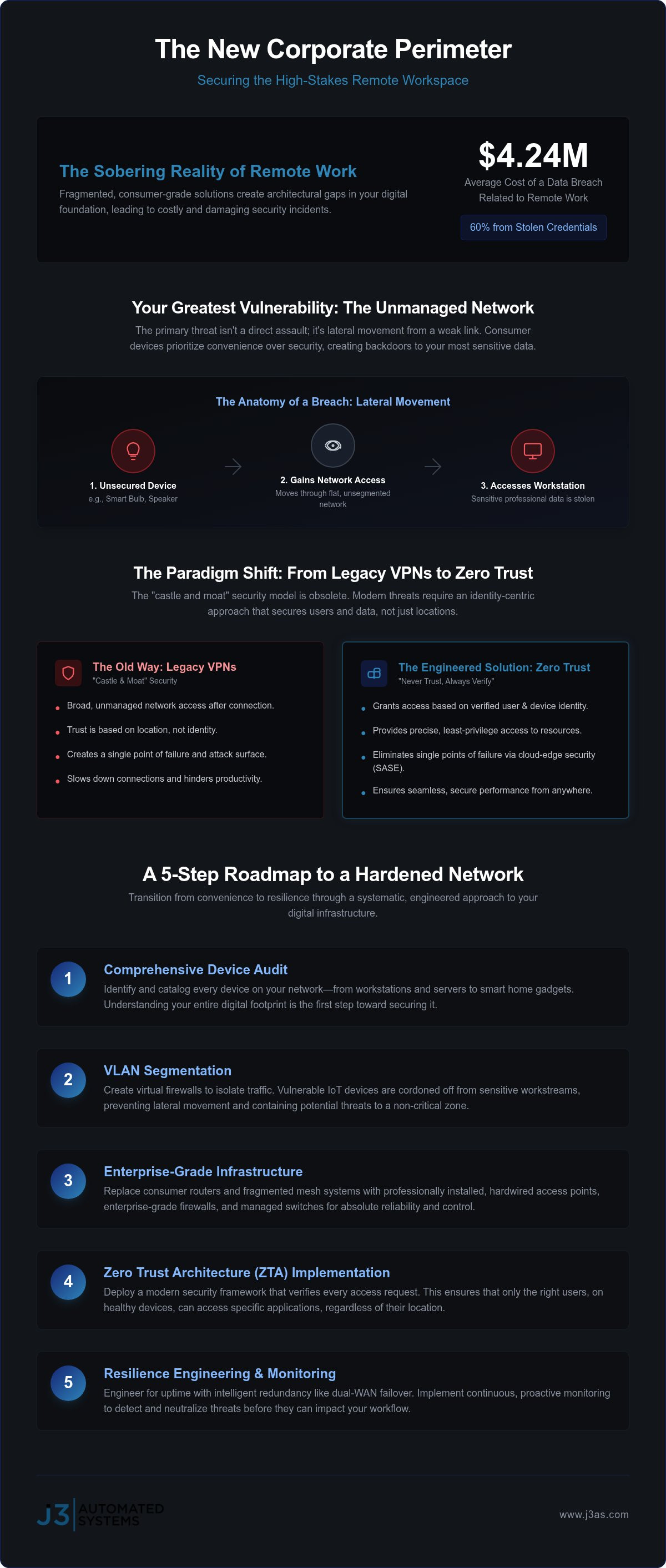
Transitioning from a standard home connection to a professional grade environment is a disciplined exercise in engineering. It requires moving beyond the reactive mindset of fixing problems as they arise toward a proactive, architectural strategy. To establish truly secure networking for remote work, you must follow a methodical roadmap that addresses both the visible hardware and the invisible protocols governing your data.
- Step 1: Conduct a comprehensive device audit. Identify every connected endpoint, from professional workstations to guest smartphones. Research indicates that 67% of remote workers use unpatched personal devices for work, creating significant vulnerabilities that must be documented and managed.
- Step 2: Implement VLAN segmentation. This is the cornerstone of estate security, ensuring that different classes of traffic never intersect.
- Step 3: Deploy enterprise encryption and SSID management. Standardize on WPA3 protocols and eliminate hidden or legacy SSIDs that provide easy entry points for sophisticated threats.
- Step 4: Establish a fail-safe home internet setup. True resilience requires dual ISPs with automatic failover to ensure your professional obligations aren't interrupted by local service outages.
- Step 5: Schedule quarterly security audits. Technology evolves rapidly. Regular reviews of firmware, access logs, and device health are essential to maintaining the integrity of your framework.
VLAN Segmentation: The Ultimate Privacy Shield
In a sophisticated estate, the network must serve multiple masters. You shouldn't have to worry that a child's gaming console or a guest's unmanaged smartphone could compromise your secure work server. VLAN segmentation allows us to create isolated digital corridors. By separating your professional traffic from the high-bandwidth needs of whole-property audio or the inherent vulnerabilities of smart lighting and shades, you ensure that a breach in one area cannot spread to another. This micro-segmentation provides a level of privacy and security that a flat, consumer-grade network can't offer.
Ensuring Absolute Uptime in Central Texas
For professionals in Austin, Boerne, or San Antonio, environmental factors and local infrastructure can lead to unexpected outages. A professional secure networking for remote work strategy includes a cellular backup, such as 5G or LTE, that engages the moment your primary fiber line fails. This automatic failover happens so seamlessly that your high-stakes video calls remain uninterrupted. We complement this with power conditioning and Uninterruptible Power Supply (UPS) systems, protecting your expensive networking hardware from the voltage fluctuations common during Texas storms.
If you're ready to transition from a patchwork of consumer tools to a professional-grade environment, contact J3 Automated Systems for a comprehensive network evaluation and engineering roadmap.
The J3 Advantage: Bespoke Networking for San Antonio’s High-Stakes Professionals
Engineering a sophisticated digital environment requires more than a collection of high-end components; it demands a single, accountable partner who understands the intricate relationship between physical space and digital security. J3 Automated Systems transcends the role of a traditional equipment vendor, acting instead as a long-term technology steward for the most demanding estates in Central Texas. Our approach to secure networking for remote work is rooted in the belief that your technology should be an invisible, reliable extension of your professional life, removing the burden of technical management so you can focus on high-level decision-making.
We provide a comprehensive, single-team solution that encompasses everything from the initial low-voltage engineering to final commissioning and ongoing security management. This holistic perspective allows us to integrate your network backbone with advanced ai business process automation, creating a property that is not just connected, but truly intelligent. By aligning your physical infrastructure with your specific business workflows, we transform a fragmented set of tools into a unified, resilient system engineered for absolute privacy and performance.
White-Glove Service from San Antonio to Austin
Our expertise is deeply rooted in the unique architectural and environmental challenges of Texas residential and commercial builds. From the limestone hills of Boerne to the sprawling estates of San Antonio and Austin, we understand that every property requires a tailored approach. The J3 commissioning process is a meticulous exercise in precision, where we tune every node and access point to eliminate dead zones and maximize throughput. Beyond the installation, our commitment continues through real-time monitoring and proactive security patching, ensuring your framework remains defended against the sophisticated threats of the 2026 landscape without requiring your manual intervention.
Your Secure Future Starts with a Roadmap
The transition from a state of manual effort and digital friction to one of intelligent, effortless operation begins with a strategic roadmap. J3 conducts a deep-thinking analysis of your current business processes, mapping them directly to a physical infrastructure designed for longevity. We don't believe in quick fixes; we value the intellectual rigor required to build systems that function flawlessly for years. This methodology ensures that secure networking for remote work becomes a self-evident reality for your household, providing the calm reliability you expect from a premium service.
If you are ready to move beyond basic connectivity and engineer a network that reflects the caliber of your professional work, we invite you to take the first step. Schedule a consultation with J3 Automated Systems today to begin the design of your bespoke remote work network and experience the harmony of a truly integrated estate.
Engineering Your Digital Legacy
The transition from a basic home connection to a professional-grade environment is more than a technical upgrade; it's a commitment to architectural excellence. By embracing Zero Trust principles and investing in a resilient physical backbone, you remove the persistent friction of dropped connections and security vulnerabilities. You've seen how a methodical roadmap, from VLAN segmentation to fail-safe internet redundancy, transforms a residence into a high-performance command center.
Achieving secure networking for remote work requires an integrator who sees the hidden connections between your professional requirements and your estate's infrastructure. Our Texas-based engineering team provides the end-to-end design and commissioning necessary to ensure your systems operate with quiet brilliance. You deserve an accountable partner who offers high-touch support and a vision for your long-term digital stability. Consult with J3 Automated Systems to engineer your secure remote network roadmap and reclaim the peace of mind that comes with a perfectly integrated system. Your future of seamless, secure productivity is well within reach.
Frequently Asked Questions
Is a standard VPN enough to secure my home office for remote work?
No, a standard VPN is no longer sufficient for the sophisticated 2026 threat landscape. Traditional VPNs often create flat networks where a single compromised login grants access to the entire corporate infrastructure. They also introduce performance bottlenecks known as the trombone effect. Modern professionals require Zero Trust Network Access (ZTNA) to ensure identity-centric security and more efficient data routing.
How does VLAN segmentation improve my network security at home?
VLAN segmentation isolates different classes of traffic into independent digital corridors. This architectural approach prevents lateral movement; if a guest's smartphone or a smart appliance is compromised, the threat remains contained within its specific segment. It ensures that your professional workstation remains entirely isolated from less secure devices, providing a critical layer of privacy and protection for your data.
What is Zero Trust Network Access (ZTNA) and why does it matter for executives?
ZTNA is a security framework that verifies every user, device, and connection request before granting access to specific applications. For executives handling high-stakes corporate assets, it eliminates the broad network exposure inherent in older systems. By shifting from location-based trust to identity-based verification, ZTNA provides the precision and intelligence required to maintain secure networking for remote work without compromising performance.
Can smart home devices like automated lighting compromise my work security?
Yes, unmanaged IoT devices like automated lighting or smart fridges are frequent entry points for cyberattacks. These devices often lack the robust security patching found in professional hardware. Without proper isolation, an attacker can use a compromised smart device to move through your network and access your professional workstation. Professional engineering solves this by placing these devices on an entirely separate, monitored network segment.
What hardware do I need for an enterprise-grade home network in 2026?
An enterprise-grade network requires a professional firewall with deep packet inspection, managed switches, and hardwired access points. You also need rack-mounted solutions with active thermal management to ensure long-term reliability. This hardware provides the processing power and granular control necessary to implement secure networking for remote work while simultaneously supporting complex whole-property automation and high-speed data demands.
Why is hardwired low-voltage cabling better than high-end mesh Wi-Fi?
Hardwired cabling provides a dedicated, shielded path for data that eliminates the latency and interference common in wireless mesh systems. While mesh Wi-Fi is convenient, it relies on wireless backhauls that can be congested or intercepted. Fiber or Cat6A backbones offer absolute stability and physical security, serving as the resilient foundation required for high-stakes professional productivity and seamless estate operation.
How does J3 Automated Systems handle network security for Texas businesses?
J3 provides bespoke engineering and end-to-end commissioning for luxury properties in San Antonio, Austin, and Boerne. We act as a single accountable partner, moving beyond simple equipment sales to offer long-term technology stewardship. Our team maps your business processes to your physical infrastructure, providing proactive monitoring and custom security roadmaps that balance technical rigor with a high-touch, white-glove service experience.
What happens to my secure connection if my primary internet service goes down?
Your connection remains active through an automatic failover system that engages a secondary ISP or cellular backup, such as 5G or LTE. This transition happens so seamlessly that high-stakes activities like video conferencing continue without interruption. When combined with power conditioning and UPS systems, this redundancy ensures that your professional workflow remains resilient against local infrastructure failures or environmental disruptions.