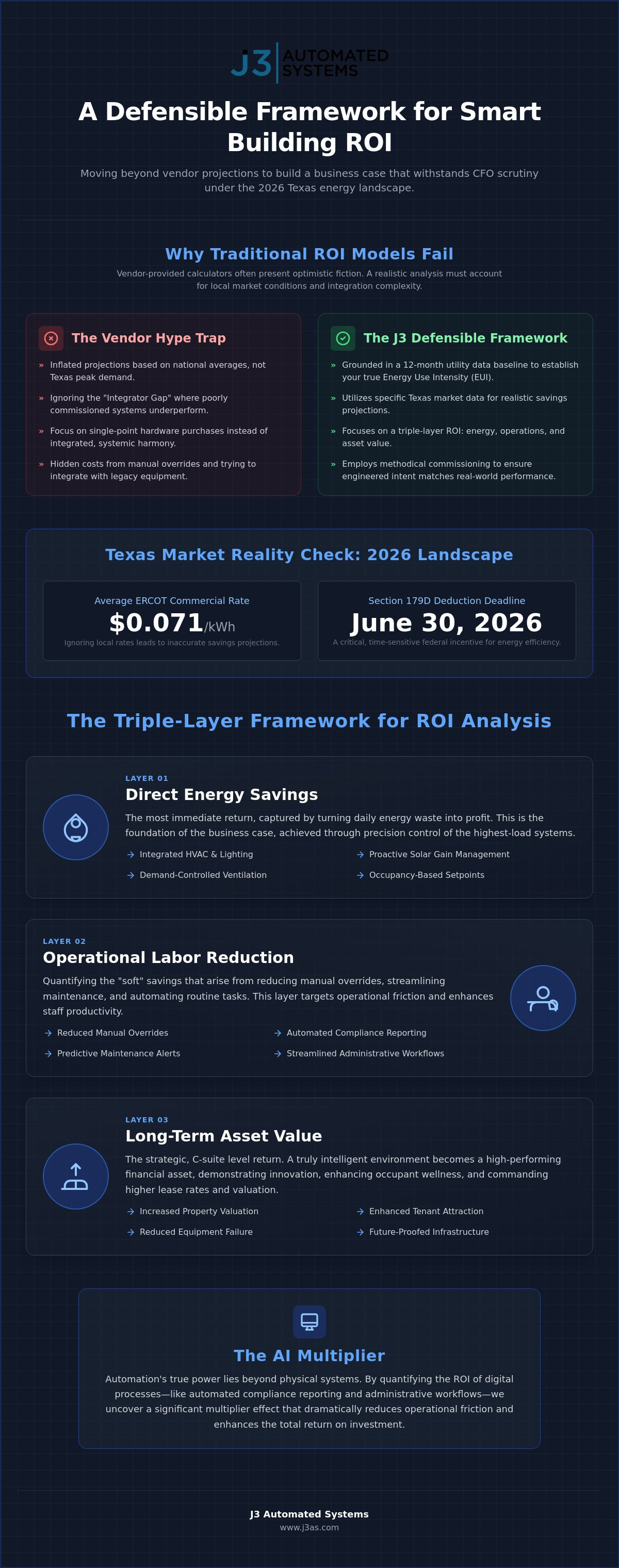
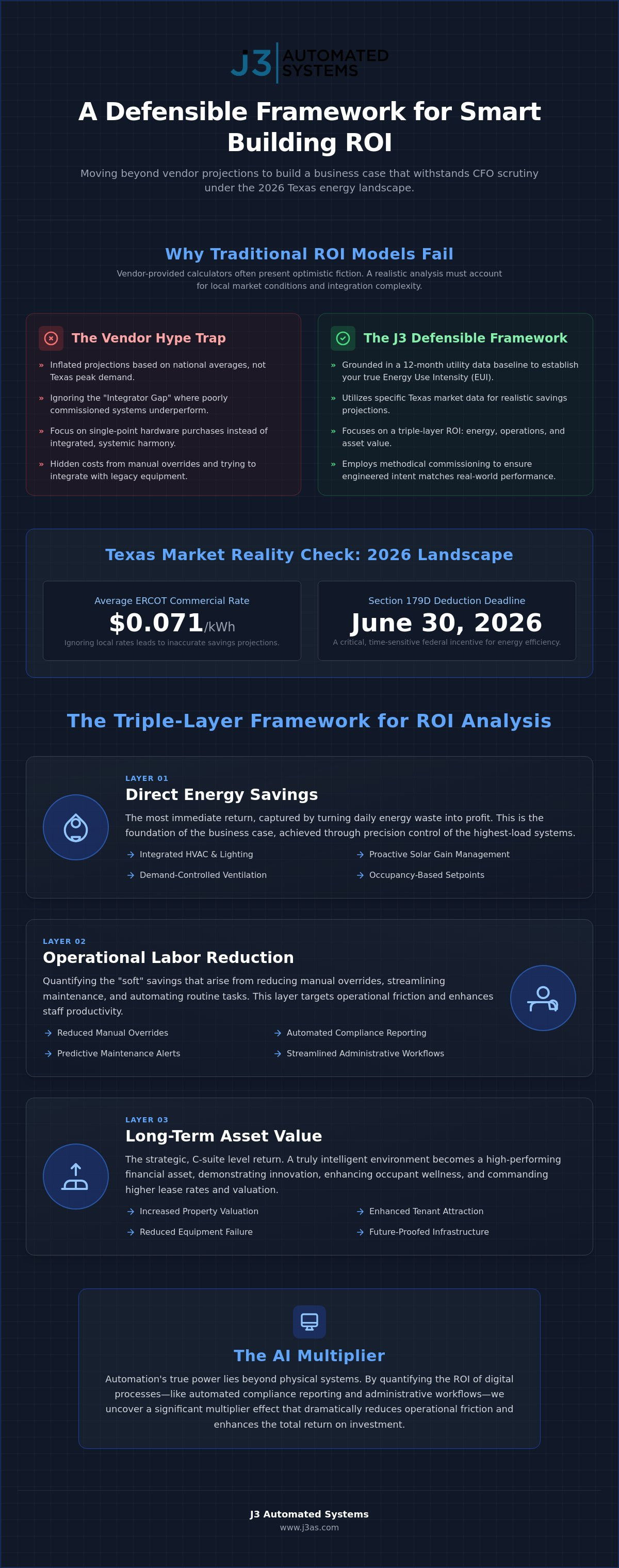
Smart Building ROI Analysis: A Defensible Framework for 2026
Most vendor-provided ROI calculators are little more than optimistic fiction designed to close a sale, leaving facility managers to defend unachievable numbers to a skeptical CFO. You understand that a truly intelligent environment isn't just a collection of sensors; it's a financial asset that must perform under the unique pressures of the 2026 Texas energy landscape. With ERCOT commercial rates averaging $0.071/kWh and the critical June 30, 2026, deadline for Section 179D tax deductions approaching, the margin for error in your smart building ROI analysis has vanished.
We believe that complexity should never be an obstacle to clarity. This article masters the methodology for calculating a realistic, conservative return on investment for building automation that satisfies both the engineering suite and the executive board. We will move from the broad theory of systems integration to the narrow reality of measurable energy savings, reduced maintenance friction, and the strategic capture of federal incentives. By the end, you'll possess a defensible framework that transforms fragmented technology into a unified, high-performing investment.
Key Takeaways
- Move beyond inflated vendor projections by adopting a triple-layer framework that accounts for direct energy savings, operational labor reduction, and long-term asset value.
- Leverage specific 2026 Texas market data, including current ERCOT commercial rates and Section 179D tax deductions, to build a business case that withstands CFO scrutiny.
- Discover how to conduct a rigorous smart building ROI analysis by contrasting upfront capital expenditure with the compounding benefits of integrated HVAC and lighting systems.
- Quantify the "AI multiplier" to see how automating administrative workflows and compliance reporting significantly reduces operational friction and enhances total return.
- Understand why professional engineering and a methodical commissioning process are the ultimate safeguards for your building’s long-term financial performance.
Beyond the Vendor Hype: Why Traditional ROI Models Fail
Traditional financial models often buckle under the weight of vendor-driven hyperbole. Many equipment manufacturers present bundled composites that promise triple-digit returns; however, these figures rarely survive the transition from a glossy brochure to a functioning mechanical room. A defensible smart building ROI analysis requires a shift in perspective. It demands that we define value not as a single metric, but as the intersection of three distinct pillars: measurable energy reduction, heightened operational efficiency, and the long-term appreciation of the physical asset.
We often see a "Return on Innovation" that traditional models overlook. While standard ROI focuses on the immediate payback of a specific piece of hardware, a Return on Innovation accounts for the systemic harmony achieved when disparate components work in concert. The foundation of this intelligence is the Building Automation System (BAS), which serves as the central nervous system for your property. Without this holistic view, you're merely buying gadgets, not engineering a solution. It's the difference between a collection of smart devices and a truly intelligent environment.
This leads to what we call the "Integrator Gap." Even the most sophisticated software will fail to deliver if the commissioning process is rushed or fragmented. Poor commissioning is the silent killer of ROI. It creates a state of perpetual friction where systems fight each other, leading to premature equipment failure and "ghost" energy consumption that never appears in a vendor’s projection. We act as the master of complexity to bridge this gap, ensuring that the final result matches the initial engineering intent.
The Danger of Generic Calculators
Generic ROI tools rely on national averages that ignore the brutal reality of Texas peak demand charges. A 10% energy saving in a temperate climate doesn't translate to the high-load HVAC requirements of San Antonio or Austin, where ERCOT commercial rates average $0.071/kWh as of July 2026. Off-the-shelf software often lacks the custom engineering required to integrate with legacy equipment. This creates hidden costs in the form of manual overrides and custom drivers. We believe a rigorous "Discovery and Mapping" phase must precede any hardware purchase to ensure the digital process aligns with the physical environment.
Defining the Baseline
Precision begins with a grounded baseline. A defensible analysis requires a minimum of 12 months of utility data to account for seasonal volatility and occupancy shifts. We use this data to establish your Energy Use Intensity (EUI), which serves as a vital benchmark against Class A peers. This process uncovers "leakage" in manual workflows, such as administrative friction in reporting or lighting schedules that no longer match tenant behavior. Only after identifying these gaps can you claim a realistic path toward the Section 179D tax deduction before the June 30, 2026, deadline.
The Triple-Layer Framework for Smart Building ROI Analysis
A sophisticated smart building ROI analysis requires an architectural mindset that looks beyond the immediate utility bill. We view the building as a high-performance machine where value is captured in distinct, overlapping layers. While a single-point solution might offer a quick win, a truly defensible business case identifies how different systems work in harmony to create a compounding financial effect. This framework moves from the obvious to the strategic, providing a roadmap that satisfies both the technical requirements of facility managers and the fiscal rigor of the C-suite over a three to five-year horizon.
Layer 1: Precision HVAC and Lighting Control
The most immediate impact stems from reducing the thermal load of the facility. In the intense Texas heat, automated lighting and shades do more than enhance occupant comfort; they proactively manage solar gain before your HVAC system is forced to compensate. This integrated approach is a core component of how to reduce commercial operating costs with automation. By implementing demand-controlled ventilation and occupancy-based setpoints, you ensure the building isn't conditioning air for empty boardrooms. These precision adjustments turn daily energy waste into captured profit, significantly lowering your Energy Use Intensity (EUI) without sacrificing the "white-glove" experience of a Class A property.
Layer 2: From Reactive to Predictive Maintenance
Operational efficiency is found in the removal of friction. Traditional maintenance models are inherently reactive, waiting for a component to fail before dispatching a technician. By integrating Fault Detection and Diagnostics (FDD), we transition your facility to a predictive model. This shift drastically reduces expensive "truck rolls" and prevents catastrophic equipment failures that often derail annual budgets. Managing these complex systems through a single-pane-of-glass interface allows your team to oversee the entire property with intellectual rigor rather than manual effort. When your systems talk to each other, you spend less on emergency repairs and more on high-value optimization.
Layer 3: Asset Value and Occupant Experience
The final layer addresses long-term strategic value and risk mitigation. Major industry players have identified several trends influencing the ROI of smart buildings, specifically the "Green Premium" where automated properties command higher lease rates and higher resale values. Beyond the balance sheet, Indoor Air Quality (IAQ) has become a primary driver for employee retention and productivity. We also mitigate operational risk through integrated commercial security system design Texas, ensuring your physical protection is as intelligent and responsive as your climate control.
These three layers don't exist in isolation; they compound. A reduction in thermal load extends the mechanical life of your HVAC equipment, while predictive diagnostics ensure that equipment consistently runs at peak efficiency. This harmony creates a resilient financial profile that protects your bottom line against rising energy costs and labor shortages. If you are ready to move past generic calculators, our team can help you engineer a custom roadmap tailored to your facility's unique requirements.
Case Study: ROI Analysis for a 50,000 Sq. Ft. Texas Facility
To ground our framework in reality, we must examine a specific application: a 50,000 square foot Class A office facility in the San Antonio-Austin corridor. A standard smart building ROI analysis for this property type often starts with a baseline energy use intensity (EUI) that reflects the intense cooling requirements of Central Texas. While generic models suggest a four-year payback, an engineered approach that accounts for local utility rebates and federal incentives often accelerates this timeline significantly. We distinguish between a "hardware-only" installation, which often leaves 15% of potential savings on the table, and an engineered system that harmonizes physical assets with digital logic.
The initial capital expenditure (CapEx) covers the integration of HVAC controls, automated lighting, and the central management interface. However, the true defensibility of the business case lies in the reduction of ongoing operational expenditure (OpEx). By automating routine system checks and energy reporting, facility teams can shift from manual oversight to strategic optimization. In the current 2026 landscape, failing to account for the Section 179D tax deduction deadline on June 30 is a missed opportunity that can alter the internal rate of return (IRR) by several percentage points.
The Central Texas Variable: Climate and ERCOT
The Texas summer heat index is the primary driver of mechanical stress and energy consumption. With ERCOT commercial rates averaging $0.071/kWh, the financial impact of peak demand charges can be staggering. An engineered system utilizes demand response programs to shed non-essential loads during grid instability, protecting the bottom line while maintaining occupant comfort. Furthermore, resilient networking ensures that these automated responses occur even if local connectivity wavers, preventing the "manual override" cycles that often sabotage energy savings in fragmented systems.
Visualizing the Payback
The following table illustrates the financial trajectory of a 50,000 sq. ft. facility utilizing a J3-integrated system compared to a traditional baseline. This analysis includes the capture of a $2.90 per square foot Section 179D deduction, assuming prevailing wage requirements are met before the mid-2026 sunset.
| Year | Investment Status | Estimated Accumulated Savings |
|---|---|---|
| Year 0 | Net Investment (After Rebates/Tax Credits) | $0 |
| Year 1 | Operational Optimization Phase | $42,000 - $55,000 |
| Year 2 | Predictive Maintenance Gains | $88,000 - $115,000 |
| Year 3 | Full Payback Threshold | $135,000 - $175,000 |
| Year 5 | Net Positive Asset Value | $240,000 - $310,000 |
Our sensitivity analysis indicates that even a 10% fluctuation in energy prices does not derail the ROI, provided the system is commissioned with the precision of a master integrator. A fragmented system often fails to reach Year 3 targets because of "integration friction," where software updates or hardware replacements break the original energy logic. By contrast, a unified engineering approach ensures that the digital process evolves alongside the physical environment, maintaining the integrity of your investment over the long term.
The AI Multiplier: Quantifying Digital Process ROI
A comprehensive smart building ROI analysis often stops at the mechanical room door. While energy savings and maintenance reductions are significant, they represent only the physical layer of the investment. To achieve a truly defensible return in 2026, we must account for the "AI Multiplier." This is the compounding effect that occurs when AI business process automation bridges the gap between raw Building Management System (BMS) data and your core business operations. By engineering intelligence into modern workflows, we remove the administrative friction that typically erodes the value of high-end facilities.
Automating the Administrative Burden
Administrative friction is a silent drain on property performance. Traditional facilities require significant manual effort to compile energy reports, verify regulatory compliance, or reconcile complex utility billing. We quantify the ROI of digital processes by measuring the hours recovered when these tasks are automated. Integrating BMS data directly into your internal business tools allows for real-time energy procurement optimization and automated scheduling based on occupancy patterns. This holistic approach is only possible with a single accountable team that understands both the physical HVAC loads and the digital logic required to manage them. When your data flows without manual intervention, you eliminate the "hidden" labor costs that generic ROI models often ignore.
Custom Dashboards and Data Sovereignty
Generic SaaS products often force your data into rigid, pre-defined templates that serve the vendor's interests rather than your own. We advocate for bespoke internal tools and custom web apps that ensure complete data sovereignty. Owning your data improves long-term ROI by eliminating recurring subscription fees and allowing for the creation of stakeholder-specific interfaces. A CFO requires a high-level financial summary of portfolio performance, while a facility manager needs granular, real-time diagnostics to prevent equipment drift. Designing these custom dashboards ensures the "white-glove" experience extends from the physical lobby to the digital user interface, providing a seamless flow of information that empowers decisive action.
Digital transformation shouldn't be a fragmented effort. When your building’s physical systems and digital processes are unified under a single engineering philosophy, the result is an environment that is both intelligent and effortless. If you are ready to explore how custom intelligence can accelerate your property's performance, contact our engineering team to discuss your specific requirements.
Engineering the Roadmap: Validating Your Investment with J3
Transforming a theoretical smart building ROI analysis into a high-performing physical asset requires more than software; it demands an architectural approach to systems integration. While generic models provide a starting point, they often fail to account for the unique mechanical signatures of individual properties. We position ourselves as the master of complexity, simplifying the intricate web of HVAC, lighting, and digital processes into a single, cohesive strategy. By moving from broad analysis to specific implementation with a single accountable partner, you eliminate the fragmentation that typically compromises long-term financial performance.
Discovery and Discovery Mapping
Our Discovery Mapping process uncovers the friction points within your current infrastructure before a single wire is installed. We analyze how your facility interacts with the Texas environment, aligning technological goals with the specific financial hurdles of your board. This tailored roadmap ensures every integration serves a dual purpose: enhancing occupant experience and securing a measurable return. For Texas businesses, this phase is critical for capturing utility rebates and meeting federal energy benchmarks before regulatory windows close. It's about engineering the solution to fit the building, not forcing the building to fit the software.
The J3 Commissioning Standard
Precision engineering is meaningless without rigorous validation. The J3 Commissioning Standard is our "white-glove" safeguard for your investment. We believe that tuning and commissioning are the most critical steps in a smart building ROI analysis, as they ensure the system actually performs to the predicted model. Many projects fail because the initial energy logic is lost during the installation hand-off. We prevent this by providing a single team responsible for both engineering and commissioning. Our ongoing support ensures your systems don't drift over time, maintaining peak efficiency and asset value long after the initial project is complete.
The path to an intelligent environment should be steady and reassuring. By unifying your physical automation and digital AI processes under one philosophy, you create a state of effortless operation that benefits both your facility team and your bottom line. If you are ready to move beyond vendor hype and build a defensible business case, Schedule your smart building ROI discovery session with J3 Automated Systems.
Securing the Future of Your Facility's Performance
Building a defensible business case requires looking past generic software projections to the architectural reality of your facility. You've seen how a multi-layered framework captures value that traditional models miss, from precision HVAC tuning to the administrative relief of custom AI integration. In the high-load Texas market, this level of technical rigor isn't a luxury; it's the only way to safeguard your investment against rising costs and grid volatility. A truly successful smart building ROI analysis is the result of a single accountable team managing the bridge between physical systems and digital logic.
It's time to move from fragmented theory to seamless operation. Request a Bespoke ROI Analysis for Your Facility to see how our expertise in high-end Texas properties and white-glove commissioning can transform your property into a high-performance asset. We look forward to engineering a more intelligent, effortless future for your facility.
Frequently Asked Questions
What is the average payback period for a smart building system in Texas?
The average payback period for a smart building system in Texas typically falls between three and five years for Class A commercial facilities. This timeline can be accelerated by leveraging the current ERCOT commercial rate of $0.071/kWh and capturing the Section 179D tax deduction before the June 30, 2026, deadline. A precise smart building ROI analysis will weigh these federal incentives against the initial capital expenditure to define a clear break-even point.
Can I achieve a high ROI by retrofitting an older commercial building?
Older commercial buildings often yield the most significant returns because their baseline energy use intensity (EUI) is typically much higher than modern structures. Retrofitting these facilities with integrated HVAC and lighting controls eliminates decades of mechanical inefficiency. By replacing fragmented, manual systems with a unified digital logic, owners can revitalize aging assets and command higher lease rates in competitive markets like Austin and San Antonio.
How does AI integration improve the ROI of traditional building management systems?
AI integration transforms a traditional building management system from a reactive tool into a proactive financial asset. By automating administrative workflows and compliance reporting, AI business process automation reduces the labor costs associated with facility management. This digital layer acts as a multiplier, ensuring that energy savings are compounded by recovered man-hours and more intelligent procurement strategies.
Are there specific utility rebates available for San Antonio or Austin businesses?
Yes, businesses in San Antonio and Austin can access specific utility incentives through CPS Energy and Austin Energy. These programs often provide rebates for demand-controlled ventilation, LED lighting transitions, and participation in demand response initiatives. We incorporate these local variables into every smart building ROI analysis to ensure clients capture every available dollar before project commissioning begins.
What are the "hidden costs" often missing from smart building ROI analyses?
Hidden costs often include integration friction, the need for custom software drivers for legacy equipment, and the long-term expense of poor commissioning. Many generic models fail to account for the labor required to manage fragmented systems that don't communicate. A professional engineering approach identifies these gaps during the discovery phase, preventing budget overruns and ensuring the system performs to its predicted financial model.
How does building automation impact the resale value of a property?
Building automation directly enhances a property's cap rate by reducing ongoing operational expenditures and increasing net operating income. This premium makes the asset more attractive to institutional investors who prioritize ESG metrics and long-term resilience. Automated properties typically enjoy higher occupancy rates and lower tenant turnover, which translates to a more stable and valuable real estate portfolio.
Why is an integrator like J3 more effective for ROI than buying standalone hardware?
Standalone hardware often creates data silos that require manual intervention to maintain, whereas an integrator ensures a unified systems architecture. We bridge the gap between physical environments and digital processes, removing the friction that causes standalone devices to fail over time. A single accountable team for engineering and implementation provides a level of precision that off-the-shelf retail products can't match.
How do I calculate the ROI of improved Indoor Air Quality (IAQ)?
Calculating the ROI of improved Indoor Air Quality requires shifting the focus from energy bills to human capital. You can quantify this by measuring reductions in health-related absenteeism and improvements in employee productivity and retention rates. While these metrics are different from utility data, they represent a significant portion of a company's total operating budget and are vital for a holistic financial framework.