Smart Home Infrastructure Design: Engineering the Invisible Backbone of Modern Estates
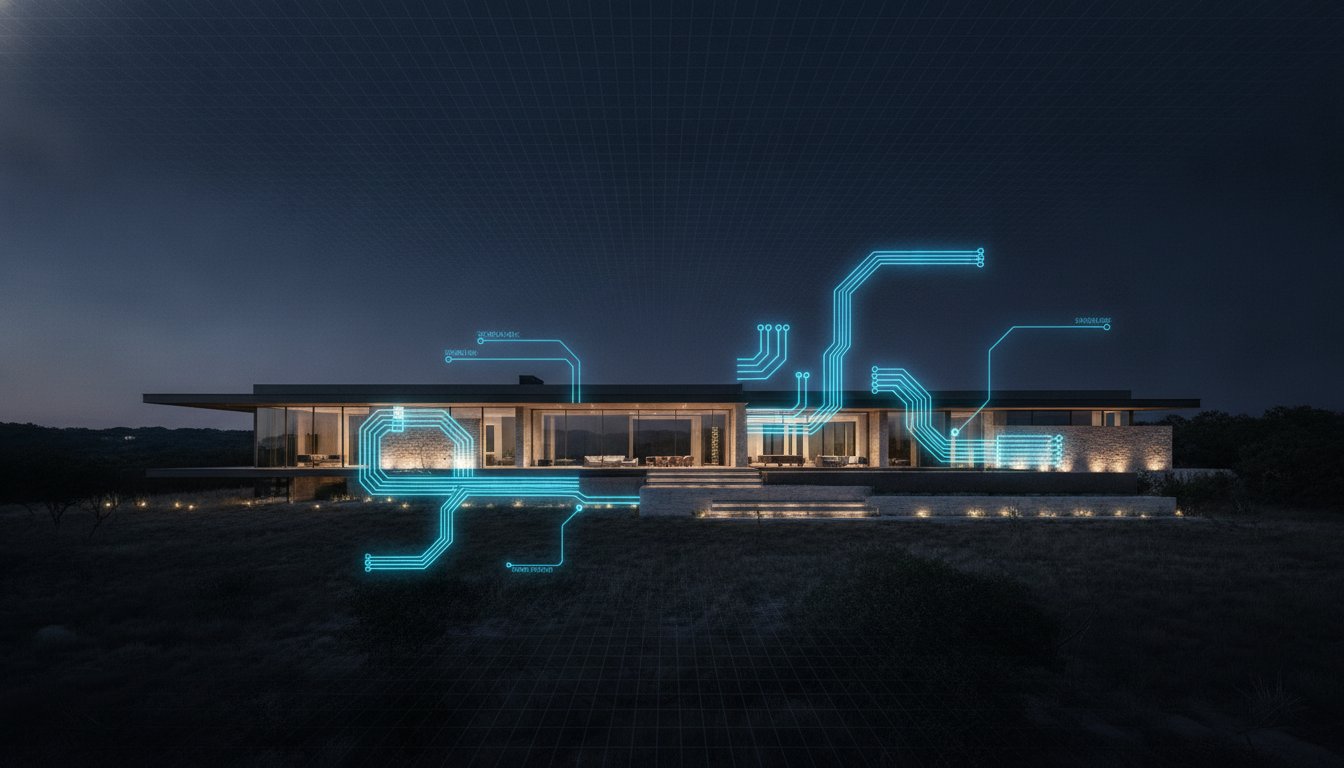
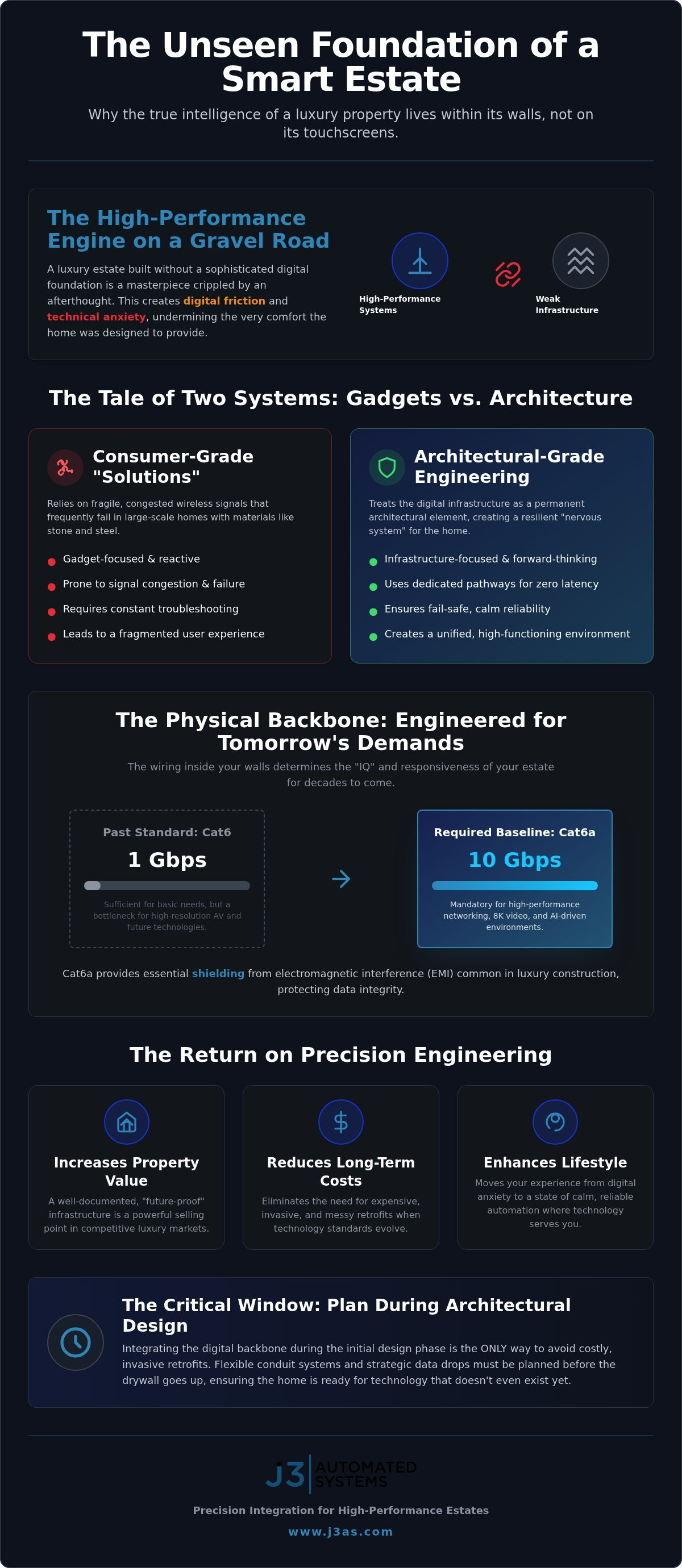
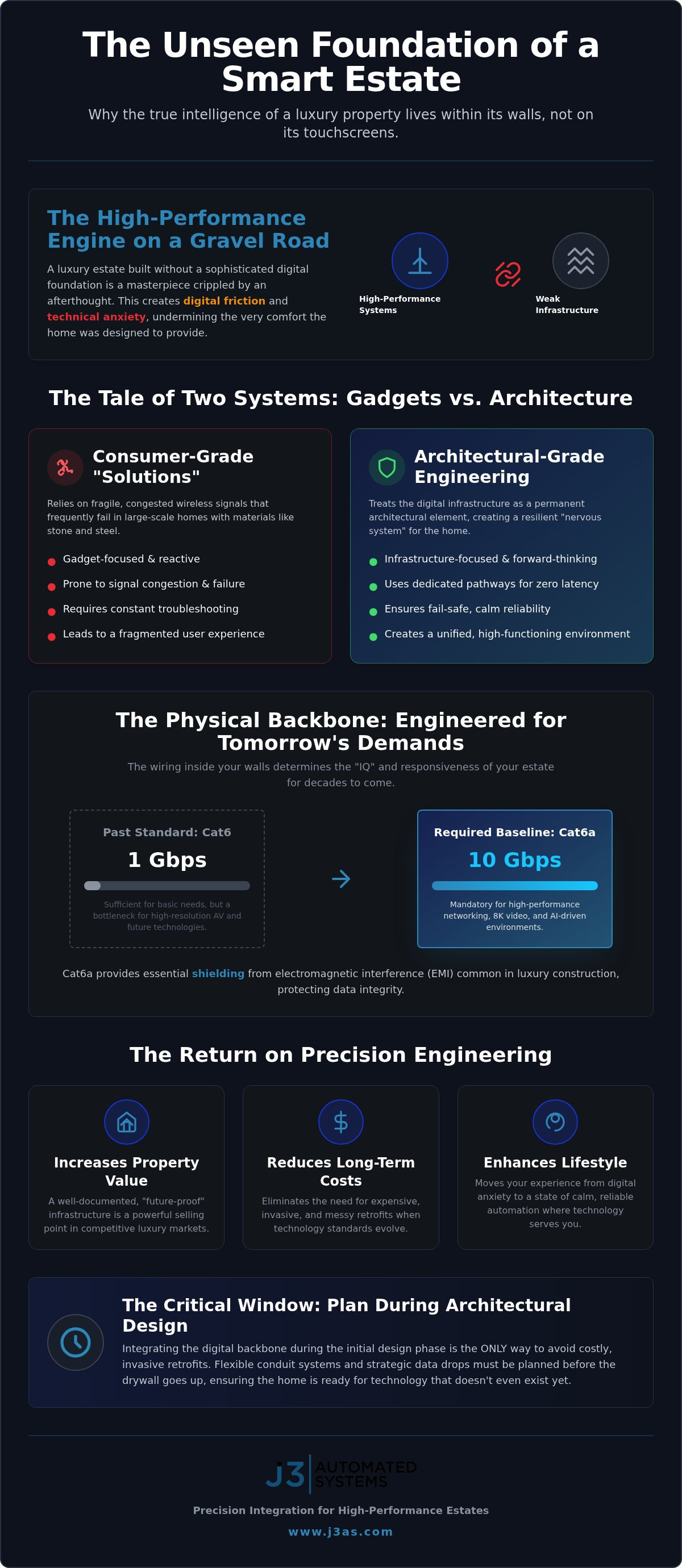
A luxury estate built without a sophisticated digital foundation is essentially a high-performance engine running on a gravel road. While many focus on visible interfaces and sleek touchscreens, the true intelligence of a property lives within its walls. Precision smart home infrastructure design is the silent architecture that ensures your technology enhances your lifestyle rather than complicating it. If you've ever felt the frustration of dropped signals in a stone-clad wing or feared the cost of tearing into finished drywall for a simple upgrade, you know that reliability is never an accident. It's a product of rigorous, forward-thinking engineering.
We believe your home should be a sanctuary of calm, not a source of technical anxiety. This article explains how a masterfully planned infrastructure eliminates digital friction and transforms a luxury residence into a high-performance intelligent estate. We'll explore the integration of the latest Matter 1.6 protocols, the impact of new IEEE standards for AI-driven environments, and the strategic balance between wired stability and wireless flexibility. You'll learn how to create a fail-safe digital environment that protects your architectural vision and remains resilient as technology continues to evolve.
Key Takeaways
- Understand why smart home infrastructure design is the essential architectural layer that prevents digital friction and ensures long-term system reliability.
- Recognize the shift toward Cat6a cabling and 10Gbps baselines as the required standard for maintaining high-performance digital environments in modern estates.
- Address the "Wireless Myth" by learning how a robust hardwired backbone mitigates signal congestion and performance failures in large-scale stone and steel structures.
- Identify the critical window during the architectural design phase to implement future-proof strategies like flexible conduit systems, avoiding invasive retrofits later.
- Discover the value of a single accountable team to manage the complex transition from engineering blueprints to a fully commissioned, frictionless lifestyle.
The Architecture of Intelligence: Defining Smart Home Infrastructure Design
The true measure of a high-performance estate is not found in the sleekness of its touchscreens, but in the resilience of what lies behind the drywall. Smart home infrastructure design is the strategic engineering of a physical network specifically built to support complex automated systems. It serves as the invisible backbone of the property, facilitating instantaneous communication between lighting, cinema-grade AV, security protocols, and climate controls. For a modern estate to function with true intelligence, this infrastructure must be treated as a permanent architectural element, carrying the same weight in the planning phase as structural framing or plumbing. Smart home infrastructure design is the engineered nervous system of the residence, a meticulously planned physical layer that eliminates digital friction and enables effortless interaction.
The Nervous System vs. The Gadgets
Most homeowners focus on the devices, yet the gadgets are merely the appendages of a much larger organism. A robust physical layer is significantly more critical than the specific smart devices you choose today because hardware will eventually be replaced, while the wiring remains. Consumer-grade setups rely on fragile, congested wireless signals that frequently fail in large-scale homes. Architectural-grade engineering, by contrast, utilizes dedicated pathways to ensure every command is executed with zero latency. This foundational layer determines the "IQ" and responsiveness of a luxury estate, transforming a collection of disconnected tools into a unified, high-functioning environment. Understanding the fundamentals of home automation is essential for recognizing why the underlying network must be as permanent as the foundation itself.
The Financial and Operational ROI
Investing in a precision-engineered backbone provides tangible returns that extend far beyond daily convenience. In competitive luxury markets like San Antonio and Austin, a well-documented infrastructure significantly increases property resale value by offering a "future-proof" guarantee to prospective buyers. It reduces long-term maintenance costs by eliminating the need for invasive, messy retrofits when technology standards shift. Beyond the financial metrics, there is a profound psychological benefit. Moving from the digital anxiety of unreliable connections to a state of calm, reliable automation allows you to enjoy your home as it was intended. You gain a fail-safe environment where the technology serves you, rather than requiring your constant attention. This shift from fragmentation to harmony is the ultimate goal of a visionary integrator.
The Physical Layer: Essential Components of a Future-Proof Backbone
Engineering a resilient estate requires a multi-layered approach to signal distribution that transcends basic electrical planning. The physical layer represents the tangible manifestation of your smart home infrastructure design, dictating how effectively data moves between the command center and the edge devices. While standard builds often settle for basic cabling, high-performance properties require a transition from Cat6 to Cat6a to establish 10Gbps as the operational baseline. This robust low voltage wiring serves as the indispensable foundation for automated lighting and shade control. By centralizing equipment within a structured wiring enclosure, we create a manageable, cooled environment that prevents the hardware failures common in decentralized, "tucked away" setups.
Category Cabling: Engineering for Bandwidth
Cat6a is no longer an optional upgrade; it's a mandatory requirement for supporting high-resolution AV and high-performance residential networking. Unlike its predecessors, Cat6a provides the shielding necessary to protect sensitive data signals from the electromagnetic interference generated by high-voltage electrical lines. This shielding is vital in luxury estates where dense clusters of wiring are the norm. We don't just pull wire for today's needs; we strategically place data drops to accommodate 2030 furniture layouts and upcoming technology shifts. This level of meticulous smart home infrastructure design ensures that your home office or media room remains functional as bandwidth demands inevitably climb. Consulting with a visionary integrator early in the process ensures these pathways are preserved before the walls are closed.
Residential Fiber Optics: The Forever Backbone
Fiber optics represent the ultimate "forever" medium for modern estates. We utilize fiber to link remote wings, detached guest houses, and expansive outdoor entertainment zones where copper cabling reaches its physical limits. Fiber's primary advantage lies in its capacity for nearly infinite bandwidth leaps; you simply swap the electronics at either end without ever pulling new glass strands. For properties in the San Antonio and Austin corridors, fiber provides a critical layer of resilience due to its total immunity to lightning strikes and electrical surges. By eliminating the conductive path between buildings, we protect your core systems from the volatile Texas weather. This architectural-grade approach replaces digital anxiety with a sense of calm, knowing your estate's backbone is immune to the environmental and technological pressures of the future.
Wired Reliability vs. Wireless Convenience: The Luxury Estate Paradox
There's a persistent misconception that modern technology should be entirely wireless. While mobile convenience is essential for handheld devices, relying solely on Wi-Fi for a complex estate is a recipe for digital friction. Sophisticated smart home infrastructure design at the highest level acknowledges a simple truth: airwaves are a finite resource. When a property attempts to manage over 100 smart devices, from automated shades to environmental sensors, the resulting congestion causes network collapse. By prioritizing wired connections for stationary systems, we provide dedicated bandwidth and zero latency. This ensures that mission-critical operations remain unaffected by the number of smartphones or tablets currently in use, maintaining a state of calm reliability throughout the property.
Overcoming Architectural Obstacles in Texas
The very materials that make Texas estates beautiful often act as formidable barriers to wireless signals. Thick limestone walls, structural steel beams, and high-efficiency radiant barriers effectively turn a home into a series of Faraday cages. These materials reflect and absorb radio frequencies, creating frustrating dead zones in master suites or detached guest wings. A fail-safe home internet setup bypasses these physical limitations by placing hardwired access points in every strategic zone. This architectural-grade approach ensures consistent, high-speed coverage across sprawling ranch-style properties and multi-story builds. We move the connection through the walls rather than struggling to penetrate them, preserving the architectural integrity of the home while delivering enterprise-grade performance.
Security and Performance Advantages
Performance isn't just about speed; it's about the integrity and security of the signal. Physical connections serve as the first line of defense in commercial security system design Texas, as they are immune to the signal jamming and interference that can plague wireless cameras and sensors. This reliability extends to entertainment as well. Eliminating signal lag is non-negotiable for cinema-grade home theater design, where high-bitrate video streams require massive, uninterrupted data flow that wireless networks simply can't guarantee. Similarly, multi-room audio distribution depends on zero-latency synchronization to prevent the "echo" effect that occurs when wireless packets arrive out of order. By engineering a balanced environment, we free up wireless bandwidth for your mobile lifestyle while keeping the estate's core functions locked behind a stable, wired foundation. This strategic smart home infrastructure design transforms a collection of gadgets into a unified, high-performance ecosystem.
Engineering the Roadmap: A Strategic Framework for Infrastructure Planning
Engineering a high-performance estate requires a fundamental shift in perspective. Successful smart home infrastructure design begins during the architectural design phase, not the trim phase when the walls are already sealed. Waiting until construction is well underway often leads to compromised performance or invasive retrofits that disrupt the architectural vision. By treating technology as a primary system similar to HVAC or plumbing, we create a roadmap that respects both aesthetic intent and operational requirements. This proactive approach utilizes "Smurf Tube" strategies, where flexible conduit runs allow for future cable swaps without ever disturbing a finished surface. Pathway engineering ensures these runs are logically organized, providing a foundation that remains serviceable for decades through professional "as-built" documentation.
The Discovery and Mapping Process
We coordinate directly with architects to identify technology "touchpoints" throughout the floor plan. These are the specific locations where human interaction meets digital response, from hidden keypad locations to automated shade pockets. A critical part of this mapping is the design of the "Head-End," a dedicated, climate-controlled equipment room where the estate's brain resides. This space must be engineered to disappear into the home's footprint while remaining accessible for maintenance. We also map the outdoor infrastructure, ensuring that lighting, audio, and secure perimeter networking extend seamlessly to the edges of the property. For those ready to begin this process, engaging a team that understands integrated automation engineering is the first step toward a frictionless build.
Conduit and Pathway Sizing
The most cost-effective insurance policy for a luxury home is "over-conduiting." We size pathways to accommodate not only current standards but also the emerging fiber optics and high-bandwidth requirements we cannot yet predict. This foresight prevents the obsolescence that plagues many older estates. Professional-grade cable management is equally vital; neatly combed and labeled runs are not just about aesthetics. They ensure long-term reliability by preventing heat buildup and making troubleshooting a simple, non-invasive process. Meticulous smart home infrastructure design transforms the complex web of wiring into an organized, high-performance system that supports the estate's IQ without ever drawing attention to itself.
The J3 Philosophy: Precision Integration for Texas Estates
J3 Automated Systems operates on the conviction that true luxury is the ultimate absence of burden. We view smart home infrastructure design as the essential foundation of a sophisticated, frictionless lifestyle, where technology anticipates your needs without demanding your attention. Our "Single Accountable Team" model eliminates the fragmentation common in high-end construction by managing every phase of the project lifecycle, from the initial engineering blueprints to the final system commissioning. We serve the unique architectural and technological needs of the San Antonio-Austin corridor, positioning ourselves as the visionary integrator who masters technical complexity so the client experiences only harmony. This holistic perspective ensures that every system, whether it's lighting or resilient networking, functions as a unified, high-performance ecosystem.
Our model is designed to remove the friction of dealing with multiple vendors who often fail to understand how their disparate systems interact. When one team handles the engineering, the low voltage wiring, and the final programming, the result is a level of integration that is impossible to achieve through piecemeal contracting. In the high-stakes world of Texas estate building, where heavy stone walls and sprawling floor plans present constant challenges, this accountability is your greatest safeguard against technical failure. We don't just build systems; we engineer the invisible connections that make a house feel like a sentient environment.
Beyond the Wire: Delivering Intelligent Harmony
Our commitment to precision extends into the digital layers that define modern efficiency. The infrastructure designs we implement are specifically engineered to support ai business process automation, allowing your estate to function as an intelligent partner in your personal and professional workflows. We bridge the gap between physical environments and digital tools by integrating services like custom web app development San Antonio into the property's backbone. This white-glove approach ensures that the digital experience is as polished and reliable as the architecture it inhabits. We value craftsmanship and meticulous planning, ensuring that even the most complex custom integrations feel effortless to the end user.
Your Partner in Architectural Technology
Discerning homeowners and luxury builders choose J3 for high-stakes automation projects because they value intellectual rigor and long-term functionality. They understand that superior smart home infrastructure design is the only way to protect their investment and ensure the property's digital longevity. We provide a professionally engineered, documented, and supported system that serves as a permanent asset to the estate, increasing its value and its operational IQ. We don't just install hardware; we steward your experience through every technological evolution, providing the calm reliability you expect from a premium service. Consult with J3 to engineer your estate’s invisible backbone.
Securing the Digital Longevity of Your Estate
A luxury residence is defined by its ability to provide a seamless, intuitive experience for those within its walls. We've explored how a meticulous smart home infrastructure design serves as the indispensable foundation for this harmony, replacing digital anxiety with engineered reliability. By prioritizing a hardwired backbone and planning for future bandwidth leaps during the architectural phase, you protect your estate from the rapid obsolescence of consumer-grade technology. This strategic foresight ensures your home remains as functional in a decade as it is on the day of commissioning.
J3 Automated Systems provides the intellectual rigor and white-glove service required for such high-stakes projects. As a single accountable team for both engineering and installation, we deliver architectural-grade documentation and long-term support that standard contractors often overlook. We master the underlying complexity so you can simply enjoy the result. Engineer your digital future with J3 Automated Systems. Your vision deserves an infrastructure that is as enduring and sophisticated as the architecture itself.
Frequently Asked Questions
Is smart home infrastructure necessary if I have a powerful mesh Wi-Fi system?
Yes, a hardwired backbone is essential because wireless mesh systems rely on shared airwaves that become congested as your device count increases. Professional smart home infrastructure design ensures that mission-critical systems, such as security cameras and high-resolution audio, have dedicated pathways. This prevents the signal drops and latency issues that frequently plague even the most advanced consumer-grade wireless setups.
What is the best type of cable to use for a luxury smart home in 2026?
Cat6a is the current baseline for high-performance copper cabling, supporting 10Gbps speeds with superior shielding against electrical noise. For linking separate wings or guest houses, fiber optics are the definitive choice. Fiber remains the only medium capable of handling upcoming bandwidth leaps while providing total immunity to lightning strikes and electromagnetic interference.
When is the best time to involve an automation engineer in a new build?
The architectural design phase is the ideal window for engagement. Involving an engineer before the blueprints are finalized ensures that technology touchpoints, equipment rooms, and cable pathways are integrated into the home's structural plan. This proactive coordination avoids the need for invasive changes or compromised performance once framing and drywall are in place.
Can I upgrade my smart home infrastructure after the walls are already closed?
Upgrading is possible but significantly more expensive and invasive if the original build didn't include a conduit strategy. If your smart home infrastructure design utilized flexible conduit, often called "Smurf Tube," new cables can be pulled through the walls effortlessly. Without these pre-installed pathways, upgrading often requires cutting into finished surfaces and specialized labor to fish wires through the structure.
What is the difference between Cat6 and Cat6a for residential networking?
Cat6a offers double the bandwidth of standard Cat6 and maintains 10Gbps speeds over much longer distances. The "a" stands for augmented, referring to the enhanced shielding that protects data signals from the interference generated by high-voltage electrical lines. This makes Cat6a the mandatory choice for luxury estates with dense wiring clusters and high-bandwidth demands.
How does low voltage wiring affect the resale value of a Texas property?
Documented low voltage systems significantly increase property value by offering a "future-proof" guarantee to prospective buyers. In the competitive San Antonio and Austin luxury markets, a professionally engineered infrastructure is viewed as a premium asset. It signals to high-net-worth individuals that the estate is ready for immediate, sophisticated operation without the need for technical retrofits.
What is a "Head-End" room and why does my smart home need one?
A Head-End room is a centralized, climate-controlled space where the core networking and automation hardware reside. This dedicated environment prevents equipment from overheating and simplifies long-term maintenance by housing all components in one accessible location. Centralizing these systems keeps unsightly racks and wires out of your living spaces, preserving the home's architectural aesthetics.
Does smart home infrastructure require specialized permits in San Antonio or Austin?
Most municipalities in San Antonio and Austin require specific low voltage permits for new construction and major renovations. These permits ensure that all cabling and equipment installations comply with the National Electrical Code (NEC). Adhering to these standards is vital for property safety, fire prevention, and ensuring the estate meets all local building regulations for high-performance systems.