The Science of Sound: Why Professional Home Cinema Audio Calibration is Essential for Bespoke Installations
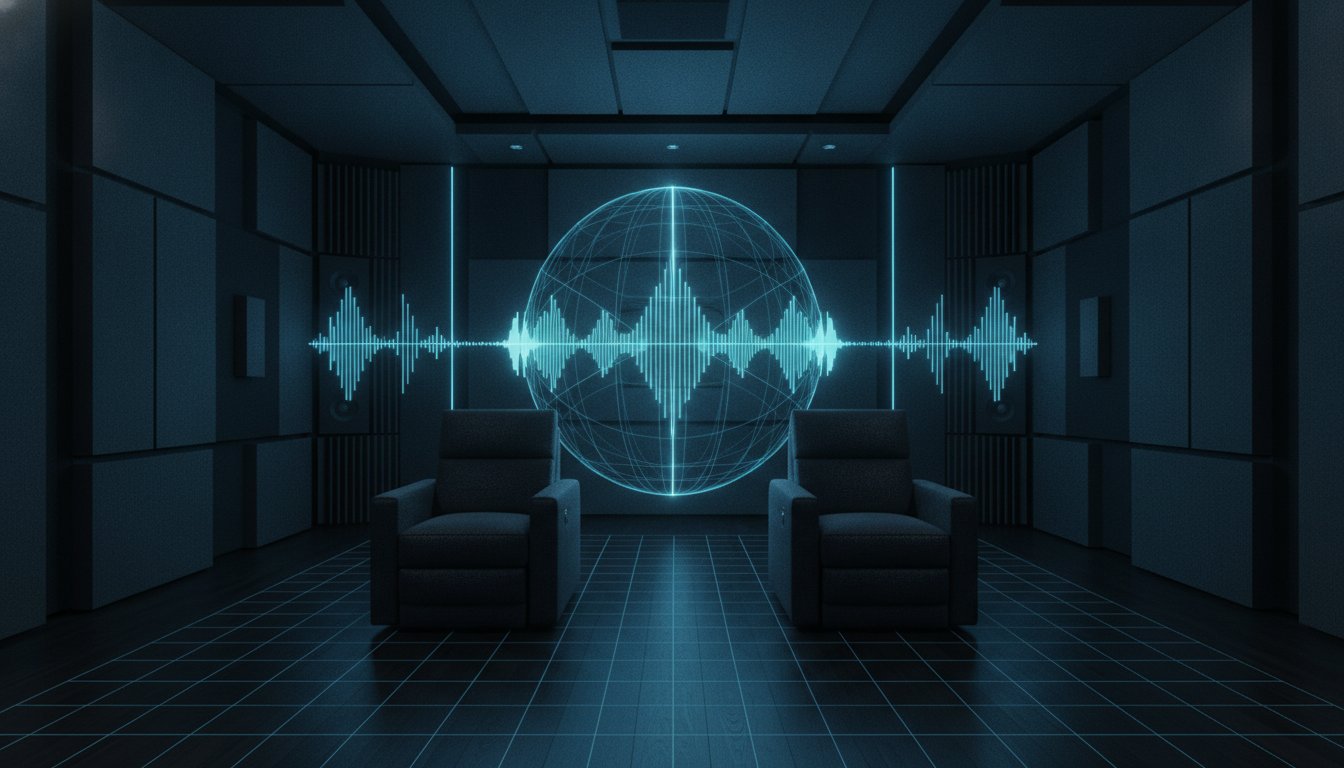
If you have invested significantly in a bespoke private cinema, why does the dialogue often feel buried under a blanket of mud during every complex action sequence? It's a jarring contradiction to own world-class hardware that produces boomy bass or an unbalanced soundstage. Most owners assume that high-end components automatically deliver high-end results, but the reality is that hardware is merely raw potential. To truly bridge the gap between a collection of expensive parts and a cohesive auditory masterpiece, you must look toward the meticulous process of professional home theater installation and calibration.
We understand that you expect nothing less than perfection from your home's technology. You want to feel the subtle textures of a film's score and hear every whispered word with absolute clarity, regardless of the volume level. In this article, you'll discover how professional audio calibration transforms your environment by neutralizing acoustic anomalies and aligning every speaker into a seamless 3D soundstage. We will explore the engineering standards that define an elite cinema experience and show you how to ensure your system finally performs at its absolute engineering limit.
Key Takeaways
- Learn why your room’s unique architecture is the most influential component in your system and how professional engineering can neutralize acoustic interference.
- Discover why professional home theater installation and calibration is required to correct room modes and eliminate the boomy, unbalanced bass that plagues uncommissioned spaces.
- Contrast the limitations of consumer-grade auto-setup software with the precision of professional measurement kits and manual diagnostic phases.
- Understand the physical adjustments, such as speaker positioning and toe-in, that are essential for achieving a crystal-clear, focused 3D soundstage.
- Explore how a holistic integration strategy aligns audio performance with automated lighting and shade control to create a seamless, cinema-grade atmosphere.
Beyond the Hardware: Understanding Home Cinema Audio Calibration
Audio calibration represents the precise alignment of a high-performance sound system to its specific physical environment. While hardware manufacturers provide impressive technical specifications, those metrics are typically recorded in anechoic chambers that bear little resemblance to the architectural realities of a luxury estate. In a bespoke theater, the room itself is the most influential component. Every surface, from floor-to-ceiling glass to custom millwork, dictates how sound waves travel, reflect, and dissipate. Without establishing a cinema-grade baseline through rigorous testing, your system remains a collection of high-end parts rather than a cohesive, immersive experience.
Contrast exists between raw equipment potential and in-room performance. A speaker capable of perfect frequency response in a lab may produce boomy, unpleasant bass when placed near a corner in your home. Professional home theater installation and calibration bridges this gap. It ensures that the sound you hear is exactly what the director intended, free from the acoustic distortions caused by the room's geometry. This process transforms a high-cost equipment list into a unified auditory masterpiece that performs at its absolute engineering limit.
The Myth of Plug-and-Play in Luxury AV
It's a persistent fallacy that expensive speakers can overcome poor room acoustics through sheer engineering power. High-performance hardware is designed for transparency; it will faithfully reproduce the audio signal, including the sonic reflections and cancellations caused by your room. Factory settings are programmed for a generic average that doesn't exist in high-end residential design. When a system lacks professional home theater installation and calibration, the result is often listener fatigue. This happens because the brain must work harder to decipher dialogue or filter out resonance, leading to a muddy soundscape that fails to engage the viewer.
The Role of the Calibration Engineer
A calibration engineer acts as a visionary integrator who sees the hidden connections between disparate components. This professional commissioning phase is the differentiator between a standard retail setup and a J3 system. By utilizing advanced Digital Room Correction techniques, the engineer can neutralize the acoustic friction inherent in complex spaces. This is a methodical process that moves from the why to the how, ensuring every digital process serves the physical environment.
Partnering with a single accountable team for commissioning protects your investment. The engineer simplifies the complexity of modern audio processing, creating a state of intelligent, effortless operation. Through meticulous planning and intellectual rigor, they ensure the final result is a polished, cinema-grade environment where technology disappears and the story takes center stage.
The Engineering of Immersion: Room Acoustics and Signal Processing
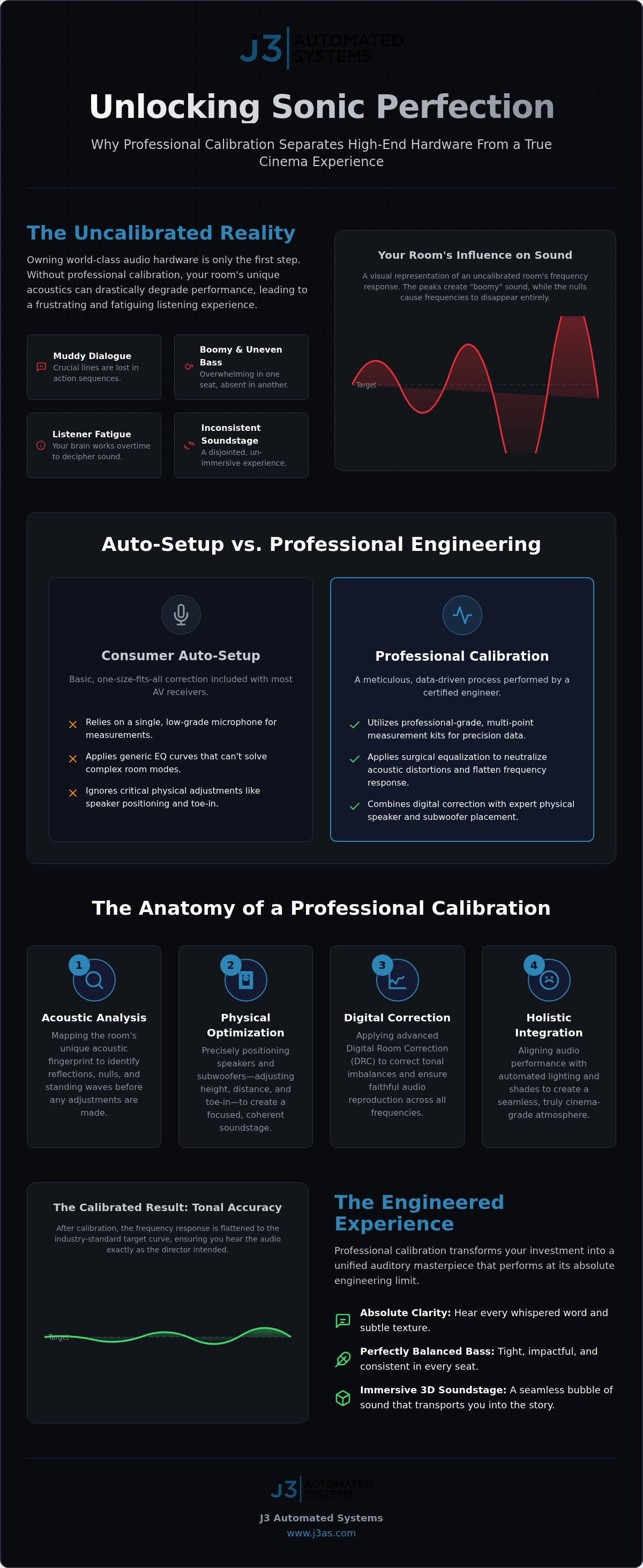
Sound waves in a residential environment behave as fluid energy, interacting with every boundary to create a unique acoustic fingerprint. In the premier estates of Austin and San Antonio, expansive floor plans and high ceilings present significant engineering challenges that typical equipment cannot solve alone. Without the intervention of professional home theater installation and calibration, these rooms often suffer from room modes. These are specific frequencies where sound waves reflect and collide, resulting in a wildly uneven bass response. One seat might experience overwhelming, boomy low-end, while the adjacent seat sits in a null where the bass completely disappears. Achieving a balanced frequency response requires the precise mapping and management of these standing waves to ensure every listener feels the same visceral impact.
Frequency Response and Tonal Accuracy
Calibration flattens the frequency response curve to ensure the audio remains faithful to the director's original vision. Architectural features like recessed ceilings or custom stone walls introduce peaks and nulls that distort tonal balance. Our engineering process identifies these anomalies and applies surgical equalization to restore accuracy. This isn't about making the system louder; it's about making it more accurate. By neutralizing the room's influence, we create a consistent auditory experience across every seat in the theater. This ensures that the money seat isn't the only place where the film sounds correct, providing a uniform experience for all guests.
Time Alignment and Phase Coherence
True immersion depends on the brain's ability to localize sound within a 3D space with absolute certainty. In a modern system featuring Dolby Atmos or DTS:X, you may have eleven or more speakers positioned at varying distances from the listener. If the sound from the rear heights arrives even three milliseconds later than the front channels, the spatial illusion collapses and the soundstage feels fragmented. Professional home theater installation and calibration ensures that every impulse reaches your ears with millisecond-level precision. This phase coherence is what creates a phantom center where dialogue feels like it's coming directly from the screen, even when no speaker is physically placed behind the glass.
If you're ready to move beyond basic setup and into the realm of true acoustic engineering, our team can commission your private cinema to its full potential. This holistic approach ensures that your hardware performs at its engineering limit, delivering the calm reliability of a perfectly integrated system.
Professional Calibration vs. Standard Auto-Setup: Decoding the Difference
The standard consumer receiver often ships with a small, plastic "puck" microphone, promising a one-touch solution for acoustic optimization. While these automated systems provide a baseline for entry-level setups, they lack the resolution and intellectual rigor required for a bespoke private cinema. Professional home theater installation and calibration utilizes laboratory-grade measurement kits and high-performance software capable of capturing data with surgical precision. Where a consumer microphone may have a high tolerance for error, professional sensors provide the granular detail an engineer needs to identify the subtle connections between speaker output and room response.
Automated software operates on rigid algorithms that follow mathematical logic without context. These systems often struggle to distinguish between a genuine acoustic reflection and a physical room defect. An engineer brings a human element to the process, using trained ears to validate what the data suggests. This ensures that the final tuning reflects the nuanced reality of the space, moving beyond the fragmented results of a generic auto-EQ to achieve a state of intelligent, effortless operation.
The Limitations of Built-in Receiver Software
Mass-market Auto-EQ frequently over-corrects the audio signal, attempting to "fix" deep acoustic nulls by pushing the amplifier to its breaking point. This process often kills the system's dynamic range, leaving the audio sounding flat and lifeless. Furthermore, software cannot identify physical environmental friction, such as a rattling HVAC vent or a vibrating light fixture, which can ruin a high-stakes film sequence. Professional tools provide a significantly higher resolution of data, allowing the engineer to apply minimal, purposeful filters that preserve the natural energy and "slam" of your speakers.
Why Bass Management Requires a Human Touch
Managing multiple subwoofers is one of the most complex tasks in modern cinema engineering. Automated software often fails to blend subwoofers with the main speakers seamlessly, leading to a disconnected soundstage where the bass feels like it's trailing behind the action. J3 engineers utilize multi-point measurements to map the entire listening area, systematically eliminating bass dead zones that auto-setup routines frequently ignore.
We also move beyond the "flat" response curve that software strives for. A perfectly flat frequency response often sounds thin and clinical to the human ear. Instead, we implement a custom "house curve" that aligns with human psychoacoustics, delivering a warm, powerful, and cinematic sound. This meticulous approach ensures your professional home theater installation and calibration results in a system that performs at its absolute engineering limit while remaining pleasing to the ear.
The Anatomy of a Professional Calibration Service
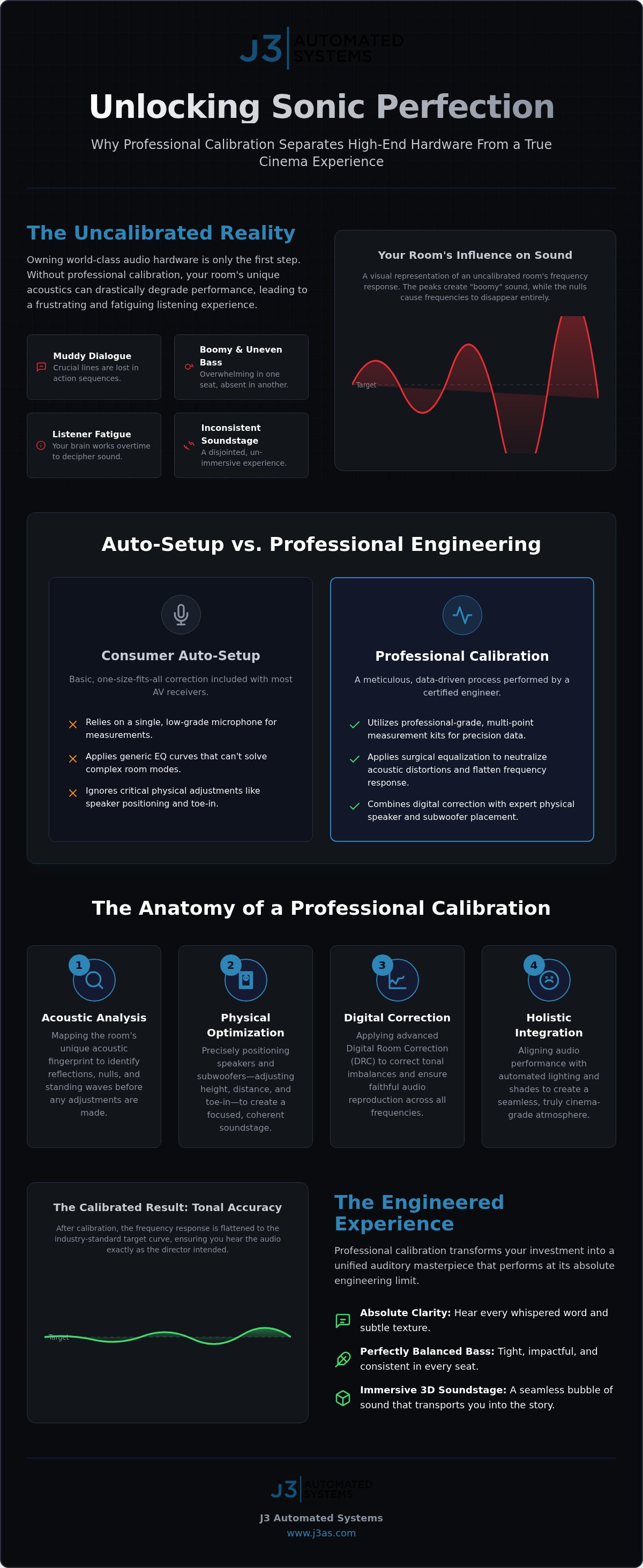
A professional engagement is a methodical journey that moves from raw acoustic data to a polished, cinema-grade reality. Unlike a standard setup that relies on guesswork, professional home theater installation and calibration follows a structured lifecycle designed to eliminate technical friction. This process begins with an analytical baseline measurement to understand how sound behaves within your specific architectural environment. By identifying the unique challenges of the room before making any adjustments, we ensure every subsequent step is rooted in engineering logic rather than trial and error.
Phase 1: Diagnostic and Physical Optimization
Every project starts by measuring the impulse response of the room. This diagnostic phase captures how sound waves travel from each speaker and reflect off surfaces, providing a high-resolution map of the environment's acoustic fingerprint. We verify the physical placement and "toe-in" of every speaker against rigorous Dolby and CEDIA standards to ensure the foundation of the soundstage is architecturally sound. If the data reveals significant reflections or energy loss, we identify the specific need for bespoke home cinema installation acoustic treatments. Solving these problems physically is always preferable to forcing a digital fix, as it preserves the natural clarity and dynamic range of your high-performance hardware.
Phase 2: Digital Commissioning and Verification
Once the physical environment is optimized, we move into the digital commissioning phase. This involves applying high-resolution filters to correct remaining architectural flaws that cannot be solved through placement alone. Precision is the primary objective here; we level match all channels to within 0.5dB. This ensures that a sound moving from the front-left to the rear-right maintains a consistent volume and tonal character, preserving the 3D spatial illusion. The process concludes with final validation measurements. These "after" reports provide empirical proof of the performance gains, giving you the confidence that your system is operating at its engineering limit.
The final stage is the client handover, where we transition the system from a complex engineering project into a state of effortless operation. We walk you through the results, demonstrating the newfound clarity in dialogue and the seamless integration of the bass. If you are ready to experience the full potential of your investment, you can book a professional calibration consultation with our engineering team today. This white-glove service ensures that your private cinema delivers a truly immersive, cinema-grade experience every time you press play.
Engineering Harmony: J3’s Vision for Bespoke Home Cinema Integration
True luxury is found in the absence of friction. In a premier residence, technology should behave with the same composed grace as the architecture it inhabits. Professional home theater installation and calibration serves as the technical heartbeat of this experience, but it doesn't exist in isolation. It's a critical pillar within a broader home automation Austin strategy where every system communicates in a single, fluid language.
When audio is perfectly aligned, it works in tandem with automated lighting and shade control to remove the manual burden from the viewer. Pressing "Play" triggers a silent, coordinated sequence: the lights fade with architectural precision, the shades descend to neutralize environmental light, and the calibrated audio system delivers a 3D soundstage with absolute tonal balance. This is the state of intelligent operation that our clients expect, where the technology disappears and the sensory experience takes precedence.
The J3 Difference: Sophisticated Reliability
For estates in Boerne and Seguin, the value of a single accountable team is vital. We act as a visionary integrator, simplifying the hidden connections between disparate systems so you don't have to. The peace of mind that comes from a master of complexity managing your AV ensures long-term functionality rather than a series of quick fixes. We move your home from a state of fragmented technology to a unified environment characterized by calm reliability. Our white-glove handover process makes these complex systems feel effortless, ensuring you command the full power of your cinema with total confidence.
Next Steps for Your Private Cinema
Determining if your current system is a candidate for a calibration refresh is a simple matter of listening. If you struggle to hear dialogue during complex scenes or if the bass feels boomy and disconnected, your system isn't performing at its engineering limit. High-performance components can drift over time, and room changes often introduce new acoustic anomalies.
For those embarking on a new build, planning for professional home theater installation and calibration during the early engineering phases is the most effective way to ensure perfection. This allows for the seamless marriage of physical acoustics and digital processing from day one. Contact J3 for a bespoke consultation in the San Antonio area and experience sound that is as composed and assured as the home it fills.
Elevating Your Private Cinema to Engineering Perfection
A high-performance private cinema is more than a collection of luxury components; it's a carefully engineered ecosystem where physics and digital processing converge. We've explored how a room's unique architecture dictates sound behavior and why mass-market automated tools often fall short of the precision required for elite systems. By prioritizing a methodical approach to professional home theater installation and calibration, you ensure that every whispered line of dialogue and every orchestral swell reaches your ears with absolute clarity. This meticulous commissioning phase is what transforms raw equipment potential into a cohesive, cinema-grade reality.
J3 Automated Systems acts as your single accountable partner for both engineering and implementation. Our expertise in high-performance residential networking and AV allows us to simplify the most complex acoustic challenges for premier estates across San Antonio, Austin, and Boerne. We invite you to move beyond fragmented technology and embrace a unified, intelligent environment that performs at its absolute engineering limit. Request a Bespoke Cinema Consultation with J3 Automated Systems to begin your journey toward a truly composed and immersive auditory masterpiece. Your vision of a perfect cinematic escape is well within reach.
Frequently Asked Questions
What is the difference between a basic setup and a professional audio calibration?
A basic setup typically relies on automated "auto-EQ" scripts and consumer-grade microphones that provide a generic, often inaccurate baseline. Professional audio calibration involves laboratory-grade measurement kits and an engineer’s trained ear to map the room’s unique acoustic fingerprint. We move beyond simple volume adjustments to correct for phase coherence, time alignment, and standing waves, ensuring the audio system behaves as a single, cohesive instrument.
How long does a professional home cinema audio calibration service typically take?
A comprehensive calibration typically requires four to eight hours of on-site engineering. This duration depends on the complexity of the speaker layout and the number of subwoofers in the system. This methodical pace allows for initial diagnostic measurements, physical speaker adjustments, digital filter optimization, and final validation to prove the performance gains through empirical data.
Do I need to buy new speakers to improve my home theater sound?
Not necessarily. Many owners find that their current hardware is simply underperforming because it hasn't been properly integrated into the room's environment. Professional calibration often yields a more significant improvement in clarity and visceral impact than a hardware upgrade alone. We focus on unlocking the raw potential of your existing investment by neutralizing the acoustic friction caused by the room's geometry.
Can you calibrate a system in a multi-purpose living room or just dedicated theaters?
Calibration is arguably more essential in multi-purpose spaces where architectural features like glass walls and hard floors create significant sonic distortions. We utilize advanced digital signal processing to manage these reflections and ensure a focused soundstage. This engineering approach allows us to deliver a cinema-grade experience in open-concept estates that weren't originally designed for private screenings.
Will professional calibration help with hearing dialogue more clearly?
Dialogue clarity is one of the most immediate benefits of a professionally tuned system. By aligning the center channel’s phase and removing the frequency "mud" caused by room resonance, we ensure voices remain distinct and intelligible even during complex action scenes. This precision allows you to enjoy a consistent auditory experience without the need to constantly adjust the volume.
Is audio calibration necessary if I have a high-end processor like Trinnov?
High-end processors provide the most sophisticated tools in the industry, but they are designed to be commissioned by an expert engineer. These systems require a master of complexity to define the target parameters and validate the software's logic against the room's physical response. Without professional oversight, even the most advanced hardware remains a collection of unoptimized potential.
How often should a bespoke home cinema system be recalibrated?
We recommend a calibration refresh every two to three years or whenever you make significant changes to the room's decor or furnishings. Subtle changes in speaker performance over time or the addition of new furniture can alter the room's acoustic fingerprint. Regular maintenance ensures your professional home theater installation and calibration continues to perform at its absolute engineering limit.