Building Management System San Antonio: Costs and Controls

A building management system is more than a sophisticated thermostat. It monitors, controls, and analyzes building systems, bringing functions such as HVAC, lighting, security, and energy management into a coordinated view. A building management system in San Antonio can range from connected controls for a single system to integrated automation across a commercial property.
If you’re evaluating a system, the project cost depends on more than equipment. Existing infrastructure, the systems to integrate, and the level of monitoring and control all shape the scope. Start by defining what the system needs to coordinate before comparing project proposals.
This article explains how a BMS works, how integrated controls and monitoring support building operations, and which decisions shape a project’s scope. You’ll also learn when a unified system can replace disconnected controls with a more coherent way to manage a property.
Key Takeaways
- Understand how a building management system brings building data, monitoring, and controls into a more coordinated view.
- See how system scope depends on the equipment and functions being integrated, from HVAC to lighting and access control.
- Learn how remote monitoring and alarm routing can support building operations while working within the facility’s IT infrastructure.
- Explore how automation and building data can inform energy management and sustainability decisions.
- Identify the project factors that shape costs, including existing infrastructure, integration needs, and the level of monitoring and control.
What is a Building Management System?
A building management system (BMS) monitors, controls, and analyzes building components through a shared interface. In a San Antonio commercial property, that can bring HVAC, lighting, security, and access control into one coordinated operating view.
Centralized Monitoring and Control
A BMS centralizes system information and control, so operators can review connected equipment through a shared interface. Instead of adjusting HVAC and lighting controls separately, staff can see their status together and respond to operating conditions. This makes it easier to spot when a setting, alarm, or equipment issue may affect another part of the building.
A BMS can organize information and controls around different users’ responsibilities. An operator may need detailed equipment status, while a building manager may want a broader view of system performance. A well-organized interface and appropriate permissions help each person focus on relevant information.
Systems Controlled by a BMS
Depending on the installation, a BMS can integrate HVAC, lighting, security, access control, energy management, and utility management. Integration connects information and controls that might otherwise sit in separate systems. For example, operators can review lighting schedules alongside HVAC operation instead of treating each function as an isolated task.
The scope can cover one building or bring multiple buildings and automation systems into a shared interface. This can help coordinate operations across a property portfolio, but the available controls depend on the connected equipment and system design.
HVAC Automation and Optimization
HVAC automation uses programmed controls to regulate heating, cooling, and related equipment according to operating conditions. A BMS can monitor temperatures, adjust setpoints, and manage equipment such as pumps. Operators can review these actions centrally and refine control sequences when building use or conditions change.
For example, a system can coordinate heating temperatures with pump operation rather than treating them as unrelated controls. Facility teams can then observe how HVAC equipment responds, identify conflicting settings, and manage operation through an organized control strategy.
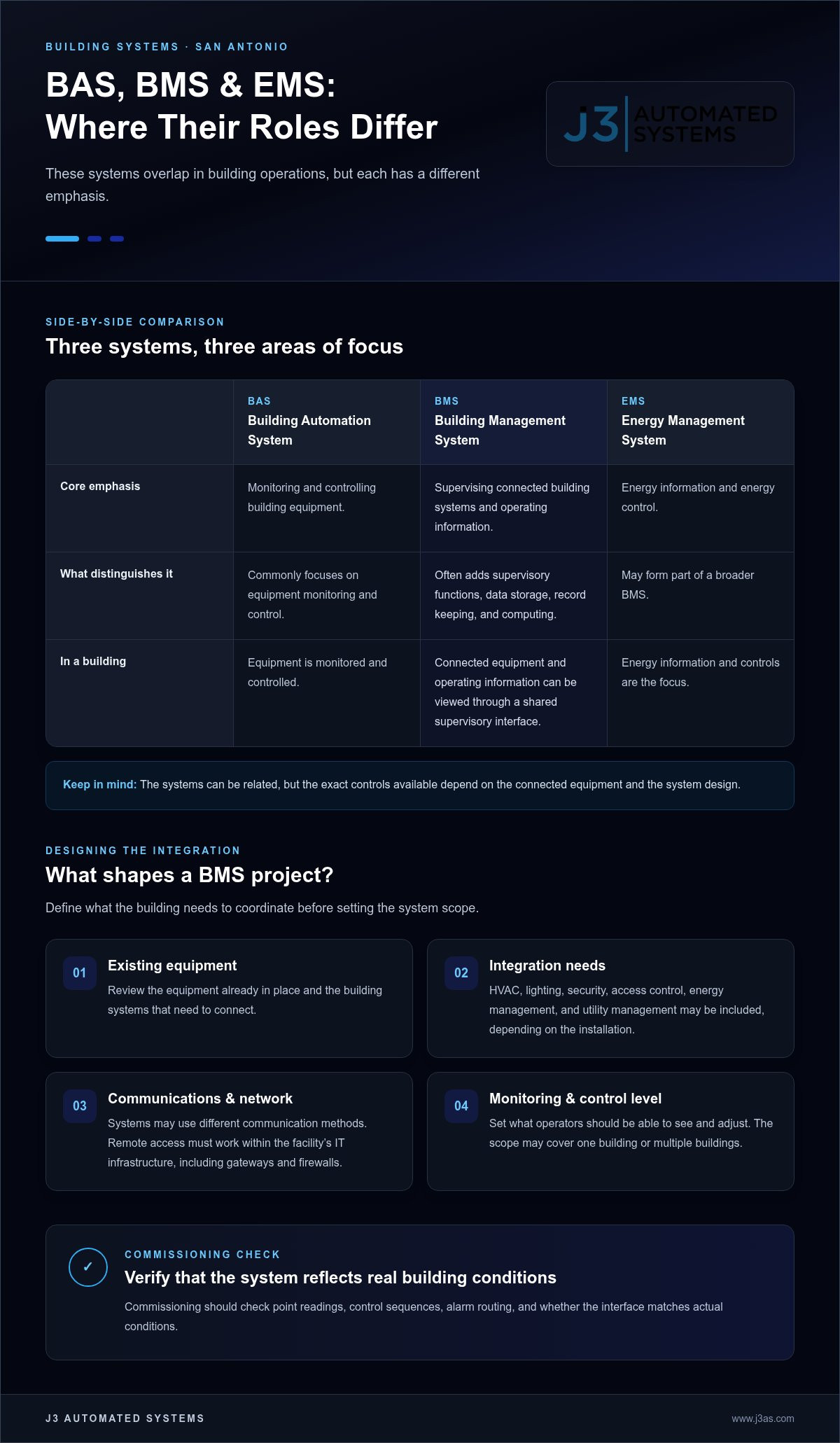
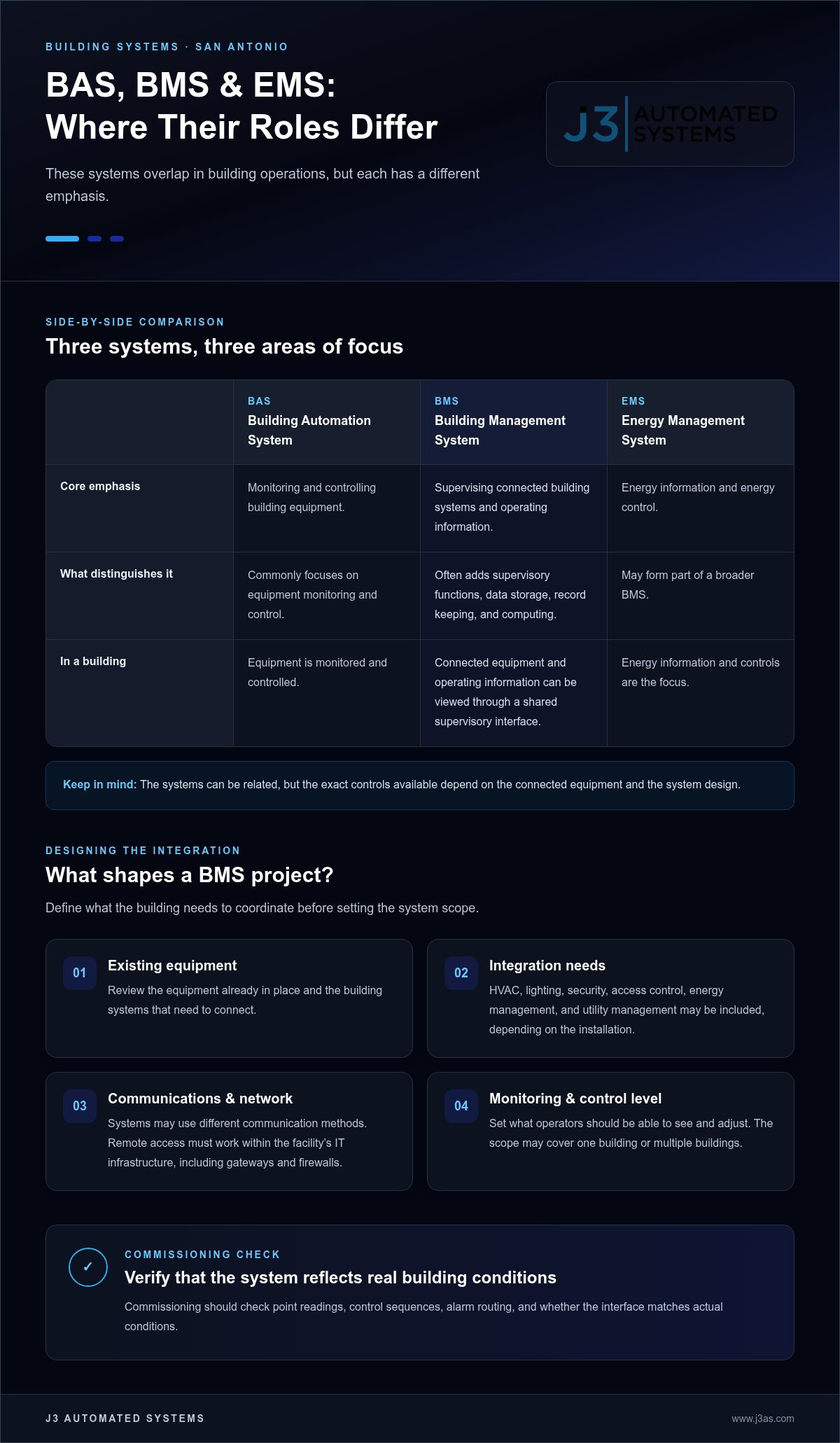
How do BMS, building automation systems, and energy management systems differ? A building automation system (BAS) commonly focuses on monitoring and controlling equipment. A BMS often adds supervisory functions, data storage, record keeping, and computing. An energy management system focuses on energy information and control, and may form part of a broader BMS.
What should businesses consider when choosing a BMS contractor in San Antonio? Consider the equipment, integration needs, network requirements, and commissioning plan. Commissioning should verify point readings, control sequences, alarm routing, and whether the interface reflects actual building conditions.
Are there San Antonio or Texas building codes and incentives relevant to BMS installation? There is no nationwide federal requirement mandating a BMS in commercial buildings. State and local energy requirements commonly use the IECC or ASHRAE 90.1; the City of San Antonio’s BuildSA portal supports building and fire permit requests, plus contractor license applications and renewals.
Which building management system companies serve San Antonio, Texas? Commercial building-automation integrators handle BMS projects, with the relevant scope shaped by the building’s existing equipment and desired controls. The work may involve HVAC integration, lighting, security, access control, or a combination.
Which BMS platforms and vendors are commonly used in San Antonio? Platform selection depends on the equipment and systems that need to communicate. Open-protocol building automation platforms can connect HVAC equipment, lighting controls, access systems, and other building technologies as part of a coordinated design.
What are the steps and typical timeline for installing or upgrading a BMS? Projects generally begin with a review of existing equipment, followed by integration design, control configuration, and commissioning. The schedule depends on equipment condition, integration scope, wiring and network needs, and testing requirements.
What cybersecurity and maintenance risks should BMS owners consider? Remote access needs to work within the facility’s IT infrastructure, including its gateways and firewalls. Maintenance planning should also cover communications and field wiring, and confirm that system readings and alarm routing continue to match actual building conditions.
BMS definition and integrated system design
A building management system is a supervisory layer that connects building equipment, controls, and operating information. Compared with a basic building automation system, a BMS typically adds storage, record keeping, and computing capabilities. This distinction matters when a facility needs more than equipment control, such as a shared interface for reviewing system status and operating history.
Integration starts with the equipment and the information each system can exchange. HVAC controllers, lighting controls, access systems, and other technologies may use different communication methods. A sound design maps those connections before defining what operators can view or adjust. For example, a facility can connect air-handling equipment and lighting controls while making access-system data available through the same supervisory interface.
The interface should reflect how the facility operates, not simply display every available point. An operator may need detailed equipment status, while a manager may need an overview of building conditions. Grouping controls by function, location, or responsibility makes information easier to interpret and clarifies which equipment a command will affect.
- Equipment layer: Sensors, controllers, and devices provide readings or receive commands.
- Communication layer: Connections carry information between equipment and supervisory software.
- Supervisory layer: The BMS presents data, records activity, and coordinates selected controls.
- Operator layer: A role-based interface organizes the views and actions relevant to each user.
These layers clarify where integration begins and ends. A sensor might report temperature, a controller might operate a valve, and the BMS might record the reading and show equipment status. Defining each role helps prevent a system from displaying information without providing the control operators expect.
A BMS can bring multiple buildings and automation systems into one interface. For a property portfolio, this can provide a common view while retaining building-specific controls. Each site’s equipment, data, and operating needs still matter: a shared screen alone does not make separate systems function as one.
For a new installation or modernization, document the equipment to integrate, the information operators need, and the control actions required. That scope gives the integration design a practical foundation. Explore commercial building automation as a way to align building controls with the facility’s operating structure.
Remote monitoring and alarm response
Remote access lets authorized staff view connected building systems away from the facility. Its usefulness depends on clear alarm routing, reliable communications, and controls designed around the building’s operations.
Remote Monitoring and Support
Remote monitoring presents system readings and alarms through an authorized network connection. Staff can review a device’s status without being beside it, helping them determine whether an issue affects one room or broader equipment.
Cloud-based BMS systems can allow security teams to view on-site cameras at any time, providing 24/7 protection. According to Air Performance Service, remote BAS access should work within the facility’s IT infrastructure, coordinating with the ISP, gateways, and firewalls as needed.
Alarm response starts with a useful signal. A temperature outside its intended range, a failed device, or a lost connection can trigger an alert for designated staff. The system should identify the affected equipment and location so the recipient can assess the issue instead of interpreting an unexplained notification.
Alarm routing shapes the operational response. An HVAC fault, for example, may go to facilities staff, while a camera alert may be directed to security personnel. Clear priorities and escalation paths help teams distinguish urgent building conditions from informational notices. Remote visibility supports diagnosis, but it does not repair equipment or guarantee a response.
HVAC and Indoor Air Quality Monitoring
HVAC monitoring tracks equipment status and building conditions, while indoor air quality monitoring adds readings from selected sensors. Together, these inputs help operators assess whether heating, cooling, and ventilation controls are responding as intended.
A temperature reading can show whether a zone is drifting from its control target. An air-quality sensor provides a separate signal that may prompt staff to review ventilation operation. The BMS can display both readings alongside equipment status, giving operators a clearer basis for investigation.
Automation links monitoring to defined control sequences. If a reading changes, programmed controls can adjust related equipment, such as a fan or heating system, within the configured sequence. Operators can review the reading, command, and resulting status to understand the response.
Remote support depends on reliable communication between sensors, controllers, the BMS, and the facility network. If a network connection fails, remote readings may be unavailable even when local equipment continues operating. Distinguishing a device fault from a communications issue helps staff focus their investigation.
For facilities in San Antonio, remote access should be planned alongside the building’s IT environment. Coordinating gateways and firewalls with the network design supports access while accounting for cybersecurity. Clear alarm ownership, useful device labels, and verified readings make remote monitoring more actionable for operations and security teams.
Sustainability and smart building automation
Building automation links operating data with controls, helping facility teams manage energy alongside comfort and equipment needs. Its value depends on how well the system reflects actual building use.
What energy savings can a BMS deliver for San Antonio commercial buildings? Savings depend on existing equipment, schedules, control sequences, and how teams use the system. A SCDOT headquarters project improved comfort and reduced energy use by 41%, showing what one project achieved rather than setting a universal result.
Sustainability Through Smart Automation
Smart automation supports sustainability by coordinating equipment operation with building conditions and occupancy. A control sequence, for example, can align HVAC schedules with operating hours rather than running equipment without regard to use.
Building data also helps managers understand how infrastructure is being used. A BMS can support organizations seeking ISO 55000 certification by providing data-driven insights about infrastructure utilization, connecting operational records with asset-management decisions.
Commercial buildings waste around 30% of the energy they use. That figure points to an opportunity for better management, not a guaranteed saving for every property. A building’s energy profile, operating schedule, equipment condition, and existing controls all shape what automation can address.
Technicians turn building conditions into functioning controls. Their work can include reviewing field devices, interpreting sensor readings, configuring automation sequences, and checking whether commands produce the intended response. For example, a technician can trace a heating issue from a temperature sensor through its controller to the equipment it governs.
That work spans three connected levels:
- Field level: Sensors, actuators, and equipment provide readings or respond to commands.
- Automation level: Controllers apply sequences to coordinate equipment operation.
- Management level: The BMS organizes system data for review, analysis, and operational decisions.
Energy Savings from a BMS
A BMS can help reduce avoidable energy use by aligning equipment schedules and control sequences with operating needs. Monitoring can also help teams spot unusual operation, such as HVAC equipment running beyond its intended schedule.
The SCDOT headquarters project improved comfort and reduced energy use by 41%. For a San Antonio property, the practical lesson is to connect energy goals with measurable system operation, then use building data to guide adjustments.
Energy management also requires follow-through. Facility teams can compare schedules with occupancy patterns, review equipment status, and assess whether control changes improve operation. A BMS can support automated data logging for energy regulations and ASHRAE energy audits, helping teams keep building performance records organized.
Building management system costs
The cost of a building management system depends on integration scope, existing infrastructure, and the controls required. Connecting one HVAC system is different from coordinating HVAC, lighting, access, and multiple buildings. Start by defining what the system must monitor, control, and record.
The price depends on the case and is given after a quote request; the main cost factors are equipment condition, integration scope, wiring and network requirements, software capabilities, and commissioning. These factors shape both the design and the work needed to make a system function reliably within the facility.
Existing equipment can significantly affect a project. Compatible controllers and reliable communications may support incremental integration, while obsolete equipment or disconnected systems may require broader replacement. A building with functioning HVAC controls but limited centralized visibility has different needs from one with repeated control failures and unreliable communication.
Software and integration needs also shape project scope. A proprietary platform that restricts connections to new equipment or third-party systems can limit future options. Air Performance Service notes that proprietary software may become difficult to find qualified technicians for within five years. Platform access, maintainability, and planned integrations are therefore important parts of the cost discussion.
Assess infrastructure as part of the project, not as an afterthought. According to Air Performance Service, field wiring, communication buses, and network infrastructure should be evaluated and upgraded as needed during a BAS replacement. A new supervisory interface, for example, cannot provide dependable readings if aging communication paths interrupt data between controllers and equipment.
Commissioning is another essential part of a project. According to Air Performance Service, commissioning should verify point readings, control sequences, alarm routing, and whether the interface reflects actual building conditions. These checks connect the design to real operation and can reveal a mislabelled sensor, an incorrect sequence, or an alarm routed to the wrong team.
To compare project scopes, outline the outcomes included in each one:
- Integration: Identify the equipment and systems brought into the BMS.
- Infrastructure: Include required wiring, communication, and network work.
- Controls: Define the operating sequences and user access needed.
- Verification: Specify commissioning checks for readings, alarms, and system displays.
Operational value depends on how teams use the system after installation. A well-defined scope connects project work to concrete needs, such as tracking equipment status or coordinating building controls. For a tailored discussion of commercial building automation, share the building’s systems and integration goals.
J3 Automated Systems: Cinema-grade home theater
J3 Automated Systems is a natural next step when a building needs connected controls designed around its operations. Its commercial building automation service addresses HVAC and BMS integration, helping bring building systems into a coordinated design. Turn to this service when planning a new system, integrating existing equipment, or modernizing controls and monitoring. For properties where lighting and shades are part of the broader automation plan, those systems can also be considered alongside building controls. The right scope begins with the facility’s equipment, operating requirements, and desired level of system visibility. Contact J3 Automated Systems to discuss your building automation goals, or visit www.j3as.com.
Shape the Next Stage of Building Performance
A building’s needs change as its spaces, schedules, and technology evolve. Treat a building management system in San Antonio as part of the property’s long-term operating framework, not just a one-time equipment decision. Start with the outcomes that matter most: better visibility, more coordinated control, or a platform that can adapt as operations develop.
That same integrated perspective can extend beyond commercial controls. J3 Automated Systems also offers cinema-grade home theater, whole-property audio, and automated lighting and shades, bringing thoughtful technology into residential spaces. The common thread is intentional design: each system should suit the way people use and experience the property.
If you’re ready to consider the next step for your building or property, contact J3 Automated Systems to start a conversation. A well-defined vision can turn complex systems into a more coherent part of everyday operations.
Frequently Asked Questions
When is BMS a requirement?
No nationwide federal rule mandates a BMS in U.S. commercial buildings. State and local energy requirements commonly use the IECC or ASHRAE 90.1, but that does not mean every building must install a BMS. The distinction is whether applicable requirements call for specific energy controls or documentation, versus requiring a particular system. For a San Antonio project, assess the building’s applicable code obligations separately from the decision to use centralized automation.
What is a building management system (BMS), and what does it control?
A BMS is a supervisory platform that can monitor and coordinate connected building equipment. Depending on its design, it may include HVAC, lighting, security, access control, and energy-related systems. A property manager could use its records to review operating patterns across several areas, while facilities staff focus on equipment-level information. The available controls depend on which systems are integrated and what actions their equipment supports.
How much does a BMS cost to install in San Antonio?
No single installation amount applies to every San Antonio building. The cost of a building management system in San Antonio depends on the project’s scope, existing equipment, integration requirements, infrastructure work, programming, and commissioning. Defining the buildings, systems, and required functions helps establish what the project needs to cover.
What factors affect BMS installation costs for commercial buildings?
Cost depends on the project boundary as well as the technology. A retrofit in an occupied facility may need phased work to maintain operations, while a new project can plan controls alongside construction. Existing documentation, the number of locations and zones, access constraints, and handover materials also shape the work. These considerations apply to commercial projects in San Antonio, New Braunfels, Seguin, Bandera, Boerne, Austin, and San Marcos.